
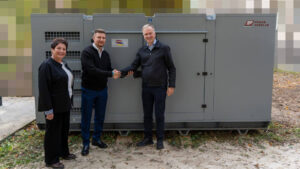
The Latvian government has donated 30 generators with capacities ranging from 80 to 650 kW to Chernihiv Oblast this year, and another 30 generators are expected to arrive, according to Vyacheslav Chaus, head of the regional military administration
“Chernihiv Oblast has received 30 generators from Latvia—this is the first batch of equipment under the agreements between the Latvian Ministry of Economy and our relevant department. In total, our Latvian partners will provide the region with 60 generators,” he wrote on Telegram on Sunday.
According to him, the first 30 generators have varying capacities, ranging from 80 to 650 kW.
The equipment was handed over by Andreis Pildegovics, Ambassador Extraordinary and Plenipotentiary of the Republic of Latvia to Ukraine.
As First Deputy Prime Minister and Minister of Energy Denys Shmyhal noted on Telegram on Sunday, since the start of Russia’s full-scale invasion, Ukraine has received over 900 metric tons of power equipment from Latvian donors. “Power transformers and current transformers, surge arresters and insulators, tractors with drilling rigs, and wireless routers—all of this helps Ukrainian energy workers restore power facilities more quickly after Russian attacks,” he explained. \
According to Shmyhal, Latvia has also allocated 600,000 euros to the Ukrainian Energy Support Fund. One of the priority areas of cooperation is the supply of equipment from decommissioned power plants in Latvia. This equipment is crucial for carrying out repair and restoration work at Ukrainian energy facilities.
“We greatly appreciate the support of our Latvian friends,” Shmyhal emphasized.

According to Experts Club, Ukrainians’ attitudes toward the United Kingdom, the Scandinavian countries, and the Baltic states remain predominantly positive: in August 2026, the share of positive assessments for the countries included in the study ranged from 66.9% to 72.6%. At the same time, the balance between positive and negative attitudes toward all countries in this group has declined slightly compared to the previous survey wave in March 2026. This is evidenced by the results of a study conducted by Active Group and the Experts Club Information and Analytical Center, reports the Experts Club Information and Analytical Center.
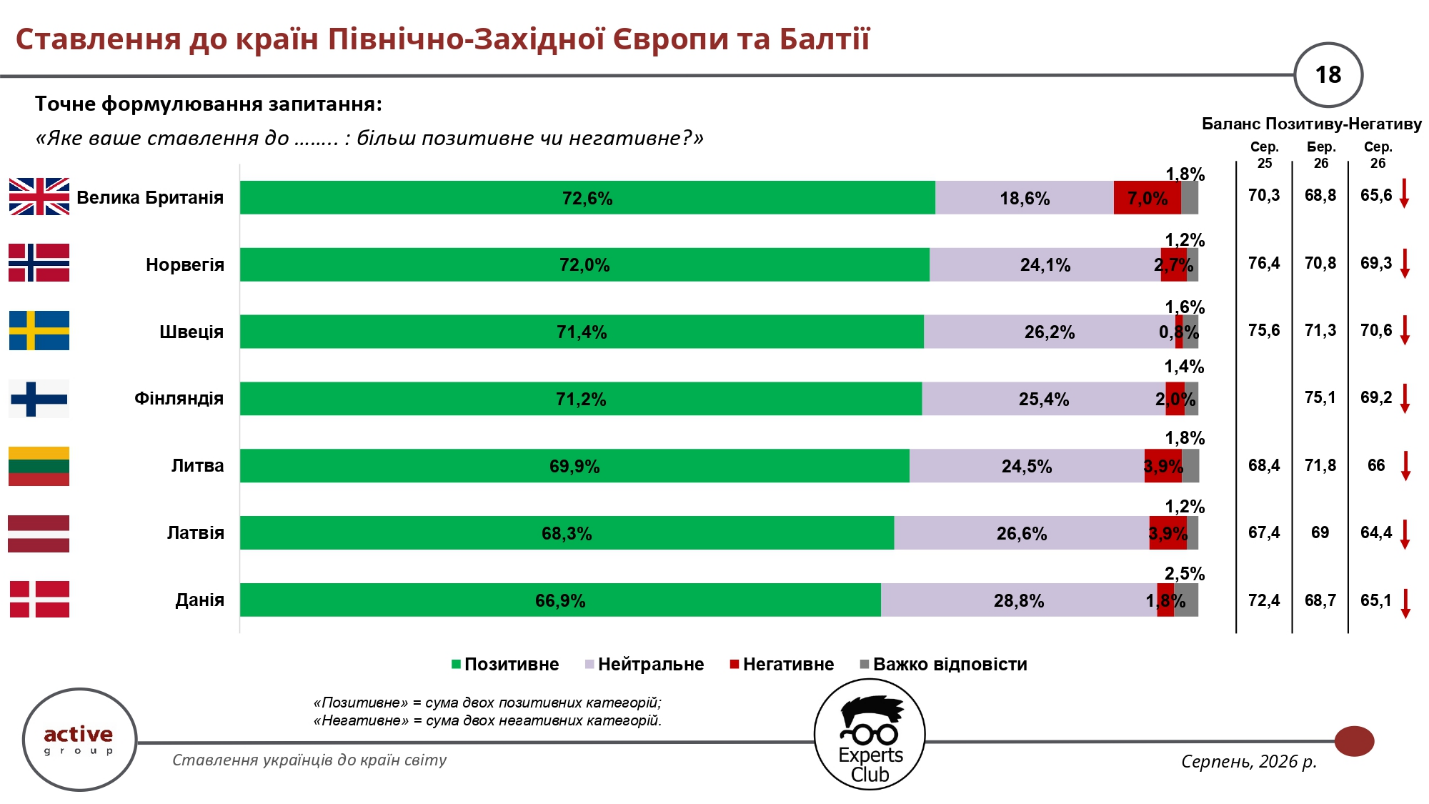
The United Kingdom received the highest share of positive assessments in the group—72.6%. 18.6% of respondents had a neutral attitude toward it, 7% had a negative attitude, and another 1.8% were undecided. The balance of positive and negative assessments stands at 65.6 percentage points, compared to 68.8 percentage points in March 2026 and 70.3 percentage points in August 2025.
Seventy-two percent of Ukrainians view Norway positively, while only 2.7% view it negatively, resulting in a balance of 69.3 percentage points. In March, this balance stood at 70.8 percentage points, and in August of last year, at 76.4 percentage points. Sweden has 71.4% positive and only 0.8% negative assessments—its balance stands at 70.6 percentage points and is the highest among the countries presented on the slide. Overall, the study records approximately 67–73% positive ratings for the countries of Northwestern Europe and the Baltic states.
71.2% of respondents view Finland positively, 25.4% neutrally, and 2% negatively. The balance stands at 69.2 percentage points, down from 75.1 percentage points in March. Lithuania is viewed positively by 69.9% of respondents and negatively by 3.9%; the balance fell from 71.8 percentage points in March to 66 percentage points in August.
A positive attitude toward Latvia was expressed by 68.3% of respondents, a neutral one by 26.6%, and a negative one by 3.9%. Its balance stands at 64.4 percentage points, compared to 69 percentage points in March. For Denmark, the corresponding figures are 66.9% positive, 28.8% neutral, and 1.8% negative assessments, with a balance of 65.1 percentage points, compared to 68.7 percentage points in the previous survey wave.
Maksym Urakin, founder of the Experts Club Information and Analytical Center, deputy director of the Interfax-Ukraine news agency, and candidate of economic sciences, emphasized the importance of constant communication between foreign partners and Ukrainian society.
“The first recommendation is to regularly showcase concrete achievements and concrete actions. Second, be open to questions and inquiries from the media and the public,” Urakin noted. According to him, the results of sociological surveys can be used to strengthen bilateral relations, particularly trade relations.
Alexander Pozniy, director of the research company Active Group, also drew attention to the need to combine public perceptions of countries with the development of practical economic cooperation.
“We should do more than just raise general awareness. We need to expand cooperation with countries where we can maintain a positive balance,” Pozniy noted. He also emphasized the role of business associations and government agencies in developing bilateral economic ties.
Overall, the results show that Northern and Northwestern Europe, along with the Baltic states, continue to enjoy a high level of positive perception among Ukrainians. At the same time, the decline in the balance compared to March 2026 indicates that even regarding countries with traditionally high ratings, public opinion is not static. In the overall ranking, Sweden, Finland, Norway, Lithuania, and the United Kingdom were among the top ten countries with the highest net sentiment.
The survey was conducted in August 2026 using self-administered online questionnaires via the SunFlowerSociology panel. It included 800 Ukrainian citizens aged 18 and older. The sample is representative by age, gender, and region; the stated maximum theoretical margin of error is ±3.5 percentage points. This is the third wave of the study, following surveys conducted in August 2025 and March 2026.
ACTIVE GROUP, DENMARK, EXPERTS CLUB, FINLAND, LATVIA, LITHUANIA, NORWAY, SOCIOLOGY, SWEDEN, UKRAINE, UNITED KINGDOM

According to the Relocation project, members of the Latvian “Progressive” Party have submitted a bill to the Saeima to abolish the option of obtaining a temporary residence permit through investments of at least 150,000 euros in a state-run alternative investment fund.
Bill No. 1521/Lp14 was introduced on September 3, and on September 10, the Saeima voted 65 to 17 to refer it to parliamentary committees for review.
The new Immigration Act, which takes effect on September 15, 2026, allows a foreign national to obtain a temporary residence permit for up to five years, provided they invest at least 150,000 euros for a period of at least five years through a state-established alternative investment fund manager. Additionally, the investor must transfer 10,000 euros to the state budget.
The “Progressives”’ proposal calls for removing this provision from the law. The authors of the initiative explain their position by citing risks related to national security, anti-money laundering, compliance with sanctions regimes, and the country’s international reputation. This is the position of the bill’s sponsors, not a decision already adopted by the Saeima.
At the same time, the bill does not abolish another investment mechanism for obtaining a residence permit—through an investment in the capital of a Latvian company. Under current law, a foreign investor may apply for a temporary residence permit, specifically, by making an investment of 50,000 euros in a company with up to 50 employees and an annual turnover or balance sheet total of up to 10 million euros, or an investment of 100,000 euros in a larger company. An initial fee of 10,000 euros payable to the state budget is also required upon initial application.
The new Immigration Law was adopted by the Saeima on August 20 and entered into force on September 15, 2026. It replaced the previous regulations governing investment-based residence permits and, in particular, eliminated the previously used grounds related to real estate purchases and subordinated bank deposits.
The fund mechanism was included in the new law following lengthy discussions in the Saeima. In June, Latvian President Edgars Rinkēvičs returned the law to parliament for reconsideration and specifically drew attention to the provision allowing the issuance of a residence permit in exchange for an investment of 150,000 euros in an alternative investment fund and a contribution of 10,000 euros to the budget.
For now, this is only a legislative proposal. To eliminate the investment-based residence permit, the amendments must undergo further review and be adopted by the Saeima.
INVESTMENTS, LATVIA, MIGRATION, REAL ESTATE, RESIDENCE PERMIT
Starting September 15, 2026, Latvia will cease issuing new temporary residence permits based on real estate purchases. These changes are provided for in the new Immigration Law, which the Saeima re-adopted on August 20 and which takes effect on September 15.
Until now, a foreign investor could apply for a temporary residence permit valid for up to five years upon purchasing real estate worth at least EUR 250,000.
The new law no longer provides for this basis for initially obtaining a residence permit. At the same time, the option to obtain a residence permit by depositing funds in a Latvian bank—which previously required an investment of at least EUR280,000—is being discontinued, according to the Prian.ru portal.
That said, investors effectively have a short transition period. Applications for temporary residence permits submitted before the new law takes effect will be processed under the old legislation.
These changes do not mean that residence permits already issued will be automatically revoked. Permits issued before September 15 remain valid until the end of their specified term. Furthermore, a special transitional mechanism is in place for holders of residence permits previously obtained through real estate purchases or bank investments: provided they maintain their investments and meet the established requirements, they will be able to apply for a renewed temporary residence permit valid for up to five years.
After the real estate option is phased out in Latvia, other investment grounds will remain available. A foreign national may obtain a temporary residence permit valid for up to two years by investing at least EUR50,000 in the capital of a small Latvian enterprise or EUR100,000 in a larger company. Additionally, a payment of EUR10,000 must be made to the state budget, and the company must meet the established requirements regarding employment, turnover, and tax payments.
Furthermore, the new law provides for an investment mechanism through a state-established alternative investment fund manager. To obtain a residence permit, applicants must invest a minimum of EUR 150,000 for a period of at least five years and additionally pay EUR 10,000 to the state budget. Such a residence permit may be granted for a term of up to five years.
Citizens of Russia and Belarus will not be able to use these investment-based options. The relevant restrictions are explicitly stipulated in the new legislation.
Latvia’s investment-based residence permit program has been in place since 2010 and, for many years, was one of the best-known European options for obtaining a residence permit through real estate.
IMMIGRATION, INVESTMENT, LATVIA, REAL ESTATE, RESIDENCE PERMIT
Latvia announced a contribution of 50,000 EUR to the Ukrainian Cultural Heritage Fund (UCHF), according to Ukraine’s Deputy Prime Minister for Humanitarian Policy and Minister of Culture Tetiana Berezhna.
“This is the eleventh country to support the Fund,” she wrote on Facebook on Tuesday.
The Ukrainian Cultural Heritage Fund was established as an international mechanism to mobilize resources for the protection and restoration of Ukrainian cultural heritage. To date, the Fund has already raised over EUR4.3 million, Berezhna noted.
“Funds from the Ukrainian Cultural Heritage Fund are directed toward specific projects—the protection, restoration, and preservation of Ukrainian cultural heritage. The first project to receive support is ‘Mystetskyi Arsenal,’” the post states.
Berezhna thanked Latvia for its support of Ukraine, its solidarity with Ukrainian culture, and its willingness to invest resources in its preservation.
As previously reported, in July 2025, the Ministry of Culture, together with its partners, presented new international instruments to support Ukrainian culture at the Recovery Conference in Rome (Italy): the Alliance for Cultural Resilience, the Ukrainian Cultural Heritage Fund, and Team Europe Ukraine.
In early November 2025, the second international conference, “Cooperation for Resilience,” took place in Copenhagen, Denmark, where the operational framework of the Ukrainian Cultural Heritage Fund was presented. Following the conference, Denmark, the Netherlands, Poland, and the United Kingdom announced that they would invest EUR 3 million in the newly established Ukrainian Cultural Heritage Fund.
In late January 2026, Berezhna stated that launching the UCHF’s operations would require an initial budget of EUR10–15 million. In June, she confirmed that EUR15 million would need to be raised by the end of 2026 for the UCHF to fully launch.
The following countries have announced their contributions: the Kingdom of Denmark—10 million Danish kroner; the Kingdom of the Netherlands—1 million euros; the United Kingdom—200,000 pounds sterling; the Republic of Poland and the Kingdom of Spain—0.5 million euros each; the Republic of Estonia—20,000 euros; the Republic of Latvia – 50,000 euros
It has been reported that the first site to be restored under the auspices of the Ukrainian Cultural Heritage Fund will be the History and Local Lore Museum in Ivankiv (Kyiv Oblast), which was destroyed by the occupiers and once housed paintings by Ukrainian artist Maria Pryimachenko.

In Latvia, the so-called “golden visa” program has once again found itself at the center of a scandal after the country’s Financial Intelligence Unit identified more than 20 companies that, according to its assessment, were used for fictitious investments with the aim of obtaining residence permits. This was reported by the Latvian public media outlet LSM, citing the investigative program De Facto.
According to the investigation, approximately 200 foreigners invested more than 10 million euros in the authorized capital of such companies. At the same time, it is noted that the funds were often not used for actual economic activity but were redirected to the scheme’s organizers or circulated among related parties, providing no tangible benefit to Latvia’s economy but formally justifying applications for residence permits.
The program provides for the possibility of obtaining a temporary residence permit in Latvia upon investing 50,000 or 100,000 euros in a company’s capital. In 2025, this procedure brought the country nearly 6 million euros, and a total of 341 people received residence permits through it, including investors and their family members. At the same time, as LSM emphasizes, the state does not systematically assess how significant the actual contribution of these companies is—in terms of turnover, number of employees, or actual activities.
Interest in the program has grown in recent years. According to the Latvian Office of Citizenship and Migration Affairs, 109 applications were submitted last year—more than five times as many as in 2021, when there were 20. However, only about one-third of the applications received a positive decision, as applicants undergo security and reliability checks.
The investigation also cites the example of L Hotels, a company established about a year and a half ago. Nine of its investors applied for residence permits last year, and the company’s list of shareholders includes 30 people from India, Afghanistan, Pakistan, Turkey, Chile, Malawi, Syria, Vanuatu, and other countries. Most of them invested 100,000 euros each but received Class B shares, which, according to the articles of association, do not carry voting rights.
Toms Platacis, head of the Financial Intelligence Unit, stated that in some cases, the 50,000 euros required by law were in fact the same funds, recycled multiple times in a loop. LSM emphasizes that the story has once again intensified criticism of the program, which was originally intended to stimulate investment and attract wealthy foreigners but has been plagued by allegations of abuse from the very beginning.



