
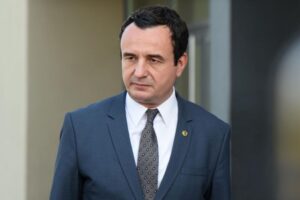
According to “Serbian Economist”, the Vetëvendosje movement led by incumbent Prime Minister Albin Kurti came in first in Kosovo’s early parliamentary elections, but failed to secure an outright majority in the 120-seat parliament.
According to Kosovo’s Central Election Commission, Vetëvendosje received 47.13% of the vote and won 53 seats. At least 61 seats are needed to form a government.
The Democratic Party of Kosovo (PDK) came in second with 19.44% and 22 seats. The Democratic League of Kosovo (LDK) received 16.69% and 18 seats, while the Alliance for the Future of Kosovo (AAK) received 6.74% and 7 seats.
Of the 20 seats reserved for national minorities, the Serbian List won 9 seats. The Democratic Turkish Party of Kosovo won 2 seats, with the remaining minority seats distributed among other political forces.
For Kurti, the result looks like a victory, but not a way out of the political impasse. His party remains the largest political force, but to form a stable government, it will need the support of minority parties or broader agreements. The issue of electing a president remains particularly complex, as the first rounds require the presence of at least 80 deputies.
It was precisely the presidential issue that triggered the current crisis. After the previous elections, the parties were unable to agree on a presidential candidate, parliament was dissolved, and Kosovo held yet another early election. This is already the third parliamentary election in less than a year and a half.
This sends an important signal to the region’s economy. Prolonged political instability in Pristina hinders the work of institutions, complicates access to international funds, and impedes progress toward EU and NATO membership. For Serbia, the key issue remains not only the composition of the new government but also whether Pristina will be ready for substantive dialogue on northern Kosovo, Serbian municipalities, trade, and security.
For Belgrade, Kurti’s victory means the continuation of a hardline political stance in Pristina. It was under his government that relations with Serbia remained tense, and the Kosovar authorities’ actions in the north provoked a sharp reaction from the Serbian side and criticism from some Western partners.
From an economic standpoint, the continuation of the crisis in Kosovo is detrimental to the entire region. Instability reduces predictability for investors, complicates transport and trade links, hinders infrastructure projects, and creates political risk for companies operating between Serbia, North Macedonia, Albania, Montenegro, and the EU.
Kosovo declared independence from Serbia in 2008, but Belgrade does not recognize this status and considers Kosovo and Metohija to be part of its territory. Kosovo has been recognized by the United States and most EU countries, but it is not a member of the UN due to the position of Serbia and its allies, notably Russia and China.
Kosovo’s independence is also not recognized by a number of major countries and EU member states, including Russia, China, India, Brazil, Indonesia, Ukraine, Spain, Greece, Romania, Slovakia, Cyprus, Bosnia and Herzegovina, and South Africa. Of the 27 EU countries, five do not recognize Kosovo: Spain, Greece, Romania, Slovakia, and Cyprus.



