
“Creating an exhibition like this will help us showcase the greatness of Ukraine… Reinterpreting our history, opening up the world of this history, and presenting it through the lens of experts strengthens our international standing. I strongly agree with the lectures by Timothy Snyder (an American historian—IF-U) when he says that the
Trypillian civilization—it is very important to use this term—is part of the European space,” said Foreign Minister Andriy Sibiga at the exhibition’s presentation on the eve of its opening on Thursday.
Sybiga emphasized that the Ministry of Foreign Affairs will make every effort to expand knowledge about the unique Trypillian civilization through UNESCO’s framework.
“In May 2026, we included the ‘Prekukuten-Ariushd-Kukuten-Trypillia’ archaeological and cultural complex on UNESCO’s Tentative List, and we are doing everything possible to have it inscribed on the UNESCO World Heritage List,” said Deputy Prime Minister for Humanitarian Policy and Minister of Culture Tetiana Berezhna.
According to her, it is very important for this exhibition to gain popularity in educational institutions and be promoted in schools.
“Trypillia is one of the components of our identity, just like language. A state and a nation begin with identity,” said Viktor Yushchenko, President of Ukraine (2005–2010).
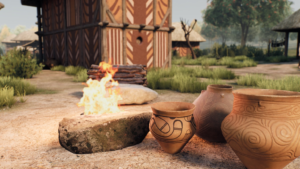
As reported by a correspondent for the Interfax-Ukraine news agency, virtual reality technology allows visitors to “step into” a world from 7,000 years ago and find themselves inside a reconstructed Trypillian settlement, visit the dwellings of the Trypillians, see the domestic areas, the potter’s workshop, and the sacred zone, and examine everyday household items. Here, visitors can observe how the Trypillians cultivated the land and grew grain, how they prepared and baked bread from it, worked with metal, and created items necessary for daily life. Agriculture, crafts, daily life, and beliefs come together in the VR space to form a comprehensive picture of life in the Trypillian community.
The virtual exhibition features digitized artifacts from the collections of the National Museum of the History of Ukraine, the Kyiv Regional Archaeological Museum, and the Museum of the History of Kyiv: ceramics, anthropomorphic and zoomorphic sculptures, tools, and household items.
The project combines archaeological and historical data, 3D modeling, VR technology, and interactive elements. The exhibition is part of the cultural and educational platform “Ukraine. The World of Trypillia,” which uses popular formats—art books, theater, and VR—to tell the story of Trypillian culture in a new way.
The exhibition was organized with the support of the Ukrainian Cultural Foundation as part of the “Cultural Heritage” grant program and in collaboration with the platform’s general partner—the “MHP-Hromadi” Charitable Foundation.
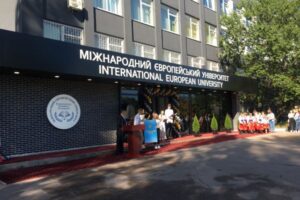
International European University presented a VR room
Virtual reality starts evolving in education while an increasing number of universities is adopting this technology.
The analysis of global experience indicates the efficiency and potential of sensor nets and advanced technologies. International European University is always in tune with the times and improves its educational programs, helping students learn chosen disciplines using cutting-edge technological solutions.
Therefore, the university has introduced the VR room allowing students to explore places of destination worldwide without leaving a classroom. The multi-award-winning program platform encourages faster learning and teaching of medical sciences and anatomy on desktop, mobile and virtual devices.
Virtual reality technologies enhance the efficiency of study, making classes more exciting, which results in better educational motivation and students’ activity.
According to Nataliia Litvinova, Director of European Medical School, the implementation of different VR-based educational programs sparks greater interest of students in this form of classes and increases their enthusiasm while preparing for each class, learning theoretical materials that will be elaborated in the virtual environment.
“It is the best model among the existing ones. This VR headset is equipped with a manipulator that enables working without a computer, as it has its own device inside. Actually, this headset is used for games, fitness and other activities, but we apply it in education. Each license allows holding classes in a group consisting of 10 and more people, as well as conducting questioning, excluding a possibility to peep a correct answer and manipulate. Due to another license, we will be able to train 200 students at the same time and learn anatomy using any device. I’m so glad that in autumn, during license update, we could see the process on computer tomography, X-ray, ultrasound investigation. We can use it in clinical subjects and show students certain organs in virtual reality,” Nataliia Litvinova says.
Besides, educational programs based on virtual reality technologies are multi-purpose (similar programs for different subject areas require almost the same firmware kit) and easily integrated into the conventional teaching process. They allow replacing real objects with their simulating models and interactive simulators so that students can model different situations and find the best possible solutions.
To sum up, we can state that virtual reality is a perfect learning environment. Perception of a virtual model with high authenticity allows training future professionals in different specialties in a high-quality and quick manner. VR-based education allows teachers to give lectures, seminars and training sessions visually, show all aspects of real items or processes to students, which produces a great effect, improves the quality and speed of educational processes, as well as reduces their cost. Virtual reality technologies allow us to comprehensively use the fact that people obtain 80% of information from the world around by vision. Meanwhile, people remember 20% of what they see, 40% of what they see and hear, and 70% of what they see, hear and make. Thus, students are totally immersed into the educational process, receiving better motivation and succeeding in their study.
EDUCATION, IEU, INTERNATIONAL EUROPEAN UNIVERSITY, TECHNOLOGY, VIRTUAL REALITY, VR, НАВОЛОКІНА



