

Ekipazh, a window manufacturer that currently ranks among the top three largest producers of PVC and aluminum windows and doors in Ukraine, plans to build a fourth plant in Odesa and increase its market share from 9–10% to 16% as part of its 2026–2031 development strategy, the company’s CEO and co-owner, Sergey Teplitsky, told the “Interfax-Ukraine” news agency.
“We have set ourselves an ambitious goal: to become the No. 1 manufacturer in Ukraine and confidently enter the European Union markets. We plan to achieve this through annual investments of 150 million UAH in production development and innovation—including our own tempering furnace and the production of tempered and triplex insulated glass units, seamless welding of laminated profiles, sliding systems, and new aluminum profile systems,” Teplitsky noted.
Currently, the company owns three plants: one in Zlatopol (Kharkiv Oblast) with an area of 21,000 square meters, one in Khmelnytskyi with an area of 42,000 square meters, and one in Brovary with an area of 9,000 square meters, as well as a separate facility for manufacturing double-pane windows. The total area of production facilities is 72,000 square meters. The main products are metal-plastic windows and doors, all-glass structures (tempered glass, triplex for interior partitioning and large facade glazing), as well as aluminum structures. Across its 21 production lines, the company is capable of manufacturing up to 4,000 units per day. By the end of 2025, 365,000 units had been manufactured, which is 4.3% more than in 2024.
Capital investments from 2013 to 2026 in low-value non-current tangible assets totaled approximately 27 million UAH, while investments in fixed assets amounted to 874 million UAH.
According to Teplitsky, all of the company’s profits are reinvested in development; given the security situation, a smaller portion of the funds is directed to the Kharkiv facilities, while the majority goes to Brovary and Khmelnytskyi. This involves not only new equipment but also, for example, energy independence. Specifically, solar power systems with a total capacity of about 1 MW have been installed on the roofs of the buildings, and the company plans to install an equal amount. The company also considered the possibility of installing a cogeneration plant—they prepared technical specifications, selected a plot of land, and assessed the conditions together with gas suppliers.
“If we decide to go ahead, we can install it in two to three months. The estimated investment is over $1 million, with a payback period of about six years,” Teplitsky said.
The strategy through 2031 calls for the construction of a fourth plant in the south of the country; the company is currently in the process of selecting a site. According to Teplitsky, the company is looking for sites in the Odesa region with an area of at least 5 hectares and a capacity of at least 1 MW of electricity; the future plant will be able to produce about 25,000 windows per month, with the potential for expansion. The estimated investment ranges from 600 to 700 million UAH, funded through a combination of the company’s own resources and loans. The company has had positive experience participating in the government’s “5-7-9” program and is basing its plans in part on that experience.
In recent years, overall window sales in Ukraine have declined significantly (from 5.2 million windows in 2021 to approximately 3.5 million last year), which is attributed to a decrease in the number of active real estate development projects. Despite this trend, the company reported a 28% increase in sales in 2026. This was achieved through investments in new technologies, a shift toward more affluent customers (middle-class and above), and the expansion of exports—measures that will help diversify risks and ensure stability and sustainability during wartime.
The company began its export operations in 2023, and by 2025, export revenue had reached approximately EUR2 million across more than 20 countries. Weekly shipments have already been established to four countries (Italy, Spain, the U.S., and Lithuania), and exports are also being made to Moldova, Poland, the Czech Republic, Slovakia, Hungary, Romania, Latvia, Estonia, Germany, the Netherlands, Austria, Switzerland, France, Slovenia, Croatia, and the UAE. The focus of export development over the next five years will be on EU countries. The company’s future plans include increasing the share of exports so that it exceeds domestic sales, developing its own brand, expanding production of tempered and laminated insulated glass units and sliding systems, and developing its aluminum division with new Procural profile systems and its own EKIPAZH AluLight line.
According to YouControl, Ekipazh PE was founded in 2000, with a registered capital of 101,251,145 UAH. At the end of the first quarter of 2026, net revenue from product sales amounted to 405,732,000 UAH, which is 3% more than during the same period last year, while net profit was 3,847,000 UAH (up 2%).
The ultimate beneficiaries are Sergey and Mikhail Teplitsky.
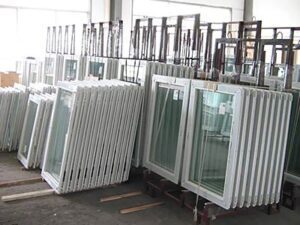
Despite the significant demand for windows to replace those damaged as a result of the armed aggression of the Russian Federation in Ukraine, their production volume fell three times compared to 2021, Oleksiy Bubnov, executive director of the Association of Window and Facade Market Participants (AUROF), told Interfax-Ukraine .
“According to our data, 150-160 thousand structures were produced in May, 170-180 thousand in June, 220-250 thousand in July. There is a positive trend, but compared to 2021, the volume of window production fell three times,” he said.
At the same time, the expert added that these data do not include the number of double-glazed windows that were produced to replace damaged windows, where the frames themselves survived.
“The industry will be able to operate at full capacity if there is glass and raw materials for the production of profiles. For other components of the window (accessories, components for double-glazed windows), everything is available and in sufficient quantity. And, of course, it will be necessary to select workers, because today all companies work in one shift,” Bubnov said.
Considering the acuteness of the issue of restoring the housing stock in the country, he proposes to consider the issue of granting a deferment from conscription to the Armed Forces of Ukraine for specialists in specialties that are critical for the window industry.
The expert named a number of other problems that need to be solved in order to launch the market at full capacity.
He, in particular, recalled that the only producer of PVC raw materials for the production of profiles, Karpatneftekhim (Kalush), has not been operating since the beginning of the war.
As reported, the Prosecutor General’s Office recently transferred the arrested corporate rights of Karpatneftekhim to the management of ARMA, but there is no information about the timing of the resumption of its work.
“The situation is absurd: national profile producers have to buy raw materials abroad and pay a protective duty of 12% on PVC raw materials, adopted in support of Karpatneftekhim. We propose to cancel it at this stage, at least until it is restored in full production,” says Bubnov.
About 80% of glass before the war was supplied from Russia and Belarus. “Since the beginning of the war, the window industry has refused any trade relations with the aggressor country and its accomplice. There remains the opportunity to buy glass in European countries, in Turkey and Azerbaijan,” he explained.
At the same time, Bubnov said, logistically, such deliveries are possible only by land, by special vehicles, the so-called “jumbos” (for transporting large-format glass), which go empty for loading, but are forced to stand in queues at customs.
The Executive Director of AUROF proposes to provide a simplified procedure – the “green corridor” – for vehicles following the glass on exit from Ukraine and at the entrance to the country.
The risk factor, the expert said, which could slow down the glazing of war-damaged buildings, is the alleged 10% tax on the purchase of foreign currency.
“Today, the cost of windows has increased by 70-80% compared to the pre-war period. Since glass is not produced in Ukraine, the introduction of this tax will automatically lead to an increase in the cost of double-glazed windows and windows. We believe that if a 10% tax on the purchase of foreign currency is introduced, it will should be canceled for contracts under which the currency will be used to purchase glass,” Bubnov believes.
Established in 2013, AUROF unites 29 market participants.

The Interdepartmental Commission on International Trade (ICMT) decided to introduce final anti-dumping duties on imports to Ukraine of swing-out mechanisms for window and balcony door units originating from Turkey for a period of five years in the amount of 30.78% for two manufacturers and 35.1% – for everyone else.
The ICMT made a corresponding decision at a meeting on April 23, the duties will come into force 30 days after the publication of the decision, the Uriadovy Kurier nrewspaper said on Thursday.
The Commission initiated an investigation into window and door fittings from Turkey in February last year at the initiative of Axor Industry LLC, a reduced duty of 30.8% will be applied to Ileri Pencere Kapi Sistemleri Sanayi and Ileri Pencere Kapi Sistemleri Sanayi.
According to the document, the deliveries of products were studied in 2017-2019, and they were investigated for 2019. During the study, the applicant’s sales volumes in the domestic market decreased by 12.9%, and their profitability – by 47.1%.
“There is a likelihood of a significant increase in dumping imports of goods originating from the Republic of Turkey, which threatens to cause significant harm to the national producer. Dumping imports of goods to Ukraine (…) were carried out at prices that were lower than the sale prices and the cost of such goods of the national producer in the domestic market of Ukraine,” the publication says.
More precise name of the taxable product sounds like “fasteners, fittings and similar products (except for window and/or balcony door handles with a key and/or without a key), of base metals for use in windows and/or balcony door blocks with a pivot and a swing-out mortar, classified according to UKTZED code 8302 41 50 10 made in the Republic of Turkey.”
According to the State Statistics Service, imports of fittings under the broader code 8302 41 50 from Turkey in January-March 2021 amounted to 0.760 tonnes for $2.01 million, while there was no export to this country. In general, during the specified period, Ukraine imported such goods for $5.89 million, exported – for $3.91 million.



