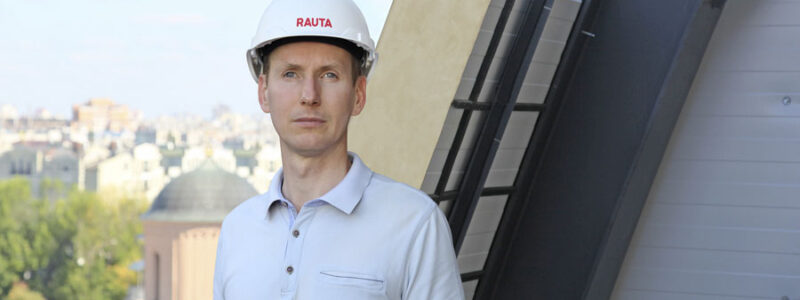
Ukraine’s post-war reconstruction will create a massive market for the construction sector, industry, and related sectors; however, Ukrainian companies need to start preparing now to compete with international contractors, according to Andriy Ozeychuk, director of Rauta and chairman of the board of directors of the Ukrainian Steel Construction Center Association.
In his column for The Page, he noted that once the war ends, demand for construction will be significant from the general public, the government, and the business sector alike. According to estimates by the Ministry of Foreign Affairs, there are about 8 million Ukrainians abroad who fled during the full-scale invasion, and the UN forecasts the return of 3–3.5 million people once lasting peace and security guarantees are in place.
According to the expert, a significant portion of those who return, as well as internally displaced persons, will need new housing or the restoration of damaged homes. At the same time, reconstruction will not be limited to the housing stock. According to estimates by the Kyiv School of Economics, residential buildings account for only about one-third of the direct losses from the war, while significant losses were also sustained by transportation and energy infrastructure, corporate assets, industry, and the agri-industrial complex.
Ozeychuk notes that, according to World Bank estimates, Ukraine’s reconstruction will require more than EUR500 billion over the next decade. This is nearly three times Ukraine’s GDP in 2025 and creates significant opportunities not only for the construction sector but also for the entire economy.
In his estimation, every hryvnia invested in construction has a multiplier effect and stimulates 1.5 to 3 times greater growth in related sectors. Examples include the postwar reconstruction of Germany and South Korea, where the construction sector became one of the catalysts for economic growth.
The expert identifies the main sources of funding for large-scale projects as direct financial assistance from international partners—including the G7, the EU, and the U.S.—the attraction of large private investments backed by state guarantees, as well as reparations and confiscated frozen assets of the Russian Federation. Ukraine’s European integration should serve as an additional incentive, as it will eventually open access to specialized EU development funds.
At the same time, Ukrainian construction companies may already face stiff competition from European players. According to Ozeychuk, the most realistic scenario would be a consortium model in which a European general contractor would work alongside Ukrainian subcontractors and use local materials certified to European EN standards.
Under this scenario, foreign companies could be involved in high-tech work, while Ukrainian businesses would handle local logistics, specialized work, and the construction of utility networks, roads, and capital construction projects.
The expert identifies financing conditions as the main barrier for Ukrainian companies. While in Ukraine construction is often carried out using substantial advance payments, the EU commonly uses a post-audit payment model—based on the completion of specific project phases. This requires significant working capital, whereas Ukrainian companies have limited access to low-cost long-term loans.
To level the playing field, Ozeychuk believes the government should launch programs for affordable long-term loans backed by state guarantees, provide preferential financing for the modernization of Ukrainian building materials plants, simplify the adoption of EN standards, and advocate for Ukrainian businesses’ participation in international grant programs.
A separate challenge will be the construction industry’s transition to European design standards. By 2028, the Ukrainian system is expected to fully integrate into the European space and adopt Eurocodes. This will remove some barriers for foreign engineers but will also require Ukrainian specialists to rapidly upgrade their qualifications.
Among the technological trends in reconstruction, the expert cites BIM modeling, digital twins of buildings, energy-efficient solutions, and the concept of net-zero energy buildings. In his assessment, the market will shift toward rapid modular construction, eco-friendly materials, and innovative solutions.
Another key constraint will be a labor shortage. According to Ozeychuk, demobilized military personnel and men returning from abroad will only partially offset the labor shortage. High demand could lead to rising wages in construction, particularly for blue-collar jobs, and could also encourage the retraining of specialists from other sectors, as well as the more active involvement of women, veterans, and older workers.
In addition, Ukrainian companies are already beginning to collaborate with agencies that specialize in the official recruitment of construction workers from South Asian countries, including India, Nepal, Bangladesh, and Pakistan.
Ozeychuk believes that the two main principles of the future reconstruction are speed of implementation and the “Build Back Better” approach—that is, rebuilding to a higher standard than before the destruction. It is precisely these criteria that will determine the demand for modern materials, technologies, and production capacity in Ukraine.
Rauta is a Ukrainian company operating in the field of prefabricated buildings, facade and roofing systems, sandwich panels, and steel construction. The “Ukrainian Center for Steel Construction” Association brings together companies working in the segments of metal structures, building materials, design, and industrial construction.
CONSTRUCTION, Eurocode, INVESTMENT, OZEYCHUK, RAUTA, RECONSTRUCTION