

Nearly 800 entrepreneurs are currently on the Antimonopoly Committee of Ukraine’s blacklist due to bid-rigging, according to the Consolidated Report on the Distortion of Tender Results. This represents 30% of the total number of businesses on this list. Overall, the largest number of such entrepreneurs are in the Lviv region. Nearly one in three sole proprietors on the AMCU’s blacklist operates in the wholesale trade sector.
As of the end of June 2026, there were 797 sole proprietors on the AMCU’s blacklist. This accounts for 30% of the total number of sole proprietorships and companies on this list.
Entrepreneurs are placed on the blacklist if the AMCU finds them guilty of collusion while participating in public procurement. This refers to situations where several tender participants merely create the appearance of competition, but in reality agree in advance on who will win. As a result, the state may end up overpaying for goods, works, or services, while other participants lose the chance to win the tender fairly.
Being included on this list has consequences: for three years following the AMCU’s decision, such entrepreneurs may be barred from participating in public procurement. That is why contracting authorities regularly check this list before determining the tender winner.
You can check whether a business is on the AMCU’s blacklist using OpenDataBot.
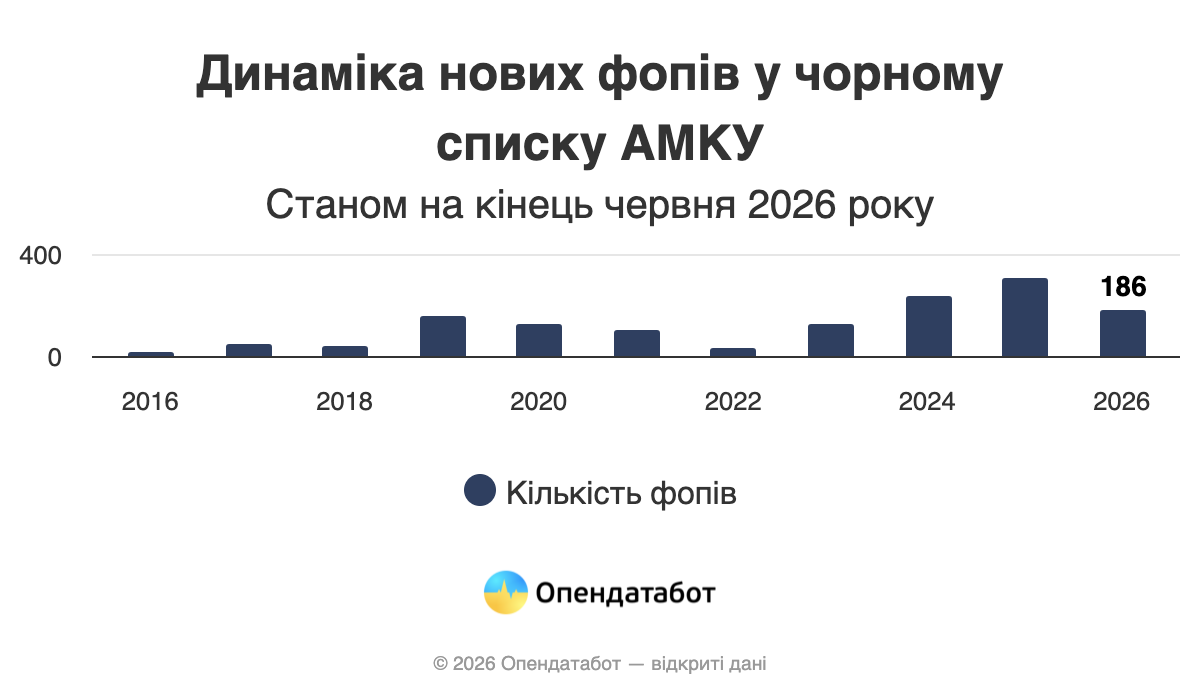
The number of businesses in violation is growing year after year. While 242 decisions regarding such businesses were issued in 2024, that number rose to 306 in 2025. This is the highest figure in the last 10 years. Another 186 entrepreneurs, whom the Committee found to have engaged in anti-competitive concerted actions, were added to the list this year.
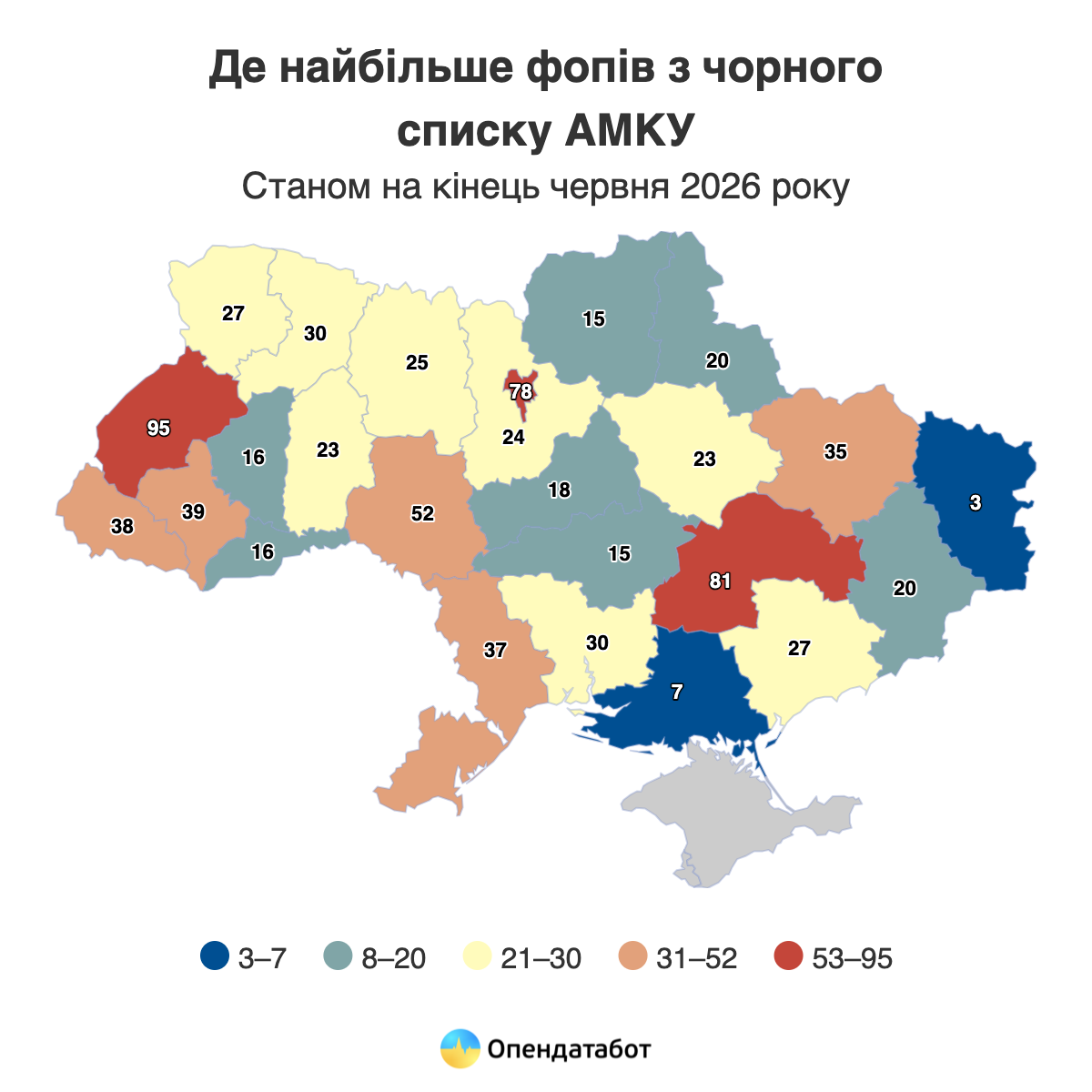
The largest number of sole proprietors on the blacklist are registered in Lviv Oblast—95 entrepreneurs, or nearly 12% of the total. Next are Dnipropetrovsk Oblast (81 sole proprietors), Kyiv (78), Vinnytsia Oblast (52), and Ivano-Frankivsk Oblast (39).
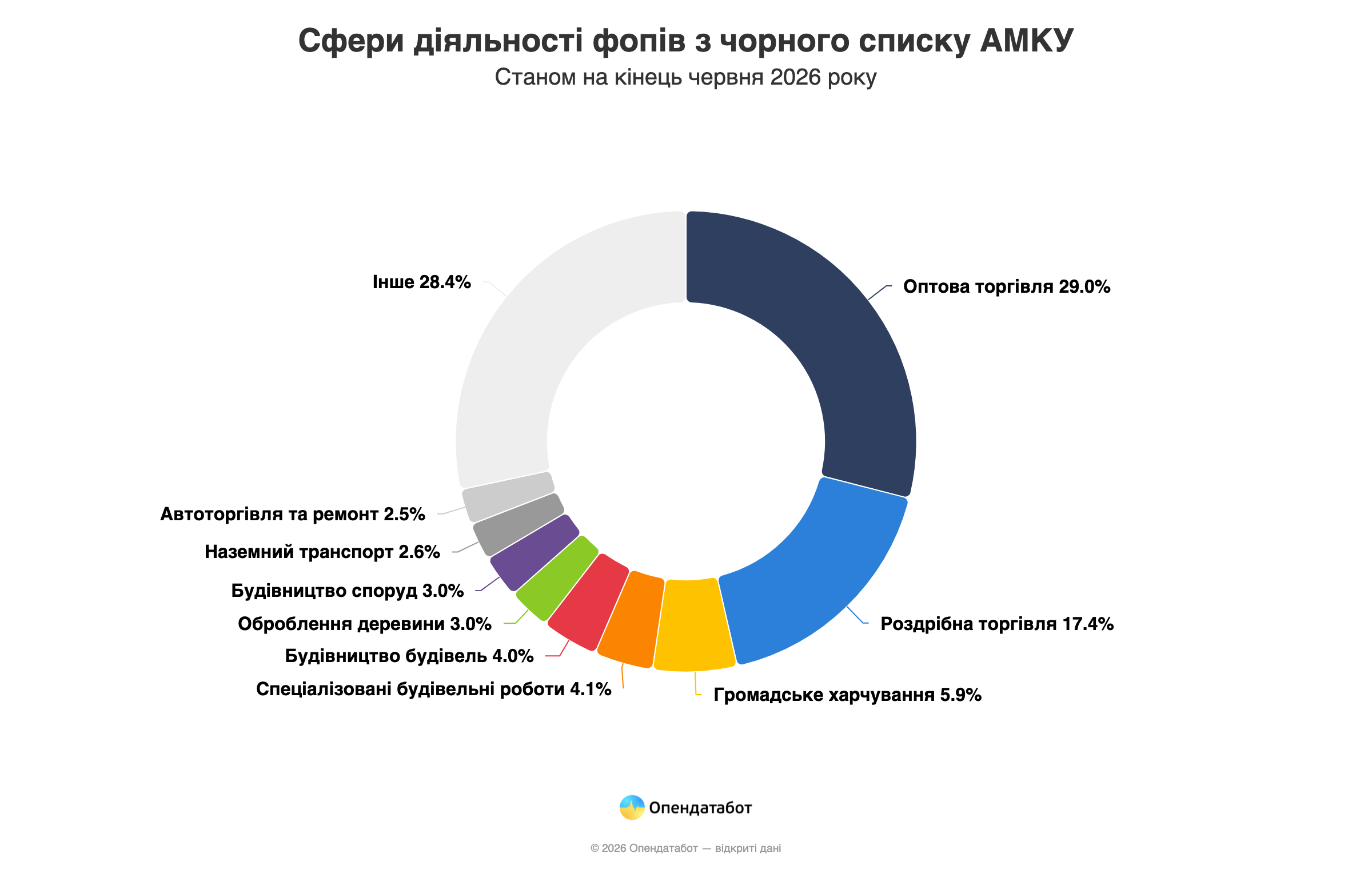
Nearly one in three of these entrepreneurs works in wholesale trade—there are 231 such sole proprietors. Another 139 entrepreneurs are engaged in retail trade. The violators also include representatives of the food service industry (47), specialized construction work (33), and general construction (32).
https://opendatabot.ua/analytics/amku-black-list-2026
The Antimonopoly Committee of Ukraine (AMCU) found LLC “Marxoll” (formerly LLC “Dryada Zakhid”) and LLC “Ligna Ukraine” guilty of collusion during their participation in two tenders for the purchase of plastic cassettes (with an estimated value of UAH 34,470,680.00) and the purchase of tags for marking timber (with an estimated value of UAH 26,534,070.00) held by the state-owned enterprise Lesa Ukrainy in 2023 and 2024, the press service of the agency reported.
The committee established circumstances which, taken together, indicate that the companies engaged in anti-competitive concerted actions with the aim of eliminating competition between them during their participation in the aforementioned tenders. The facts revealed showed joint and coordinated behavior by the companies in preparing for and participating in the tenders, as well as communication between them and the exchange of information, the statement said.
The AMCU recognized the actions of Markosoll LLC and Ligna Ukraine LLC as a violation of competition law under paragraph 4 of part 2 of Article 6, and Article 50(1) of the Law “On Protection of Economic Competition,” which led to a distortion of the tender results, and fined them a total of UAH 5,495,260.
The agency recalled that, according to the Law “On Public Procurement,” the basis for refusing to participate in a procurement procedure is the fact that a business entity (participant) has been held liable within the last three years for committing anti-competitive concerted actions related to the distortion of tender results.
The Antimonopoly Committee of Ukraine has launched an investigation against the producer of water “Karpatska Dzherelna” for possible misleading of consumers. Delo.ua* reports with reference to the AMCU’s statement.
It is noted that the agency has initiated consideration of case No. 127-26.4/116-24 on the grounds of a violation by Carpathian Mineral Waters Limited Liability Company, as provided for in Article 15-1 of the Law of Ukraine “On Protection against Unfair Competition”, in the form of dissemination of misleading information.
“The subject matter of the case is, in particular, the actions of Carpathian Mineral Waters LLC in the form of disseminating information about the water of the Carpathian Dzherelna trademark, namely, the origin and characteristics of such products,” the AMCU notes.
The agency draws attention to the fact that “Karpatska Dzherelna” is extracted from wells, so it cannot be called “spring water”. In addition, the water under this brand has nothing to do with the Carpathians, as it is extracted and packaged hundreds of kilometers away.
The AMCU adds that such actions, in the absence of appropriate confirmation of such information by Carpathian Mineral Waters LLC, contain signs of a violation under Article 15-1 of the Law of Ukraine “On Protection against Unfair Competition” in the form of dissemination of misleading information to consumers.
About Carpathian Mineral Waters
“Carpathian Mineral Waters has been a national producer of mineral waters and soft drinks for over 15 years.
The company started its activities in the mineral water market in 1996 with the first bottling of mineral natural table water under the brand name Karpatska Dzherelna, and in June 2002 was reorganized into a plant for the production of mineral water and soft drinks Karpatski Mineralni Vody. In 2002, the company started production of sweet carbonated drinks under the Fruktova Dzherelna and Sokovynka brands, and in 2016 – the Dragon energy drink.
Today, the Carpathian Mineral Waters Group of Companies is a powerful player in the Ukrainian market of natural mineral waters and soft drinks.
Karpatska Dzherelna mineral water is extracted from two artesian wells at a depth of 90 meters from a natural source. According to the company, the production facility is located right next to the source, and the water from the wells is piped to the bottling line. During the bottling process, the water is filtered only from mechanical impurities and retains all useful natural trace elements.
As a reminder, the Antimonopoly Committee of Ukraine has imposed a fine of almost UAH 1 million on three companies of businessman Viacheslav Suprunenko.
Thus, Kyiv Plant Rosinka LLC was fined UAH 169,999, Kyiv BCC LLC was fined UAH 300,000, and Kyivkhlib LLC was fined UAH 500,000. The penalty was imposed for violation of the legislation on protection of economic competition by acquiring assets in the form of a single property complex of PrJSC “Kraplynka” without the AMCU’s permission.
The Antimonopoly Committee of Ukraine (AMCU) has identified grounds for banning the acquisition of control over lifecell group by French billionaire Xavier Niel’s DVL Telecom, a member of NJJ group.
In particular, the antitrust agency believes that it is necessary to check the relationship of control of lifecell itself and the parent company Turkcell with the person to whom the decision of the national security and defense Council of Ukraine applied personal special economic and other restrictive measures (sanctions).
“When considering applications for the acquisition of control over the group “Lifecell” by the company “DVL Telecom” arose the need to verify the relationship of control of the participants of the concentration, in particular the group “Lifecell” and the group “Turkcell” with the person to whom the personal special economic and other restrictive measures (sanctions) applied by the decision of the National Security and Defense Council of Ukraine,” – said the press service of the AMCU on Monday.
The report states that, having considered the applications on the acquisition of control by DVL Telecom over Lifecell LLC, Global Bilgi LLC and Ukrtauer LLC (lifecell group), the AMCU has identified grounds for banning the said concentrations.
“Given that the concentrations in the form of acquisition by DVL Telecom of control over Lifecell LLC, Ukrtauer LLC and Global Bilgi LLC constitute a single transaction and will take place under a single sale and purchase agreement, a separate authorization for DVL Telecom’s acquisition of control over Global Bilgi LLC cannot be granted by the Committee either,” the AMCU notes.
Considering the above, on March 7, 2024, the Committee again started consideration of the concentration cases in the form of acquisition by DVL Telecom of control over Lifesell, Global Bilgi and Ukrtauer LLC. At the same time began consideration of the case on concerted actions, which are directly related to the implementation of these concentrations, specified in the press service.
Earlier it was reported that at the meeting on March 7 AMCU allowed DVL Telecom to acquire control over Datagroup Holding Limited (“Datagroup-Volya”). In addition, the antimonopoly agency allowed concerted actions between NJJ UPAM (Paris, France), Lorimer II Ventures Limited (Nicosia, Cyprus), DVL Telecom (Paris, France) and a natural person – citizen of Ukraine in the form of implementation of provisions on refraining from competition, provided by Section 19 of the shareholders’ agreement, which will be concluded between these entities for a period of five years.
On December 29, 2023, Turkcell, a Turkish company, signed an agreement to transfer 100% of the shares, as well as all rights and debts of Lifecell LLC (TM lifecell), Ukraine’s third largest mobile operator, including contact center outsourcing company Global Bilgi LLC and tower rental service provider Ukrtauer LLC, to the French investment company NJJ Capital.
The decision to sign the agreement was made by the Board of Directors on December 20, but as early as May 9 it decided not to disclose information about the possible deal. Turkcell specified that the nominal price of Lifesell shares is UAH 12 billion 711.849 million, Global Bilgi – UAH 47.226 million and Ukrtauer – UAH 1 billion 964.04 million.
Authorized representatives of NJJ Capital (Paris, France) and Global Bilgi LLC (Kyiv, Ukraine) applied to the Antimonopoly Committee (AMCU) for authorization of NJJ Capital to indirectly acquire a part in the authorized capital of Global Bilgi, which provides for exceeding 50% of votes in the supreme governing body of the company, as well as parts providing for exceeding 50% of votes in the supreme governing bodies of Lifesell and Ukrtauer on December 29, 2023. The applications were returned to them as they did not meet the requirements set by the committee.
On January 23, 2024, AMCU received a second application to acquire the stake that provides control in Lifsell, Global Bilgi and Ukrtauer LLC from DVL Telecom, a member of the NJJ group.
According to market participants, a problem for the completion of the deal may also be the partial seizure of stakes in the companies being sold on charges against the under-sanctioned Mikhail Fridman, who indirectly controls a minority stake in Turkcell.

The Antimonopoly Committee of Ukraine (AMCU) has returned without consideration the application of the Irish CRH group for permission to concentrate the assets of the Italian Buzzi in Ukraine, Forbes Ukraine reported citing the agency.
According to the publication, the application submitted by CRH did not meet the requirements of the committee. In addition, the AMCU pointed to the presence of an oligopoly in the Ukrainian cement market, with CRH already holding about a third of the market.
Interfax-Ukraine contacted CRH for comment.
As reported, Italian cement producer Buzzi has reached an agreement to sell its Ukrainian business and ready-mixed concrete assets in Slovakia to CRH for EUR100 million. The deal is expected to be completed in 2024.
Buzzi Unicem SpA (Italy) unites companies producing cement, concrete, sand, gravel, etc. The group’s core business is cement production, which is produced at its own facilities in Germany, the USA, Luxembourg, the Czech Republic, Poland, Russia and Ukraine. Buzzi’s Ukrainian subsidiary, Dickerhoff Cement Ukraine, operates branches based at Volyn Cement (Zdolbuniv, Rivne region) and Yugcement (Olshanske, Mykolaiv region). The group also operates in the ready-mix concrete sector in Kyiv, Odesa and Mykolaiv.
In Eastern Slovakia, Buzzi’s assets consist of six ready-mix concrete plants.
As reported, in March 2023, the National Agency for the Prevention of Corruption (NAPC) added the Italian cement producer Buzzi Unicem to the list of international sponsors of war. In Russia, Buzzi operates through SLK Cement LLC, which owns two cement plants, Sukholozhskcement and Korkino, a terminal in Omsk, and the Cemtrans transportation company. According to the NACP, the company is among the top five leaders in the Russian cement industry.
Ireland’s CRH Plc, the world’s largest manufacturer of building materials, which owned six construction mix plants in Russia, announced its withdrawal from the Russian market.
CRH entered the Ukrainian market in 1999 by acquiring the Kamianets-Podilskyi cement plant in Khmelnytskyi region. Currently, CRH also owns Odesa Cement Plant and Mykolaivcement (Lviv region).
CRH’s separate business in Ukraine is the production of concrete and reinforced concrete products. PoliBeton Energo, a Bila Tserkva-based concrete goods plant, is a specialized enterprise that produces power transmission towers. PoliBeton’s concrete hub in the north of Odesa joined CRH in 2020.
The Antimonopoly Committee of Ukraine (AMCU) has fined the private companies Fialka and Style-Decor UAH 92 million for collusion in the tender for the reconstruction of the Avangard stadium in Rivne, the agency’s press service has said.
According to the statement, the committee found evidence of coordination between the two companies during the participation in the tender due to which the competition between them was eliminated. The expected cost of works at the tender was UAH 202.2 mln, the AMCU notes.
For the concerted actions at the auction the companies, in addition to the fine, are banned from participating in public procurement for three years.
According to Opendatabot, the owner and beneficiary of the private industrial and commercial firm “Fialka” (Sumy) is Vahid Kurbanov. According to the company’s financial statements for 2020, it was not engaged in economic activities.
The owner and beneficiary of LLC “Style-Decor” is named Vera Rozhchuk. In 2020 the company received 151 thousand UAH of net loss and 23 million UAH of income.



