
NovaPay Invest LLC, established by the owners of the Nova Group and “Nova Poshta” Vyacheslav Klimov and Volodymyr Poperechnyuk, together with Supervisory Board Chairman Taras Kyrychenko, notified the National Securities and Stock Market Commission (NSSMC) and BTA Bank of their intention to acquire 100% of the bank’s shares.
According to a statement by “NovaPay Invest” published in the National Securities and Stock Market Commission’s (NSSMC) disclosure system on Friday, the company intends to acquire 20 million common registered shares of BTA Bank, representing 100% of its total common shares.
As of the date of the announcement, “NovaPay Invest” and its affiliates do not hold any shares in BTA Bank.
As previously reported, on June 24, “NovaPay Invest” submitted an application to the Antimonopoly Committee of Ukraine requesting preliminary conclusions regarding the need to obtain permission to acquire control over BTA Bank.
The company’s press office declined to comment to the Interfax-Ukraine news agency on what preliminary conclusions the AMCU had provided.
As of early 2026, BTA Bank was 100% owned by Kenes Rakishev, a citizen of Kazakhstan. According to the National Bank, as of September 1, 2026, the financial institution ranked last—59th—among Ukrainian banks in terms of total assets, with 338.49 million UAH. Over the first eight months of the year, the bank reported a profit of 1 million UAH.
Klimov, Poperechnyuk, and Kyrychenko—who had long headed Pravex Bank—each hold a 33.33% stake in NovaPay Invest.
The founders of the Nova Group, which is represented in the financial sector by NovaPay, announced their plans to enter the banking market in March of this year.
In June, the publication “Ekonomichna Pravda” reported that Nova had signed a memorandum with BTA Bank regarding the future acquisition of the institution and the creation of a financial inclusion bank based on it.

Asvio Bank has launched the amobank mobile banking app as a complement to its existing business model, which is primarily focused on the corporate segment, the financial institution’s CEO, Yevgen Shulika, announced on LinkedIn on Wednesday.
“It’s official now. We’ve launched another mobile banking app during the war,” he wrote.
According to him, the launch of amobank is expected to intensify competition in the Ukrainian banking market, where customers typically use cards from four or five different banks, choosing specific institutions based on terms for deposits, loans, cards, or cashback.
“These statistics indicate that the market still cannot offer customers a comprehensive experience at a single bank,” noted the chairman of the board.
At the same time, Shulika emphasized that the launch of amobank does not mean Asvio Bank is abandoning its current model.
“Asvio Bank is a traditional bank, focused primarily on the corporate segment. It has its own business model, and our goal is not to replace it, but to complement it and expand its technological capabilities,” he added.
According to the regulator, as of September 1, 2026, Asvio Bank ranked 34th in total assets (7.5 billion UAH) and reported a net profit of 2.7 million UAH for January–August.

In September 2026, Ukrainian banks increased their net loan portfolio by 1.9%, or 25.1 billion UAH, compared to August—to 1 trillion 329.4 billion UAH, while the deposit base increased by 0.7%, or 23.1 billion UAH, to 3 trillion 254.7 billion UAH, according to operational data from the National Bank of Ukraine (NBU).
The main growth came from the corporate segment: the business loan portfolio increased by 15.3 billion UAH, or 1.6%, over the month—to 946.3 billion UAH.
The volume of loans to households at the end of the month stood at 383.1 billion UAH, which is 9.8 billion UAH, or 2.6%, more than a month earlier.
Within the corporate portfolio, hryvnia-denominated loans increased by nearly 0.7%, or 4.3 billion UAH, to 654.9 billion UAH, while foreign-currency loans (in hryvnia equivalent) rose by 3.9%, or 11.1 billion UAH, to 291.4 billion UAH.
On a year-over-year basis, hryvnia-denominated loans to legal entities rose by 32.3%, foreign-currency loans (in hryvnia equivalent) by 29.7%, and the retail loan portfolio by 38.4%.
In the deposit market, the trend was the opposite of that in the loan market: the largest increase came from household deposits, which rose by 21.4 billion UAH, or 1.4%, to 1 trillion 556.0 billion UAH, while corporate deposits increased by 1.8 billion UAH, or 0.1%, to 1 trillion 698.7 billion UAH.
On a year-over-year basis, household deposits increased by nearly 17.0%, and corporate deposits by 14.9%.

The Cyber Police of Ukraine have warned of a new fraud scheme in which perpetrators distribute malicious applications disguised as free offline navigation apps that can gain access to users’ personal data and banking services.
According to the Cyber Police, potential victims are offered a navigation app that supposedly works without an internet connection, contains no advertising and is available free of charge. Advertisements for such applications are distributed primarily through social media.
After clicking on an advertisement, users are redirected to a third-party website where they are offered a program to download, including through a Telegram bot. Instead of the advertised navigation app, a malicious file may be installed on the smartphone.
During installation, the program requests permission to download applications from unknown sources, as well as access to certain smartphone functions. After obtaining these permissions, perpetrators can track the device owner’s actions, intercept messages and notifications, and obtain confidential information.
The malicious program’s access to SMS messages and system notifications poses a particular threat. The information obtained may be used to intercept verification codes and access the user’s accounts and financial services.
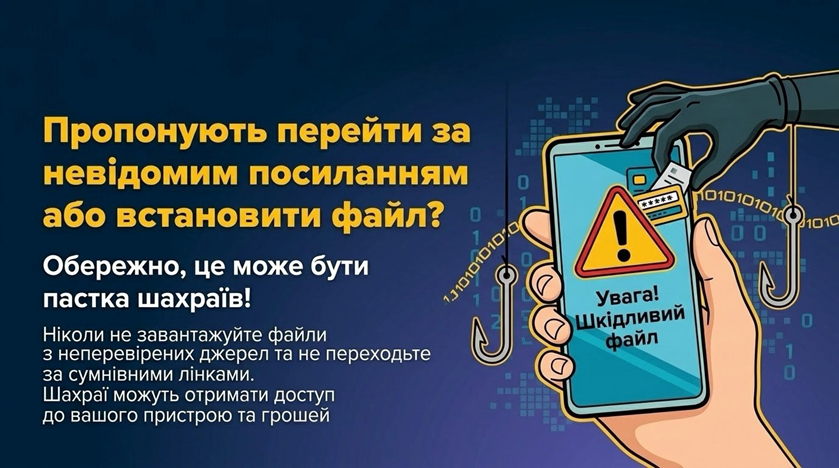
The Cyber Police recommend installing mobile applications exclusively from the official Google Play and App Store marketplaces and not downloading APK files through Telegram bots, unknown websites or advertising links.
Users are also advised to carefully check the permissions requested by an application. In particular, a navigation program should not gain access to SMS messages, notifications or device management functions without an objective need.
If a suspicious application has already been installed, specialists recommend temporarily refraining from using banking and other critically important services on that smartphone, disconnecting the device from the internet and changing the passwords for primary accounts from another secure device.
The suspicious program should be removed, and the permissions granted to it should be checked. If the application cannot be removed or continues to run in the background, seeking technical assistance is recommended.
If banking details have been disclosed or unknown transactions appear, users must immediately contact their bank to block possible unauthorized access to their accounts. Cases of fraud can be reported to the Cyber Police through their official online form.
The Cyber Police also recommend checking information about current fraud schemes on the government platform StopFraud.
Source: Cyber Police of Ukraine
APPLICATION, BANK, CYBER POLICE, CYBERSECURITY, fraud, smartphone

Sense Bank was the first in the Ukrainian banking market to launch a bundled subscription service, which allows customers to combine several digital services into a single package and pay for them at a single price.
Inna Tyutyun, a member of the management board and director of IT, retail and payment business, and digitalization at Sense Bank, discussed the results of the launch of this new initiative during the FinRetail conference in Kyiv.
According to her, the subscription model is changing the bank’s role: instead of being a traditional payment intermediary, it is becoming part of an ecosystem that connects customers and partner services. For the bank, this means the opportunity to generate regular, recurring revenue; for retailers, it means lowering the cost of customer acquisition and extending the duration of customer engagement; and for users, it means saving money on services they use regularly.
“Today’s consumer seeks convenience and predictable value. A subscription is a tool that breaks down the psychological barrier to repeat purchases and allows a bank to invest in a customer relationship once, while remaining useful to the customer for years to come,” noted Tyutyun.
Sense Bank believes that this model creates a closed-loop loyalty ecosystem: the bank drives customer traffic, partners offer special terms, and users receive long-term benefits within a single digital space.
The service is available in the Sense SuperApp. The bank offers three package tiers: Small, Medium, and Full. Customers can customize their own set of services and choose only those they actually use.
Packages can combine transportation, streaming, entertainment, and other digital services, as well as security solutions.
The main advantage of this model is the cost of the bundle. According to the bank, a single package costs the customer less than purchasing each subscription separately.
Going forward, Sense Bank plans to expand its partner network, enhance the personalization of its offerings, and scale its subscription banking model.
The bank expects this format to be particularly in demand amid rising costs of digital services and users’ desire to better control their recurring expenses.
Sense Bank has been a state-owned bank in Ukraine since July 2023. 100% of its shares are owned by the Ukrainian government, represented by the Cabinet of Ministers. The bank is included in the NBU’s list of systemically important banks. Previously, the bank operated under the name Alfa-Bank Ukraine.
Learn more about Sense Bank’s subscription packages.
BANK, digital service, FINTECH, Sense Bank, subscription, SuperApp

According to Fixygen, the widespread adoption of stablecoins could change not only the payments market but also the way central banks’ monetary policy operates, warned Petra Chudin, a member of the Governing Board of the Swiss National Bank (SNB).
The SNB representative outlined her position on new forms of money on September 30 at the KOF Prognosetagung 2026 in Zurich.
One of the main risks is linked to a potential shift of funds from traditional bank deposits to stablecoins.
If individuals and companies begin transferring large amounts of money from bank accounts into digital tokens, commercial banks could lose part of their relatively cheap source of funding.
As a result, resources for lending to the economy will decrease, and banks will have to seek more expensive market-based financing.
But for central banks, the problem runs even deeper. By changing the interest rate, the central bank influences the cost of money within the banking system. Banks then adjust their deposit and loan rates accordingly, which affects household spending, corporate investment, and, ultimately, inflation.
The greater the proportion of money that moves outside the traditional banking system into stablecoins, the weaker this channel for transmitting monetary policy could potentially become.
Chudin also highlighted the fundamental issue of the unity of money. Under normal conditions, one Swiss franc in a bank account is equivalent to one franc in cash or central bank money.
A stablecoin is an obligation of a private issuer and does not necessarily have the same characteristics as central bank money.
This is precisely why the widespread adoption of various private digital currencies could potentially lead to a more fragmented monetary system. At the same time, the SNB does not reject the technology of digital money itself.
Switzerland is one of the most active European markets for institutional tokenization. The central bank is already experimenting with settlements using central bank digital currency for transactions involving tokenized assets.
Thus, the question for regulators is no longer whether new forms of money will emerge, but rather which digital form of money will become the primary unit of account—stablecoins issued by private companies, tokenized bank deposits, or central bank digital currencies.
This rivalry is becoming one of the most prominent structural trends in the financial market of 2026.
In the United Kingdom alone, Barclays, HSBC, Lloyds Banking Group, and NatWest conducted the first interbank transactions involving tokenized deposits in September.
At the same time, European banks are developing their own stablecoin projects, while global financial groups are experimenting with round-the-clock settlements on the blockchain.
As a result, the market is gradually moving beyond the former “cryptocurrency versus banks” dichotomy. Banks and central banks are beginning to build their own digital infrastructure that competes with the functions currently performed by USDT, USDC, and other stablecoins.



