
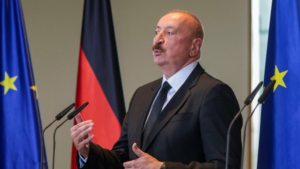
President of Azerbaijan Ilham Aliyev on September 15 sharply criticized the European Parliament, calling it “a den of corrupt officials.” He made the statement in Baku during a meeting with participants of international conferences. The quote is confirmed by the official transcript on the website of the President of Azerbaijan.
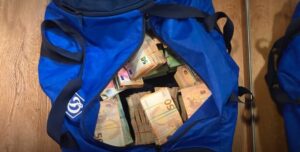
Aliyev referred to the Qatargate corruption scandal, which erupted in the European Parliament at the end of 2022 and was linked to former EP Vice-President, Greek politician Eva Kaili. According to him, “suitcases containing millions of dollars were seized from the home of its vice-president,” after which, Aliyev claims, the case was allegedly “hushed up.” He also accused the European Parliament of bias against Azerbaijan and Islamophobia.
At the same time, the factual circumstances of the case differ somewhat from the wording used by the Azerbaijani president. In December 2022, Belgian investigators did indeed discover about EUR1.5 million in cash as part of Qatargate, but the money was seized in several locations: about EUR150,000 in Kaili’s apartment, around EUR750,000 in a suitcase that was with her father, and another approximately EUR600,000 in the home of another person involved in the investigation.
Kaili was arrested in December 2022, lost her position as Vice-President of the European Parliament and spent some time in custody. Therefore, Aliyev’s claim that “no measures were taken” against her does not correspond to the full chronology of the case. Kaili herself denies committing any crimes.
It is also not yet possible to say that the case was closed or officially “hushed up.” As of the end of June 2026, the Belgian Qatargate investigation was continuing and had not yet reached trial. In February 2026, the Brussels Chamber of Appeal rejected procedural objections from the main suspects and allowed the investigation to continue. At the same time, the investigation has been criticized because of its duration and a number of procedural problems.
AZERBAIJAN, CORRUPTION, EUROPEAN PARLIAMENT, QATARGATE, Алієв
According to the “Serbian Economist,” on September 3, Montenegro’s Skupština (parliament) unanimously supported a proposal to amend the Constitution, which would remove the immunity of the country’s president, prime minister, and members of the government in cases of crimes against official duties, including corruption offenses.
All 66 deputies present at the session voted in favor of the proposal; there were no votes against or abstentions. A two-thirds majority of parliamentarians was required to initiate the constitutional amendment process.
This specifically concerns abuse of office, accepting and offering bribes, as well as other corruption-related crimes. The government explains these changes as necessary to address situations where the immunity of a high-ranking official becomes an obstacle to criminal prosecution.
The initiative was drafted by the government back in the spring of 2026. The Cabinet of Ministers proposed amending Article 86 of the Constitution to explicitly revoke immunity for the president and members of the government in cases of crimes against official duties. The government links this reform, in particular, to the implementation of recommendations from the Council of Europe’s anti-corruption group GRECO and Montenegro’s progress under Chapter 23 of the EU accession negotiations.
However, formally, immunity has not yet been abolished. Parliament has instructed the Constitutional Committee to prepare a draft of the amendments within four days. According to Article 156 of the Constitution of Montenegro, after the draft is approved by two-thirds of all deputies, it must undergo a public consultation lasting at least one month, after which the final text must again receive the support of two-thirds of Parliament.
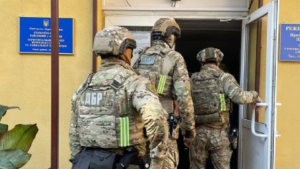
A total of 76.7% of Ukrainians consider the system of territorial recruitment and social support centres to be the most affected by corruption.
This is evidenced by the results of a sociological survey conducted by the Politarena publication jointly with the Active Group company on 1 August 2026.
According to the survey, 82.6% of respondents believe that the level of corruption in Ukraine has increased since 2022. A decline was reported by 6.6% of respondents, while 10.8% were unable to decide on an answer.
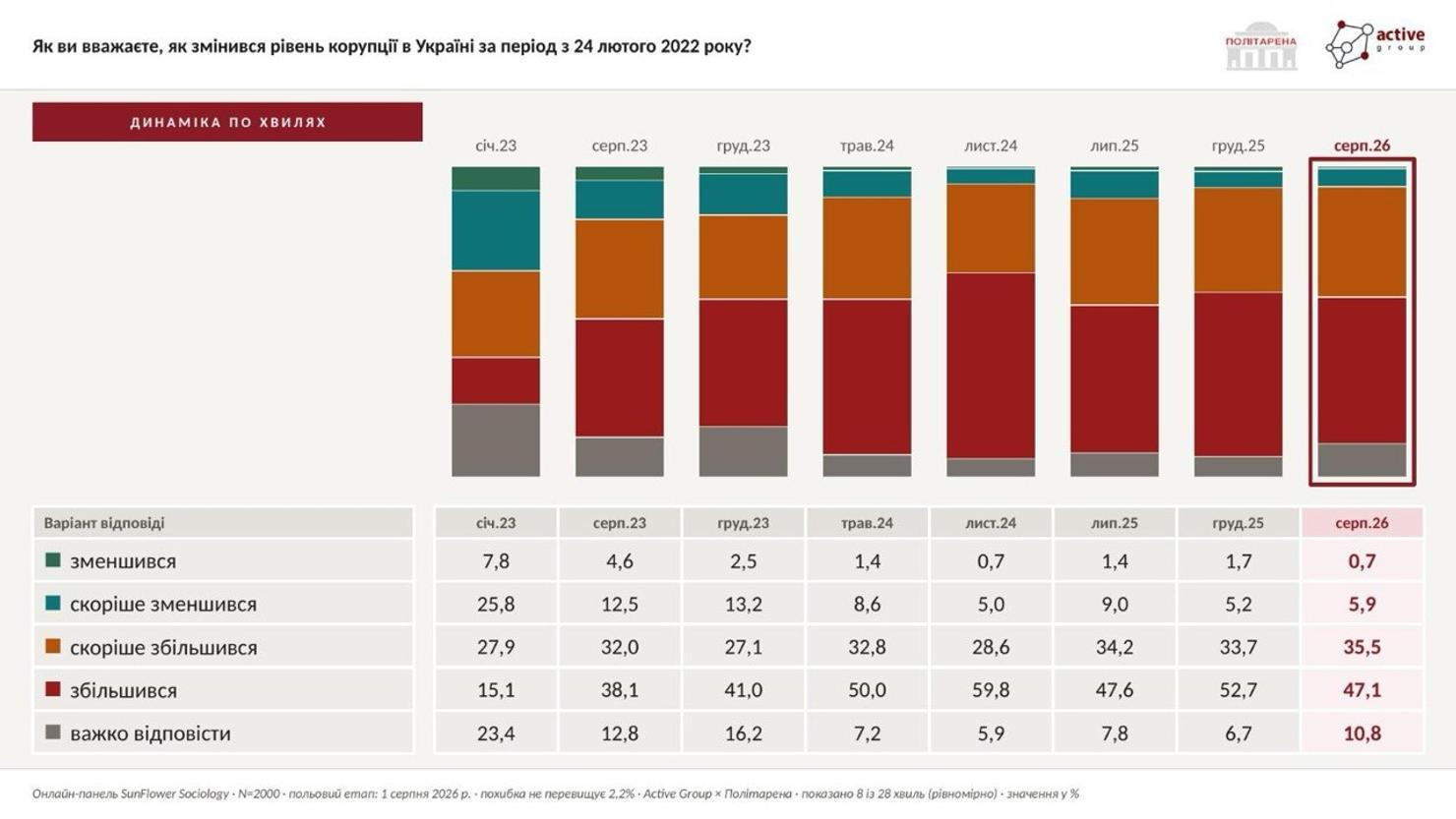
Compared with January 2023, Ukrainians’ assessments have deteriorated significantly. At that time, 43% of respondents spoke of an increase in the level of corruption, while 33.6% spoke of its decrease.
Territorial recruitment and social support centres ranked first among the structures that Ukrainians consider the most corrupt, with a figure of 76.7%. In October 2024, 71.3% of respondents expressed this opinion.
The judicial system ranked second, with 62.2% of respondents calling it corrupt, compared with 71.2% in 2024. Law enforcement agencies ranked third with 59.1%, compared with 67.7% in 2024.
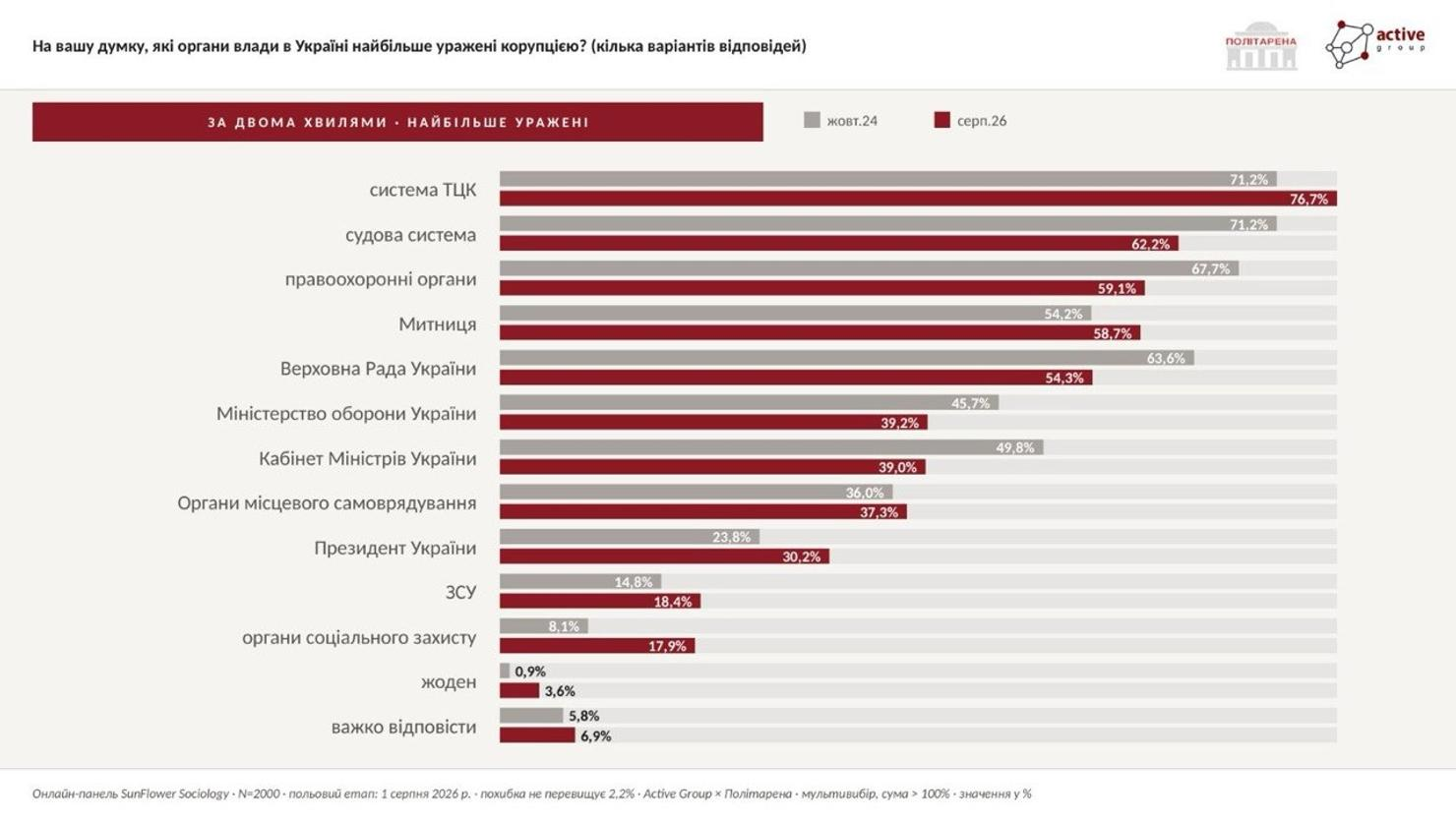
The Ministry of Defence of Ukraine is considered corrupt by 39.2% of survey participants, the Cabinet of Ministers by 39%, and local self-government bodies by 37.3%.
A total of 30.2% of respondents included President of Ukraine Volodymyr Zelenskyy among corrupt institutions and officials. The Armed Forces of Ukraine were described as corrupt by 18.4% of respondents, while social protection bodies were named by 17.9%.
Research methodology: the study was conducted using the SunFlower Sociology online panel. Method: self-completion of questionnaires by Ukrainian citizens aged 18 and over. Sample: 2,000 questionnaires (representative by age, gender and region of Ukraine). The theoretical margin of error at a confidence probability of 0.95 does not exceed 2.2%. Data collection period: 1 August 2026. Median salary values were calculated among those who provided a substantive response, using linear interpolation within the intervals; the extreme categories were taken as UAH 5,000 (“up to UAH 10,000”) and UAH 150,000 (“over UAH 150,000”).
On February 10, 2026, Transparency International published the Corruption Perceptions Index (CPI) 2025—an annual ranking of perceptions of corruption in the public sector. In the new release, Ukraine received 36 points out of 100 and ranked 104th out of 182 countries and territories.
Ukraine’s score increased by 1 point compared to the previous edition of the index. In CPI 2024, Ukraine had 35 points and ranked 105th (that edition assessed 180 countries and territories).

The TI report notes that Ukraine belongs to the group of countries that are gradually “moving from the bottom of the ranking toward the middle” thanks to long-term efforts to build an anti-corruption infrastructure. At the same time, the document describes 2025 as difficult for Ukraine—against the backdrop of high-profile scandals in procurement and the defense sector, but with an important emphasis: the exposure of violations and bringing cases to verdicts indicates that the new anti-corruption architecture “is delivering results.”
Overall, CPI 2025 records a further deterioration of the global picture: the world average score fell to 42 points, and more than two thirds of countries scored below 50 points. Denmark once again received the highest score (89), and at the bottom of the list are Somalia and South Sudan (9 each).
The CPI measures not “actual corruption,” but perceptions of the level of corruption in the public sector, aggregating data from expert assessments and business surveys on a 0–100 scale.
Corruption in the energy sector is systemic and long-standing. Since 2022, the National Anti-Corruption Bureau (NABU) and the Specialized Anti-Corruption Prosecutor’s Office (SAP) have been investigating five high-profile cases in the energy sector, according to anti-corruption authorities.
On Tuesday, NABU and SAP posted an infographic on criminal cases in the energy sector on their Telegram channel, which, in particular, highlights the Energoatom case with losses to the state of UAH 100 million, which is currently being considered in court, and the Ukrenergo case, with losses of UAH 600 million, which is also at the stage of judicial review.
In addition, the completion of the pre-trial investigation of the Kharkivoblenergo case, with losses to the state amounting to UAH 12.6 million, and the court’s consideration of the case of bribery by the Deputy Minister of Energy are mentioned, as well as the Energoatom case on kickbacks from contractors, which is still under investigation.
“Not just Midas: 5 high-profile cases of NABU and SAP in the energy sector since 2022,” the anti-corruption authorities said in a statement.
“The criminal organization that was exposed during Operation Midas is only part of a much bigger problem. Corruption in Ukraine’s energy sector is systemic and long-standing. NABU and SAP cases in this area cover various levels: from direct bribery in the ministry to large-scale market manipulation and theft of resources at state-owned enterprises,” NABU and SAP note.
The statement notes that anti-corruption agencies continue to consistently expose these crimes regardless of the political context or the names of those involved. “Cases are brought to court, and new challenges receive an immediate response. The work to clean up one of the most strategic and at the same time most corrupt industries will continue in the future,” NABU and SAP assure.
The National Anti-Corruption Bureau of Ukraine (NABU) and the Specialized Anti-Corruption Prosecutor’s Office (SAP) are conducting a large-scale operation to expose corruption in the energy sector, according to a report on NABU’s Telegram channel on Monday morning.
“15 months of work and 1,000 hours of audio recordings. The activities of a high-level criminal organization have been documented. Its members have built a large-scale corruption scheme to influence strategic enterprises in the public sector, in particular JSC ”NAEK “Energoatom.” Details to follow,” the message says.
A message with identical content was published on the SAP’s Telegram channel.
Earlier, the media and MP Yaroslav Zheleznyak (Golos faction) reported on searches at the home of Timur Mindich, co-owner of the Kvartal 95 studio, Minister of Justice Herman Galushchenko, and at NAEK Energoatom JSC.
Zheleznyak said that the statement on corruption at Energoatom was filed by him and his colleagues. According to the MP, “Mindyich, Herman, Energoatom — all are in our investigation and in one subsequent statement to NABU.”
Later, he wrote in a telegram that “this is not all.”



