

The most expensive newly built homes among the European markets surveyed are located in Luxembourg, the Czech Republic and Germany, while the cheapest are in Turkey, Serbia and Albania. At the same time, in a number of cities in Central and Southeastern Europe, purchasing housing requires more than 15 average annual salaries, according to the findings of the Deloitte Property Index 2026 study.
As the international consulting company Deloitte reported on October 13, 2026, its 15th annual study covered 25 countries and 71 cities. The indicators are based on data for 2025 and include prices of newly built residential properties, apartment purchase affordability, rental rates, residential construction and mortgage lending.
According to Deloitte, the average price per square meter of new housing in Luxembourg reached €9,160, compared with €5,412 in the Czech Republic, €5,200 in Germany, €5,199 in Austria and €5,186 in the Netherlands.
By contrast, the average price of new housing in Turkey was €864 per sq. m, compared with €1,706 in Serbia, €1,720 in Albania, €1,917 in Romania and €1,931 in Greece.
Thus, the difference between the most expensive and cheapest national markets among the countries surveyed exceeded tenfold.
Ranking of countries with the highest average prices for new housing in 2025:
Luxembourg — €9,160 per sq. m.
Czech Republic — €5,412.
Germany — €5,200.
Austria — €5,199.
Netherlands — €5,186.
Five countries with the lowest prices:
Turkey — €864 per sq. m.
Serbia — €1,706.
Albania — €1,720.
Romania — €1,917.
Greece — €1,931.
At the same time, a low absolute price per square meter does not always mean high housing affordability for the local population, since the determining factor is the ratio between property prices and household incomes.
The least affordable among the cities surveyed was the Albanian city of Vlorë, where purchasing a standard new apartment measuring 70 sq. m requires 21.3 average gross annual salaries. In Prague, this figure was 16.9 annual salaries, in Athens — 16, and in Slovakia’s Košice and the Czech city of Brno — 15 each.
Cities with low housing affordability also included Bratislava, where purchasing a standard apartment requires 13.7 annual salaries, and Banská Bystrica, with a figure of 13.4.
At the opposite end was the Italian city of Turin, where purchasing a new 70 sq. m home requires 4.7 average annual salaries. In Norway’s Bergen and Denmark’s Odense, the figure was 4.9 salaries each.
Overall, the number of European cities surveyed where purchasing a standard apartment requires more than ten annual salaries increased from 11 to 19.
Separately, Deloitte analyzed the largest urban markets in terms of the absolute cost of new housing. Munich was the most expensive, with an average price of €11,200 per sq. m. It was followed by Luxembourg City at €10,567, Amsterdam at €8,650 and Barcelona at €8,037.
The cheapest new homes among the major cities surveyed were offered in Turkey: the average price was €870 per sq. m in Ankara, €1,155 in Izmir and €1,339 in Istanbul.
In 2025, increases in average new housing prices were recorded in 19 of the 22 countries for which Deloitte had comparable nationwide data. The highest rates of price growth were observed in Romania (+14.4%), Croatia (+14.3%), Slovakia (+12.5%) and Hungary (+10.9%).
By contrast, according to the study, average prices in euros decreased by 9% in Turkey and 2.5% in Serbia. At the same time, individual urban markets showed the opposite trend. In particular, new housing prices rose by 20% in Belgrade and by approximately 24% in the Albanian city of Durrës.
Luxembourg became the most expensive rental housing market, with an average monthly rate of €45.4 per sq. m. In Paris, rent amounted to €31.2 per sq. m, in Barcelona — €30.9, Dublin — €30.8 and Oslo — €28.9.
Significant differences in the cost of mortgage lending also persist across European countries. Deloitte recorded the highest average rates in Hungary at 9.08%, Poland at 6.91%, Romania at 5.86% and Norway at 5.44%. The lowest figures were in Bulgaria and Finland at 2.77% each, Turkey at 2.84%, Croatia at 2.90% and Spain at 2.94%.
The average mortgage rate in the countries surveyed fell by 0.38 percentage points to 4.09%.
Turkey led in the number of completed residential units, with nearly 674,000 housing units put into operation in 2025. The corresponding figure was 379,000 in France, 209,000 in Poland and 207,000 in Germany.
Ukraine is not represented in the Deloitte Property Index 2026 ranking, so its average price per square meter cannot be directly compared with the figures for other countries within the framework of this study.
At the same time, according to the State Statistics Service of Ukraine, the housing price index in the primary market increased by 13% in 2025, while in the secondary market it rose by 13.4%. These indicators reflect changes in prices in Ukrainian hryvnias rather than the average price per square meter in euros, and therefore are not part of the Deloitte ranking.
Additionally, in May 2026, the State Statistics Service updated its methodology for calculating housing price indices in accordance with European statistical standards.
Deloitte analysts note that the main problem facing the European market remains the mismatch between rising housing prices and household incomes. The situation is aggravated by the limited supply of new homes, high construction costs, lengthy permit procedures and the cost of mortgage financing.
The Deloitte Property Index is an annual international study of residential real estate markets that the company has conducted for 15 years. It is used to compare housing prices and affordability, residential construction, rental markets and mortgage lending across European countries.
Sources: Deloitte Property Index 2026 — official study, Deloitte, press release dated October 12, 2026, State Statistics Service of Ukraine — housing price statistics.

On the night of October 24–25, 2026, Ukraine will switch to standard time by setting clocks back one hour. At 4:00 a.m. Kyiv time, the clocks must be set back to 3:00 a.m., in accordance with the current Cabinet of Ministers Resolution No. 509 of May 13, 1996.
Thus, Sunday, October 25, will last 25 hours, and Ukraine will switch from daylight saving time (UTC+3) to standard time (UTC+2).
Most modern smartphones, computers, and other electronic devices will adjust the time automatically, provided the time zone is set correctly. Mechanical watches and some electronic devices will need to be adjusted manually.
A distinctive feature of this year’s transition is the uncertainty surrounding the abolition of the seasonal time change. Back on July 16, 2024, the Verkhovna Rada adopted Bill No. 4201 “On the Calculation of Time in Ukraine,” which provides for the elimination of the annual switch to daylight saving time and the adoption of a permanent Kyiv time of UTC+2.
The bill was supported by 261 members of parliament. On August 21, 2024, it was sent to Ukrainian President Volodymyr Zelenskyy for his signature. However, as of October 2026, the law has not been signed and has not entered into force.
Therefore, a government resolution remains in effect in Ukraine, under which clocks are adjusted twice a year: one hour forward on the last Sunday in March and one hour back on the last Sunday in October.
Along with Ukraine, most European countries—including Poland, Germany, the Czech Republic, Hungary, Serbia, and Montenegro—will switch to standard time on October 25.
At the same time, the time difference between Ukraine and Central European countries will remain unchanged. Specifically, Kyiv will be one hour ahead of Warsaw, Belgrade, and Budapest.
The switch to standard time means that it will get light earlier in the morning according to the clock, but it will get dark about an hour earlier in the evening.
Under current rules, Ukraine’s next switch to daylight saving time is scheduled for March 28, 2027, unless the law is amended before then.

The Romanian port of Constanța on the Black Sea is among the European logistics hubs used for the illegal import of cocaine from Latin America. At the same time, international criminal groups are expanding their presence in Romania and other countries in Southeast Europe by establishing ties with local criminal networks, according to research by the European Drug Agency (EUDA) and an international investigative report by The Guardian.
According to The Guardian’s investigation, published on October 13, 2026, criminal organizations from Colombia, Brazil, Ecuador, Venezuela, Mexico, and other Latin American countries are already active in at least 12 European countries. At the same time, certain networks—in particular Brazil’s Primeiro Comando da Capital (PCC)—may be operating in 16 European countries, according to law enforcement estimates.
Over the course of four months, journalists analyzed data from law enforcement agencies, international investigations, and court cases, and spoke with experts from eight countries. The investigation revealed that Latin American cartels are increasingly collaborating with European criminal groups, leveraging their connections and logistical capabilities.
Traditionally, the main routes for cocaine entering the European market remain Belgium, the Netherlands, Spain, Portugal, and France. However, law enforcement agencies are noting an expansion of drug networks’ activities in Germany, Romania, Bulgaria, Croatia, and other countries in Central and Southeastern Europe.
The port of Constanța is of particular concern; the EUDA identifies it as one of the entry points for cocaine into Europe, alongside Antwerp, Rotterdam, Hamburg, Valencia, Algeciras, and Gioia Tauro in Italy.
According to analysts, tighter controls at major ports in Western Europe are prompting criminal organizations to make greater use of alternative maritime routes. This increases the risks to port infrastructure in the Black Sea and Adriatic regions.
The scale of the European cocaine market remains significant. According to EUDA data, between 2014 and 2024, the volume of cocaine seized in Europe increased by 471%.
In 2024, European Union member states reported 97,000 cocaine seizures totaling 330 metric tons. This is less than the record 419 metric tons seized in 2023; however, the number of seizures increased, which may indicate a shift in drug trafficking routes and methods.
The largest seizures in 2024 were recorded in Spain—124 metric tons, France—53.5 metric tons, and Belgium—44.6 metric tons. These three countries accounted for about 67% of the total amount of cocaine seized in the EU.
Significant quantities were also seized in the Netherlands (37.6 metric tons), Germany (23.8 metric tons), Portugal (23 metric tons), and Italy (11 metric tons).
At the same time, the countries of the Western Balkans play a special role in the international drug trade. According to a study by the Global Initiative Against Transnational Organized Crime, criminal networks from Montenegro, Serbia, Albania, Bosnia and Herzegovina, and other countries in the region have become active participants in global cocaine supply chains over the past two decades.
The Montenegrin port of Bar holds a special place among Balkan ports. According to data from the Montenegrin Ministry of Health and the EUDA, in August 2021, law enforcement agencies discovered more than 1.4 metric tons of cocaine in a container shipment of bananas that arrived from Ecuador via the port of Bar. In January 2022, another approximately 500 kg of cocaine was discovered in the country in a shipment of bananas that passed through this port.
Montenegrin authorities viewed these incidents as confirmation of the country’s role as a transit point in international drug smuggling. The small domestic market could not have been the final destination for such large quantities.
In general, the main established maritime routes for cocaine smuggling into Europe pass through the Atlantic ports of Antwerp in Belgium, Rotterdam in the Netherlands, Hamburg in Germany, Valencia and Algeciras in Spain, as well as through Portuguese and French ports.
In the Mediterranean region, Gioia Tauro in Italy and Piraeus in Greece remain key hubs. In the Adriatic, major seizures have been recorded in Bari (Montenegro), Durres (Albania), Ploče, and Rijeka (Croatia). In the Black Sea basin, ports attracting the attention of law enforcement agencies in the context of cocaine smuggling risks include Constanța in Romania and Varna in Bulgaria.
However, these routes carry different weight in international drug trafficking: ports in Belgium, the Netherlands, and Spain remain the primary points of entry in terms of seizure volumes, while Balkan and Black Sea ports primarily serve as secondary transit points.
EUDA analysts warn that route diversification, corruption risks, and the use of international transport chains complicate the work of customs and law enforcement agencies. Under these conditions, international information sharing, the inspection of high-risk cargo, and cooperation among European port authorities are becoming increasingly important.
Sources: The Guardian, investigation dated October 13, 2026; EUDA, study of European cocaine supply routes; EUDA, European Drug Report 2026; Montenegro Ministry of Health / EUDA, drug situation overview; Global Initiative Against Transnational Organized Crime, study from April 2025.

Kyiv ranked first among 33 European capitals for the lowest electricity costs for households in September 2026, reports the Experts Club information and analytical center. The cost of one kilowatt-hour, including taxes, in the Ukrainian capital was 8.4 euro cents, according to data from the international Household Energy Price Index (HEPI) study, published by Euronews Business on October 14.
Budapest ranked second at 10.3 euro cents per kWh, while Podgorica came third, where electricity cost 11.3 euro cents. The five cheapest capitals also included Belgrade (11.6 euro cents) and Valletta (12.3 euro cents).
The average cost of electricity in the capitals of European Union countries was 27.2 euro cents per kWh. Thus, electricity in Kyiv was approximately 69.1% cheaper than the EU average, in Budapest 62.1% cheaper, in Podgorica 58.5% cheaper, and in Belgrade 57.4% cheaper.
The most expensive electricity for households was recorded in Brussels, where the price reached 41.3 euro cents per kWh. It was followed by Berlin (39.6), Dublin (38.7), Bern (38.6) and London (38.3).
Among other European capitals, high tariffs were recorded in Rome (36.6 euro cents), Vienna (34.4) and Prague (34.3). In Madrid, electricity cost 28.3 euro cents per kWh, and in Paris, 28.1 euro cents.
The difference between the most expensive and the cheapest capitals was almost fivefold: 41.3 euro cents in Brussels compared with 8.4 euro cents in Kyiv.
According to HEPI, from the beginning of February to the beginning of September 2026, the average cost of electricity for households in EU capitals increased by 4.2%. Meanwhile, natural gas prices rose by 12% over the same period.
The differences between European capitals are explained by the structure of their energy mix, dependence on imported energy resources, tariff policies, taxes and government mechanisms for supporting households.
At the same time, researchers emphasize that comparing nominal tariffs does not fully reflect the affordability of electricity for the population. When purchasing power is taken into account, the ranking changes significantly, as household incomes and overall price levels differ considerably across European countries.
The Household Energy Price Index study has been conducted monthly since 2009 with the participation of the Austrian energy regulator Energie-Control, the Hungarian regulator MEKH and the international consulting company VaasaETT. It covers 33 European capitals and takes into account supplier tariffs, network charges, taxes and government subsidies.
According to Experts Club, the United Kingdom continues to enjoy one of the highest levels of positive perception among Ukrainians: in August 2026, 72.6% of respondents viewed the country positively, while 7.1% viewed it negatively. Compared to March, the share of positive assessments has decreased slightly, but the overall attitude remains consistently favorable, reports the Experts Club Information and Analytical Center.
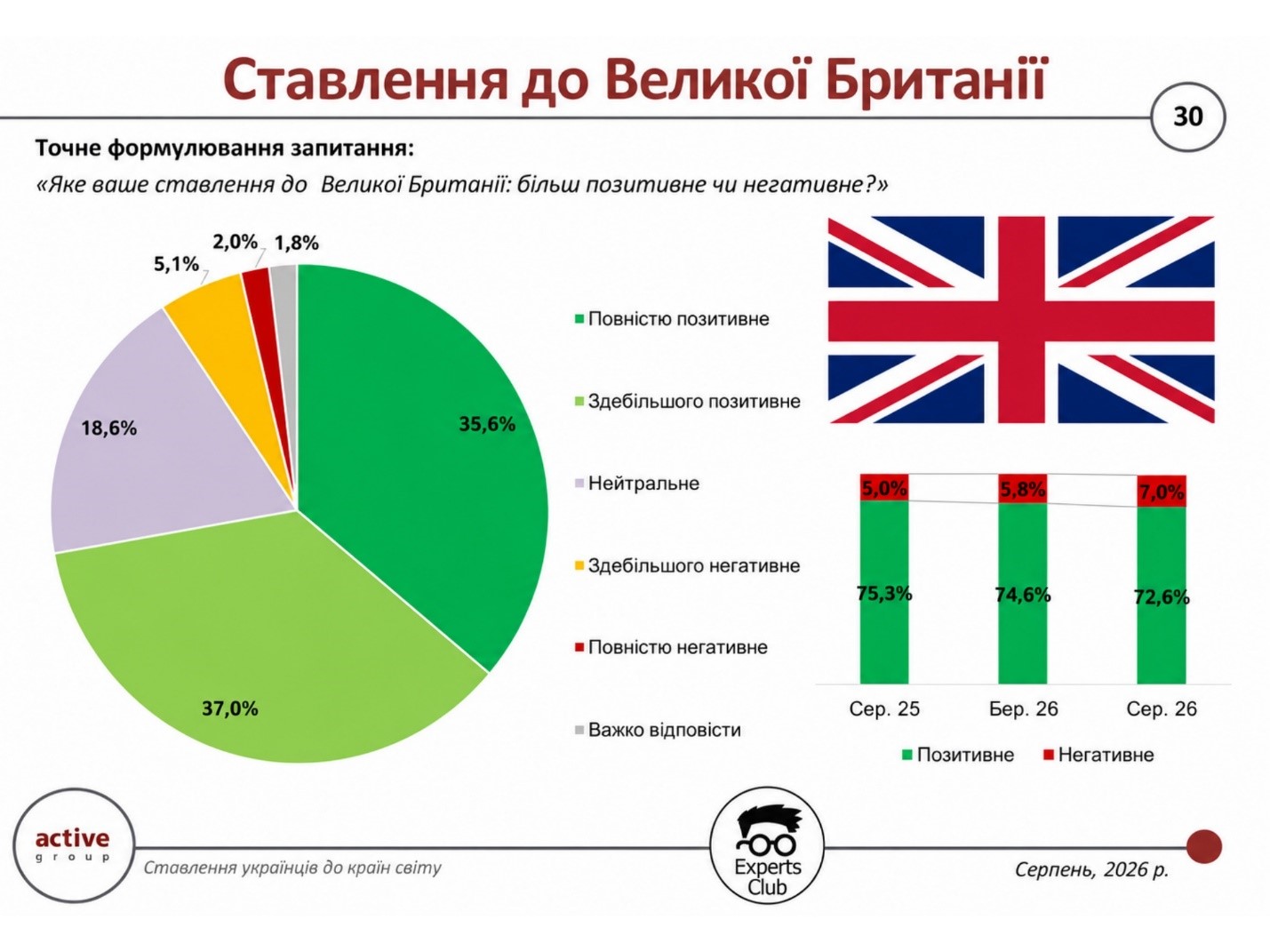
According to the results of the August survey, 35.6% of Ukrainians have a completely positive view of the United Kingdom, and 37% have a mostly positive view. 18.6% of respondents hold a neutral position. 5.1% view the country mostly negatively, 2% view it entirely negatively, and another 1.8% were undecided.
Based on the rounded figures in the table, the balance between positive and negative assessments stands at approximately plus 65.5 percentage points. Thus, positive attitudes outweigh negative ones by more than ten times, and the United Kingdom remains among the countries with the highest level of public favor among Ukrainians.
In March 2026, the overall share of positive assessments of the United Kingdom stood at 74.6%. At that time, 40.3% of respondents described their attitude as entirely positive, while another 34.3% described it as mostly positive. A neutral response was chosen by 18.2% of those surveyed, and negative assessments accounted for about 5.8%.
Thus, over the course of five months, the share of positive responses decreased by approximately 2 percentage points—from 74.6% to 72.6%—while negative responses increased by approximately 1.3 percentage points. The share of neutral responses remained virtually unchanged—18.2% in March versus 18.6% in August.
At the same time, a noticeable shift has occurred in the structure of the positive segment. The share of entirely positive assessments fell from 40.3% to 35.6%, while the share of mostly positive assessments rose from 34.3% to 37%. This suggests a certain softening in the intensity of positive attitudes rather than a fundamental change.
Oleksandr Pozniy, director of the research firm Active Group, had previously linked the high ratings for the United Kingdom to the nature of its relationship with Ukraine.
“Support from London during the war—both political and military—was highly valued by Ukrainian society. The United Kingdom is perceived as a reliable ally,” Pozniy noted.
At the same time, commenting on the trends in subsequent waves of the survey, he emphasized that the ratings for certain countries had deteriorated somewhat compared to the previous survey.
The current results confirm that a high level of positive attitude toward the United Kingdom remains, although it has weakened somewhat compared to March. At the same time, the country remains in the top group of nations in terms of the balance of positive and negative assessments by Ukrainians.
The survey was conducted in August 2026 using self-administered online questionnaires in the SunFlowerSociology panel among 800 Ukrainian citizens aged 18 and older. In the previous survey wave in March, 800 respondents were also surveyed; the sample was representative by age, gender, and region, with a maximum theoretical margin of error of ±3.5 percentage points for indicators at the 50% confidence level.
ACTIVE GROUP, EUROPE, EXPERTS CLUB, international relations, PUBLIC OPINION, SOCIOLOGY, UKRAINE, UNITED KINGDOM

Ukrainians’ attitudes toward Hungary have improved significantly compared to March 2026, but negative views still outnumber positive ones. In August, 22.9% of respondents viewed the country positively, 35.6% negatively, and another 37.4% took a neutral stance. This is evidenced by the results of the third wave of a survey conducted by Active Group and Experts Club, according to the Experts Club Information and Analytical Center. Experts.news
According to the results of the August survey, 6.3% of Ukrainians view Hungary entirely positively, while 16.6% view it mostly positively. A neutral attitude was expressed by 37.4% of respondents. At the same time, 28.8% view the country mostly negatively, 6.8% view it entirely negatively, and another 4.1% were undecided.
The balance of positive and negative assessments in August stands at minus 12.7 percentage points. Based on this indicator, Hungary remains among the countries with a negative balance of public opinion; however, the trend over the past five months has shifted significantly in a positive direction. In the survey’s overall ranking, China had a lower balance in August at minus 25.4 percentage points, and India at minus 14.3 percentage points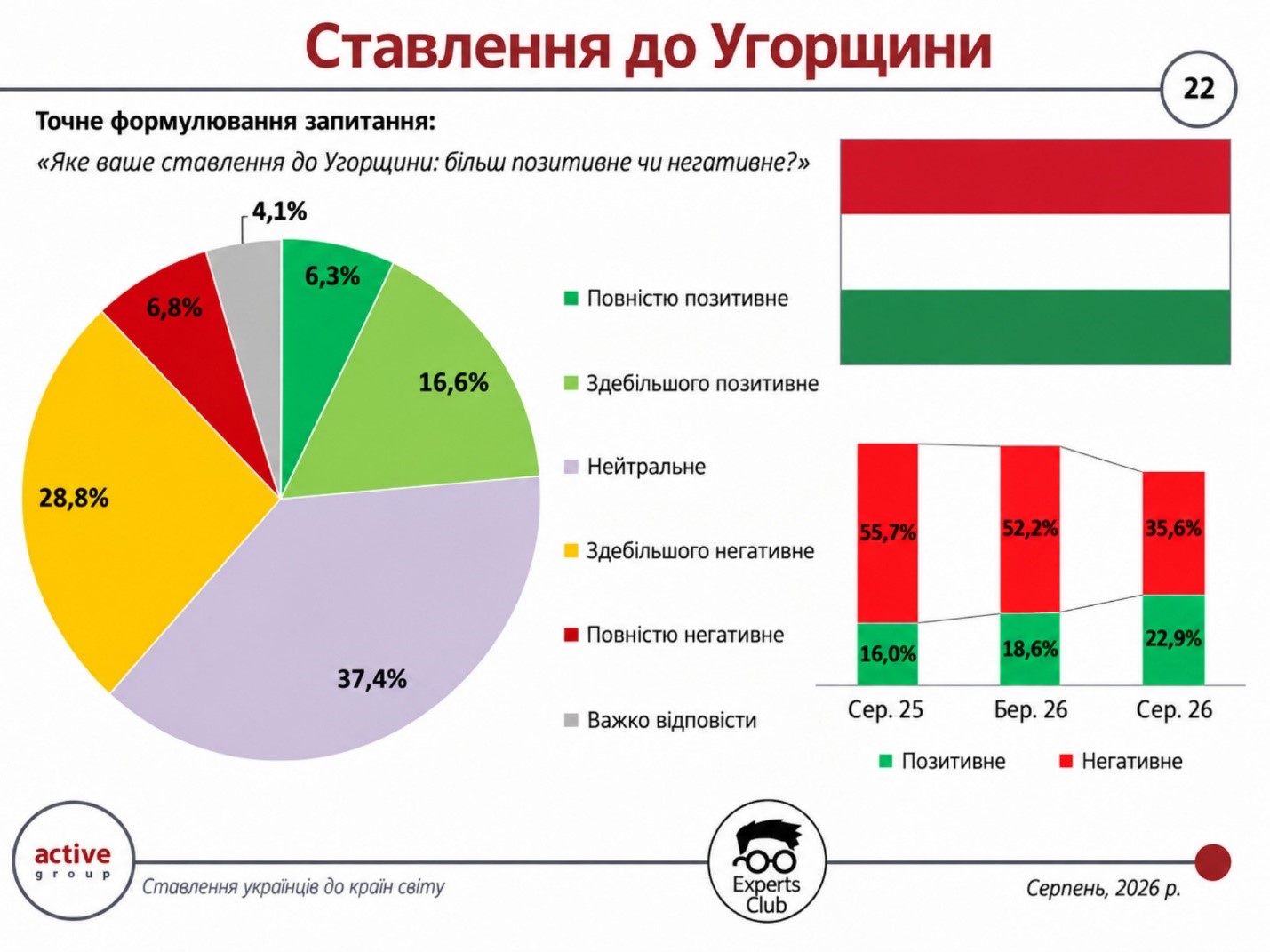
In March 2026, the situation was noticeably more negative. At that time, 4.9% of respondents viewed Hungary entirely positively, and 13.8% viewed it mostly positively—meaning that positive assessments totaled 18.6%. A total of 52.2% of respondents viewed the country negatively: 34.3% viewed it mostly negatively and 17.9% viewed it entirely negatively. 27.3% held a neutral position.
Thus, between March and August, the share of positive assessments increased by 4.3 percentage points—from 18.6% to 22.9%—while negative assessments fell by 16.6 percentage points—from 52.2% to 35.6%. At the same time, the share of neutral responses rose by 10.1 percentage points—to 37.4%.
The shift in the balance is even more pronounced: in March, it stood at minus 33.6 percentage points, and in August, at minus 12.7 percentage points. Thus, the gap between positive and negative assessments narrowed by 20.9 percentage points. At the same time, a significant portion of the former negative sentiment did not directly shift to positive assessments—it was the group of respondents with a neutral attitude that increased significantly.
Oleksandr Pozniy, director of the research company Active Group, commenting on previous waves of the survey, drew attention to the connection between public assessments and international politics as well as perceptions of support for Ukraine.
“This survey confirms the general trend in public sentiment in Ukraine, which has intensified since the start of the full-scale war. Ukrainians clearly associate the support received primarily from European Union countries and the United Kingdom with a positive attitude toward them,” Pozniy noted. Speaking specifically about Hungary, he emphasized: “These results are not surprising—the official rhetoric from Budapest and Bratislava often diverges from Ukraine’s interests and is viewed as pro-Russian, which inevitably influences public opinion.”
The new wave shows a significant softening in assessments of Hungary compared to March. At the same time, it is still too early to speak of a predominantly positive perception: negative responses remain about one and a half times more common than positive ones, and respondents with a neutral attitude now constitute the largest single group.
The survey was conducted in August 2026 using an online self-administered questionnaire via the SunFlowerSociology panel among 800 Ukrainian citizens aged 18 and older. The sample is representative by age, gender, and region; the maximum theoretical margin of error for indicators at the 50% confidence level is ±3.5 percentage points.
ACTIVE GROUP, EUROPE, EXPERTS CLUB, HUNGARY, international relations, Pozniy, PUBLIC OPINION, SOCIOLOGY, UKRAINE



