
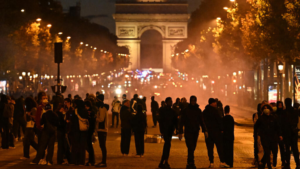
On October 17, 2026, large-scale nationwide protests took place in France against the rising cost of living, increasing fuel prices, and cuts in funding for public services. According to the country’s Ministry of the Interior, approximately 550,000 people took part in the demonstrations, while organizers estimate the number of participants at 800,000, Reuters and the French newspaper Le Monde report.
A total of 110 demonstrations took place across the country. In Paris alone, according to Interior Minister Laurent Nuñez, approximately 110,000 people took to the streets. The protests also spread to Marseille, Lyon, Lille, Bordeaux, Toulouse, and other major cities.
The participants’ main demands included higher wages and pensions, measures to curb food and energy prices, increased funding for education and healthcare, and the preservation of social guarantees.
Trade unions, student organizations, representatives of farmers’ associations, transport sector workers, and activists from the “yellow vests” movement, which emerged in France in 2018 due to rising fuel prices, joined the demonstrations.
The current wave of protests began in September with student demonstrations against teacher shortages, the poor condition of educational institutions, and insufficient government funding for education. Subsequently, the demands expanded to include issues of purchasing power, social inequality, and the government’s economic policy.
Despite the predominantly peaceful nature of the demonstrations, clashes with police, vehicle arson, vandalism and looting of shops, and attacks on administrative buildings occurred in several cities.
In Paris, the most tense situation was observed near Place de la République, where some groups of rioters threw stones and pyrotechnic devices at police officers. Law enforcement officers used tear gas and water cannons. There were also reports of shops being looted and bank branches being damaged.
In Marseille, a group of protesters entered the city council building; in Lyon, a tourist office was set on fire; and in Limoges, a fire damaged the town hall building. Incidents involving damage to administrative buildings were also recorded in other cities.
According to preliminary data from the French Ministry of the Interior, police detained approximately 400 people. Authorities reported injuries among law enforcement officers and civilians. A separate investigation was launched following the serious injury of a minor participating in a protest in Saint-Étienne.
French President Emmanuel Macron condemned the violence and stated the need to hold those responsible accountable. Prime Minister Sébastien Lecornu emphasized that the government would not allow the unrest to be used to exert pressure on state institutions.
At the same time, protest organizers emphasize that the overwhelming majority of participants demonstrated peacefully and demanded a revision of the state’s socioeconomic policy.
The mass demonstrations are taking place against the backdrop of a difficult situation in France’s public finances. According to the draft state budget for 2027 presented on October 1, the government plans to reduce the deficit from a projected 5.4% of GDP in 2026 to 5% of GDP in 2027.
To achieve this goal, overall fiscal consolidation measures totaling €54 billion are envisaged, including €43 billion within the framework of the draft laws on the state budget and the financing of the social security system.
At the same time, the government forecasts a slowdown in France’s economic growth to 0.5% in 2026, with a possible acceleration to 1% in 2027. Public debt servicing costs could rise from €79.2 billion in 2026 to €91.2 billion the following year.
Trade unions fear that measures to limit public spending will increase the burden on households, primarily those with low and middle incomes.
The protests have already caused disruptions to urban public transport, the temporary closure of certain Paris Metro stations, and damage to commercial properties. A final assessment of the economic damage caused by the unrest has not yet been released.
The new wave of social discontent is increasing political tensions in France ahead of the 2027 presidential election and complicating discussions on fiscal policy. Further developments will depend, among other things, on negotiations between the government, trade unions, and representatives of the student movement.
France is the second-largest economy in the eurozone after Germany and one of Ukraine’s largest trade and economic partners in the European Union.
The Embassy of Ukraine in Albania has recommended that Ukrainian citizens postpone visits to the consular section in Tirana, if possible, due to the deteriorating security situation caused by mass anti-government protests and clashes between demonstrators and police.
According to the official website of the diplomatic mission, protests are taking place, among other locations, near the Ukrainian Embassy, creating additional risks for visitors.
“Due to the deteriorating security situation during protests in the city of Tirana and near the Embassy of Ukraine in the Republic of Albania, we recommend taking the current security situation into account when planning a visit to the Embassy’s consular section and, if possible, postponing the visit until the situation stabilizes,” the statement said.
At the same time, the diplomatic mission continues to operate as normal. Ukrainians are advised to observe personal safety measures, avoid places of mass gatherings and monitor announcements from local authorities.
The deterioration of the security situation was caused by a new wave of anti-government protests that began on October 13, 2026, and spread across Tirana and other cities in Albania. Students and young people have been at the center of the protest movement, opposing the high cost of education, unsatisfactory learning conditions, difficulties in finding employment and corruption.
The protest movement had been developing over the preceding months. One of the reasons for the mobilization of activists was disputes surrounding a major tourism investment project on the Albanian coast linked to American investor Jared Kushner, the son-in-law of U.S. President Donald Trump. Environmental organizations and local activists opposed development in protected natural areas, while the government views the development of tourism infrastructure as a source of investment and new jobs.
Subsequently, the protesters’ demands expanded. Demonstrators began demanding the resignation of Prime Minister Edi Rama, measures to combat corruption and reform of the education system. Supporters of the opposition Democratic Party also joined the protests.
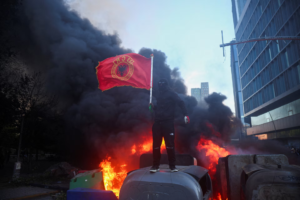
On October 14–15, the protests escalated into large-scale clashes with law enforcement officers. Demonstrators threw stones, used pyrotechnics and set fire to certain administrative and commercial facilities. Police used tear gas and water cannons.
According to Albanian law enforcement authorities, police officers were injured as a result of the unrest, and damage to government institutions, bank branches and private property was recorded. Some protesters were detained.
Prime Minister Edi Rama rejected demands for his resignation and condemned the violent actions. At the same time, he stated that dialogue was necessary regarding the problems that had caused dissatisfaction among young people.
The escalation of the situation has already affected the operation of government institutions and transport services in the Albanian capital. In particular, a scheduled plenary session of parliament was canceled on October 15 due to security risks.
The diplomatic missions of the United States, Italy, the United Kingdom and other European countries also issued warnings to their citizens. The foreign ministries of Bulgaria and Croatia separately recommended that their citizens avoid central areas of Tirana where demonstrations are taking place.
The most tense situation is observed near Skanderbeg Square, Durrës Street, the Ministry of Education and government buildings. Local authorities warn of possible traffic restrictions, street closures and new demonstrations.
For Ukrainians living in Albania or planning trips to Tirana, this means the need to take into account possible transport restrictions and changes in access to government and consular institutions.
Albania is a parliamentary republic and a candidate for accession to the European Union. Prime Minister Edi Rama’s Socialist Party retained power following the 2025 parliamentary elections. Political tensions are unfolding against the backdrop of negotiations on European integration, reform of state institutions and attraction of foreign investment.
According to Serbian Economist, the U.S. Embassy in Pristina has warned citizens about possible large-scale demonstrations on September 16 in downtown Pristina and other major cities in Kosovo. According to the diplomatic mission, the demonstrations could lead to road blockages, major traffic jams, and serious disruptions to public transportation.
U.S. citizens are advised to limit their travel and, if possible, avoid routes passing through areas where protests are taking place. U.S. government employees are advised to avoid any non-essential travel near locations of mass gatherings and not to send their children to school on September 16 due to likely transportation problems.
The heightened security measures are related to the expected September 16 ruling by the Kosovo Chambers in The Hague in the case of former Kosovo President Hashim Thaçi and three former leaders of the Kosovo Liberation Army—Kadri Veseli, Jakup Krasniqi, and Redžep Selimi. All four deny the charges of war crimes and crimes against humanity.
On September 12, a rally attended by thousands took place in Pristina in support of the defendants.
Kosovo declared independence from Serbia in February 2008, but its statehood still lacks universal international recognition. Serbia does not recognize Kosovo’s independence and continues to consider it part of its territory. Kosovo is also not recognized by, among others, China, Russia, and Ukraine, and within the EU—Spain, Greece, Romania, Slovakia, and Cyprus. The European Parliament notes that the issue of Kosovo’s status remains linked to the EU-mediated dialogue between Belgrade and Pristina.
https://t.me/relocationrs/3669
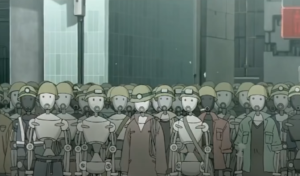
By 2035, Europe may face street protests and conflicts between people and service robots amid mass robotization of the service sector and the displacement of some workers from the labor market, according to a new Europol analytical report, The Unmanned Future(s): The Impact of Robotics and Unmanned Systems on Law Enforcement.
According to the British newspaper The Daily Telegraph, citing the document, Europol estimates that by the mid-2030s, robots and unmanned systems will be widely used in areas such as delivery and cleaning, which could lead to job losses among low-skilled workers from disadvantaged areas and cause protests accompanied by attacks on robots and infrastructure, including medical devices and service machines.
The report emphasizes that the widespread introduction of robotic systems could change not only the labor market, but also the landscape of crime and law enforcement in the EU, including new threats ranging from attacks on service robots to the use of drones for criminal purposes.
At the same time, a number of experts interviewed by the media express doubts about the realism of a “war between humans and robots” scenario in the next ten years, pointing out that the development of regulation and retraining programs could mitigate the social risks of robotization.
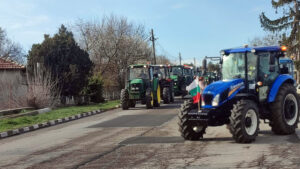
Farmers in Romania and Bulgaria staged protests Friday against the European Union’s decision to exempt agricultural products from Ukraine from duties, which ended up oversaturating local markets and contributing to lower prices, the Associated Press (AP) reported Friday.
“Farmers in Romania and Bulgaria staged protests Friday over the European Union’s stance on excessive supplies of Ukrainian agricultural products that have flooded local markets and weakened prices,” AP reported.
Protests took place in Bucharest and other Romanian cities. In Bulgaria, farmers blocked several border points.
“The new harvest is less than three months away and there is a danger that produce cannot be sold above the production price,” AP quoted Liliana Peron, executive director of the Romanian Farmers’ Association, as saying.
Polish farmers have also protested in recent weeks over duty-free supplies of Ukrainian grain to European markets adopted by the EU, forcing the country’s Agriculture Minister Henrik Kowalczyk to resign.
Last year, the EU abolished customs tariffs for Ukraine for freer grain shipments.
On Monday, the European Commission said it wanted to help the Ukrainian population by organizing the export of Ukrainian grain, but it is making sure that the EU market is not hit too hard by Kiev’s support measures.
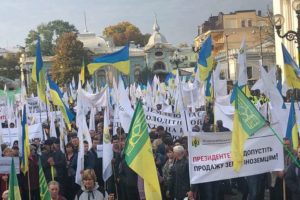
Farmers held several protests on roads in various regions of Ukraine on Monday, the police ensured public order and prevented blocking of traffic on roads, the National Police told Interfax-Ukraine.
“Farmers are staging protests. They are not numerous so far. The police are protecting public order and preventing blocking of traffic on roads,” the police said and added that law enforcers explained the protesters that blocking of traffic on roads was illegal.
The National Police added that traffic on roads was only constrained and in general the situation was peaceful.
As reported, protesters blocked the Kyiv-Chop road near the Mali Pidlisky village, Lviv region. Around 100 farmers continuously walked the pedestrian crossing in protest against the government’s intention to cancel a moratorium on sale of farming land. The protesters let vehicles with children pass, however a significant traffic jam appeared on the road.
Earlier, the All-Ukrainian Agrarian Council, which organized the protest, reported that it was planning to stage protests on M05 road near Zhashkiv and E95 road near Uman (Cherkasy region), M19 road in Chortkiv district (Ternopil region), M12 road 10 kilometers to Novoarkhanhelsk (Kirovohrad region), and M14 belt road in Mykolaiv.
The council also said that it was planning to stage protests on E50 road in Prybuzke (Khmelnytsky region), the road near Pysarivka in Vinnytsky district, the road Makhnivka in Koziatynsky district, P36 highway in Shpukiv, Tulchynsky district (Vinnytsia region), M21 highway in Osykove, Berdychivsky district (Zhytomyr region), M05 and E95 highways in Demydove (Odesa region), M03 highway in Maryanivka, Velykobachahansky district, M03 road in Chutove (Poltava region), M19 and T0311 highways in Verbka, Volodymyro-Volynsky district (Volyn region), M06 road in Diadkovychi (Rivne region), H17 road in Mali Midlisky, Zhovkovsky district, Lviv region.



