
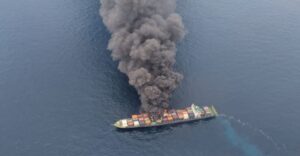
Turkey has called on Russia and Ukraine to agree to a moratorium on attacks on ships and maritime-related facilities in the Black Sea amid a sharp increase in attacks on the commercial fleet.
Turkish Foreign Minister Hakan Fidan stated on August 8 that Ankara is proposing that the parties establish a special mechanism to halt mutual attacks in the Black Sea.
“We have called on both sides to establish a mechanism for declaring a moratorium,” Fidan said in an interview with the Turkish state news agency Anadolu. According to him, Ukraine had previously put forward a similar proposal, after which Turkey conveyed it to the Russian side and is now awaiting Moscow’s response.
The Turkish foreign minister noted that the war has effectively spread to the entire Black Sea. While the attacks initially targeted mainly military ports and warships, commercial vessels are now increasingly coming under fire.
Ankara is particularly concerned about attacks on vessels linked to Turkey—those flying the Turkish flag, owned by Turkish companies, or carrying Turkish crew members.
According to Fidan, Russia and Ukraine are also attacking logistics facilities of strategic importance to the opposing side, and the further escalation of such actions is becoming “extremely dangerous.”
Ankara’s statement came after a sharp deterioration in the security situation for commercial shipping.
According to data from Ukraine’s Ministry of Community and Territorial Development, as cited by Reuters, in July alone, Ukraine recorded 35 attacks on ships in ports, 22 attacks on ships at sea, and 67 strikes on port infrastructure.
By comparison, Reuters counted 14 attacks on ships in the Ukrainian sector of the Black Sea throughout all of 2025. At the same time, Ukraine has intensified its strikes on tankers linked to the Russian oil trade. Both Moscow and Kyiv claim that their targets are facilities associated with military activities.
The escalation is already affecting global trade in grain and oil. More than 90% of the country’s agricultural exports pass through Ukrainian Black Sea ports, while the Russian ports of Novorossiysk and Tuapse remain major export hubs for grain and petroleum products.
The cost of war risk insurance for ships calling at Black Sea ports has risen to approximately 2% of a ship’s value, up from about 1% two weeks earlier, while the cost of chartering oil tankers on certain routes has exceeded $300,000 per day.
Amid rising risks, reports emerged that Turkey had begun restricting the passage of certain commercial vessels into the Black Sea. However, on August 9, two Turkish officials told Reuters that traffic through the Bosphorus and the Dardanelles was proceeding as usual. Ankara has indeed implemented temporary additional security measures, but these do not mean that the straits are closed to commercial shipping.
Passage is governed by the 1936 Montreux Convention, which grants Turkey control over the Bosphorus and the Dardanelles and special powers regarding military vessels, while ensuring freedom of passage for civilian vessels.
For Ankara, the security of the Black Sea is of fundamental economic importance. Large volumes of Russian and Ukrainian agricultural products, oil, and petroleum products pass through this region, and Turkish shipowners are actively engaged in these routes.
Since the start of the full-scale war, Turkey has maintained contacts with both Kyiv and Moscow and has sought to play the role of mediator. Ankara has not joined Western sanctions against Russia, yet it continues to cooperate with Ukraine and has repeatedly acted as a mediator on issues related to Black Sea shipping.

French Justice Minister Gérald Darmanin has proposed imposing a temporary three-year moratorium on legal immigration, stating that the country has reached the limits of its capacity to integrate and assimilate newcomers.
According to Le Parisien, citing Darmanin’s interview with the Journal du Dimanche, the minister believes it is necessary to “put an end to immigration as it exists today.” He proposes suspending legal immigration for three years and reforming the Constitution to introduce binding, rather than merely advisory, quotas on the entry of foreigners.
Darmainin had previously advocated for a temporary suspension of regular immigration for two to three years. This would apply to labor migration and family reunification, though exceptions could be maintained for doctors, researchers, and certain categories of students. Following the moratorium, the minister proposed transitioning to a system of immigration quotas, the volume of which would be determined after consultation with citizens.
Darmann’s proposal has not yet been adopted as state policy. Its implementation would require a political decision, a legislative process, and, according to the minister himself, a constitutional amendment. However, the initiative signals an intensification of the migration debate in France ahead of the 2027 presidential election.
Potential restrictions could affect several key channels of legal entry: labor migration, certain student programs, and family reunification. At the same time, France faces a shortage of foreign workers in medicine, science, certain service sectors, and professions with labor shortages, making a potential moratorium politically and economically contentious.
The issue of migration remains a central one in French domestic politics. According to Le Monde, in 2025 the country issued over 380,000 initial residence permits to citizens of non-EU countries, an 11% increase from the previous year. About half of the new permits were issued to students and for humanitarian reasons: international students received about 118,000 permits, humanitarian categories—about 92,000, family migration accounted for about 91,000, while professional immigration fell by nearly 13%—to approximately 51,000 permits.
Historically, the overall structure of immigration to France has been dominated by people from North Africa and Southern Europe. According to data cited by The Connexion based on INSEE, among immigrants by country of birth, the largest groups are those from Algeria—12.4%, Morocco—11.7%, Portugal—7.3%, Tunisia (4.9%), Italy (3.6%), Turkey (3.4%), and Spain (3.1%). These seven countries account for 46.4% of all immigrants in France.
Ukrainians occupy a distinct place in France’s current migration landscape as recipients of temporary protection following the start of Russia’s full-scale war against Ukraine. According to Eurostat, as of the end of March 2026, 4.33 million Ukrainian citizens and residents were granted temporary protection in EU countries. The largest countries hosting refugees were Germany, Poland, and the Czech Republic. Eurostat’s country-specific tables for France as of March 2026 indicate approximately 70,700 people under temporary protection.
For France, a potential moratorium would mark one of the most drastic shifts in migration policy in recent years. For businesses, it could mean more difficult access to foreign labor; for universities, the risk of a reduction in international enrollment; and for family-based immigration programs, additional uncertainty. At the same time, Ukrainians under temporary protection are governed by a separate European regime that operates within the framework of EU decisions and is not considered ordinary labor or family-based immigration.
US President Donald Trump has lifted the moratorium on the issuance of new liquefied natural gas (LNG) export licenses imposed by his predecessor Joe Biden. The US Department of Energy reported that it is returning to the normal regime of reviewing export applications in accordance with Trump’s order.
“The Department has been instructed to resume reviewing applications for the export of US LNG to countries that do not have a free trade agreement with the United States. The proper review of export applications is required by law and must be carried out accordingly,” the Energy Ministry said in a statement.
In December, the agency published the results of a study on LNG exports and set February 18 as the deadline for public comments on it. Now the Ministry of Energy has decided to extend the comment period until March 20, 2025.
Earlier, the Experts Club think tank, Brian Mefford and Maxim Urakin, released a video analysis on what changes are expected to occur in US domestic and foreign policy under Trump, the video is available on the Experts Club YouTube channel – https://youtu.be/W2elNY1xczM?si=MM-QjSqGce4Tlq6T
EXPERTS CLUB, EXPORT, GAS, LICENSE, MORATORIUM, TRUMP, URAKIN, Меффорд
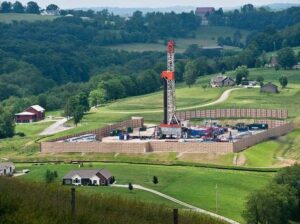
British Prime Minister Rishi Sunak intends to return the moratorium on hydrocarbon production by hydraulic fracturing (HF) in England, writes the Financial Times newspaper.
The ban, in place since November 2019, was lifted by the Liz Truss government in September. Then Truss explained this decision by the fact that the energy security of the country should become an absolute priority.
Sunak, who spoke in the House of Commons on Wednesday, said he supported the Conservative Party’s 2019 public declaration saying fracturing in England would not be allowed “until science clearly shows it can be done safely.” “.
The UK has halted hydraulic fracturing after a series of tremors were recorded in the country’s only shale well near Blackpool in northwest England.

Associations of Ukrainian manufacturers call on the Ministry of Infrastructure of Ukraine to impose a moratorium on raising tariffs for rail freight traffic for the period of martial law and six months after its termination.
“There was no real discussion between shippers and the carrier about a compromise solution to increase tariffs – we were simply presented with a fact. When Ukrzaliznytsia announced the discussion of raising tariffs by 70%, the order to increase tariffs had already been signed. We had specific proposals: to introduce a moratorium for the period of martial law and six months after it on the increase in tariffs within the borders of Ukraine, and all related services,” Liudmyla Kripka, the Executive Director of the Ukrcement Association, said at a press conference at the Interfax-Ukraine agency on Thursday.
According to her, Ukrzaliznytsia did not take into account the transportation of raw materials, coal, fillers in the infrastructure component of transportation, and did not include the tariff distance, which is why the cost of the final product will increase more significantly than in the carrier’s forecast.
“The impact on the cost of the final product will be much higher than presented by Ukrzaliznytsia. On the example of cement: for us, the main raw material is limestone, and there the highest figure is 55%. Other industries fell into the values of 0-13%,” she said.
In addition, from August 1, the calculation for the use of wagons will be changed to the actual one instead of the planned one, which will also increase the costs of shippers due to delays in border crossings, the expert noted.
Oleh Misiuk, a representative of the Ukrainian Lime Industry Association, pointed out that the decision to raise tariffs would have a significant impact on the lime market, which is already undergoing a significant decline in production volumes.
“Before the war, the cost of delivery from the west of Ukraine to Dnipro was UAH 400 per tonne, now it is UAH 650. With a producer price of up to UAH 300/tonne, the consumer overpays another UAH 200-250 from July 1. In general, lime production has fallen from the pre-war 1.2 million tonnes per month to 350,000 tonnes in May-June. The decision of Ukrzaliznytsia to increase tariffs will hit the market even harder, we expect a fall by another 30-40%,” he said.
MISIUK, MORATORIUM, RAIL FREIGHT, TARIFF, UKRAINIAN PRODUCERS ASSOCIATIONS, UKRCEMENT, UKRZALIZNYTSIA, КРИПКА
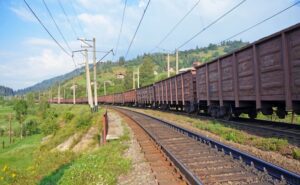
Associations of Ukrainian manufacturers call on the Ministry of Infrastructure of Ukraine to introduce a moratorium on raising tariffs for rail freight for the period of martial law and 6 months. after its termination.
“There was no real discussion between shippers and the carrier about a compromise solution to increase tariffs – we were simply presented with a fact. When Ukrzaliznytsia announced the discussion of raising tariffs by 70%, the order to increase tariffs had already been signed. We had specific proposals: to introduce a moratorium for the period of martial law and 6 months after on the increase in tariffs within the borders of Ukraine, and all related services,” said Ludmila Kripka, executive director of the Ukrcement association, at a press conference at the Interfax-Ukraine agency on Thursday.
According to her, UZ did not take into account the transportation of raw materials, coal, fillers in the infrastructure component of transportation, and did not include the tariff distance, which is why the cost of the final product will increase more significantly than in the carrier’s forecast.
“The impact on the cost of the final product will be much higher than presented by UZ. On the example of cement: for us, the main raw material is limestone, and there the highest figure is 55%. Other industries fell into the values of 0-13%,” Kripka said.
In addition, from August 1, the calculation for the use of wagons will be changed to the actual one instead of the planned one, which will also increase the costs of shippers due to delays in border crossings, the expert noted.
Oleg Misyuk, a representative of the Ukrainian Association of the Limestone Industry, pointed out that the decision to raise tariffs would have a significant impact on the lime market, which is already undergoing a significant decline in production volumes.
“Before the war, the cost of delivery from the west of Ukraine to the Dnieper was 400 UAH per ton, now it is 650 UAH. With a producer price of up to 300 UAH / t, the consumer overpays another 200-250 UAH from July 1. In general, lime production has fallen from pre-war 1, 2 million tons per month to 350 thousand tons in May-June. The decision of UZ to increase tariffs will hit the market even harder, we expect a fall by another 30-40%,” he said.
The expert also noted that the increase in tariffs may put Ukrainian lime producers in a non-competitive position in front of foreign companies interested in entering the Ukrainian market.
At the same time, the increase in the cost of logistics for grain exporters, coupled with the blocking of Ukrainian ports, can play a decisive role in the bankruptcy of most agricultural producers, says Nikolai Gorbachev, president of the Ukrainian Grain Association.
“With this increase in tariffs, the logistics to the port of Constanta in Romania is already $180. The price for a loaded vessel is about $240 per ton. Thus, the agricultural producer needs to sell barley from the elevator for $50-60. The cost of growing it is more than $160. He will not receive even a third of his costs, so he will not carry out any sowing campaign in August. This will lead to the bankruptcy of most agricultural producers,” he said.
The Ukrainian Association of Ferroalloys and Other Electrometallurgical Products also opposed the increase in tariffs.
“Ferroalloys are cargo of the third tariff class, and are transported by rail only accompanied by guards paid by the hour. And given the change in the logistics of transportation due to the war, cargo in some directions is on the road 9-10 times longer than before the war” – explained the head of the association Sergey Kudryavtsev.
Meanwhile, transportation of ferroalloy products was cost-effective for UZ even with tariffs before the increase, he added.
Metallurgical enterprises are currently not operating at full capacity, many of them have been stopped and destroyed, while they continue to pay wages to workers, said Alexander Kalenkov, head of the Ukrmetallurgprom association.



