
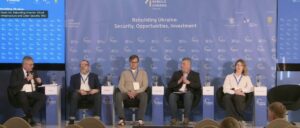
At the Rebuilding Ukraine: Security, Opportunities, Investments forum in Bucharest, participants in a panel discussion on the role of the private sector in Ukraine’s reconstruction emphasized that attracting private capital is critical for the implementation of large-scale projects, but its participation is impossible without effective mechanisms for financing, insurance, and reducing investment risks.
The panel “Private Sector – A Key Actor in the Reconstruction of Ukraine. Financing and Insurance Instruments” was moderated by Victor Srayer, managing partner of Otto Broker (Romania). The discussion was joined by Volodymyr Tsabal, secretary of the Verkhovna Rada Committee on Budget, and Susan E. Walton, senior advisor on new markets – global risks and sustainability (USA) Susan E. Walton, CEO of BCR – Romanian Commercial Bank Sergiu Manea, Director of Legal and External Relations at Vodafone Romania Alexandra Olaru, and JBIC Regional Head for EMEA, Resident Executive Officer of the Japan Bank for International Cooperation Takayuki Sato.
Participants noted that the private sector, both Ukrainian and foreign, faces a double challenge. Ukrainian companies have limited access to debt financing due to high interest rates, war risks, and domestic capital market constraints. Foreign investors, in turn, are forced to take into account political and military risks, as well as regulatory peculiarities of working in Ukraine.
The main solutions identified were the use of blended financing instruments, the involvement of international financial organizations to cover part of the risks, and the creation of a guaranteed framework by the state and partners that makes projects “bankable” for commercial structures. “For private capital to enter the reconstruction process, investors need to clearly see which risks are assumed by the state and international financial institutions, and which are assumed by themselves. Without this, projects either do not start or remain at the conceptual level,” Manea noted.
Special attention was paid to the role of political and military risk insurance, as well as the importance of transparent information and local partner networks. According to the speakers, successful project implementation requires strategic coordination between government agencies, donors, and private businesses, particularly in terms of selecting priority projects, structuring agreements, and monitoring their implementation.
The panel participants also emphasized that reconstruction is impossible without reliable digital and energy infrastructure. The experience of neighboring countries that have undergone large-scale infrastructure programs can be used to implement practical solutions in Ukraine. “Private capital, combined with government support and good governance, can significantly accelerate post-war recovery. The state’s task is to create predictable rules of the game and an institutional environment that will make this possible,” Walton concluded.
Following the discussion, participants concluded that the private sector has significant potential in rebuilding Ukraine, but that realizing this potential depends on the availability of financial instruments, effective insurance protection mechanisms, and coordinated action between public and private actors.
The forum “Rebuilding Ukraine: Security, Opportunities, Investments” is being held on December 11-12 in Bucharest under the auspices of the Romanian Ministry of Foreign Affairs and the Ukrainian Ministry of Foreign Affairs and is organized by the New Strategy Center. According to the organizers, more than 30 panel discussions and parallel sessions are planned over two days with the participation of representatives of governments, international organizations, the private sector, financial institutions, and experts from Europe, North America, and Asia. The topics of the panels cover security and defense, infrastructure, financing and investment, green energy, digitalization, human capital, and cross-border cooperation.

On December 11–12, Bucharest will host the forum “Rebuilding Ukraine: Security, Opportunities, Investments,” organized by the Center for New Strategies under the patronage of the Romanian Ministry of Foreign Affairs and the Ukrainian Ministry of Foreign Affairs. This event, which is being held for the second time, brings together officials, representatives of international organizations, the private sector, international financial institutions, and experts from various fields, such as defense, finance and banking, energy, infrastructure, digitalization, cybersecurity, and agriculture. The conference will be attended by numerous representatives of Ukrainian regional authorities who are directly involved in the planning and implementation of recovery projects.
Participants will gain a deeper understanding of Romania’s role in the recovery process in Ukraine, especially in the southern regions of the country located near Romania, as well as in issues related to connectivity, energy, and cross-border cooperation projects that have a positive economic impact on communities in both Romania and Ukraine. Over the course of two days, the event will feature more than 30 panel discussions and parallel sessions with guests from Europe, North America, and Asia. The discussions will address key elements of Ukraine’s reconstruction: security and defense, infrastructure, communications, financing and investment, green transition, energy security, digitalization, human capital, agriculture, and cross-border cooperation.
The panel discussions will address important topics such as:
● Regional security architecture and possible diplomatic developments;
● Lessons learned from the war in Ukraine and how they can be applied by Ukraine’s allies;
● Cooperation for the development of projects in the defense industry;
● Connectivity projects between Romania, Ukraine, and the Republic of Moldova;
● Financial instruments, guarantees, investments, and the role of the private sector;
● The strategic role of the Danube in Ukraine’s reconstruction;
● Black Sea ports;
● Energy sustainability, rare minerals, and the future of the green transition;
● Cloud infrastructure, advanced digitalization, and cybersecurity;
● Reintegration of displaced persons, veterans, and community recovery;
● Ukraine’s integration into the EU and necessary reforms;
● The role of local communities and minorities in cross-border cooperation.
The conference provides a unique platform for establishing links between decision-makers and the business community, financial institutions, local authorities, and experts from various fields, facilitating the creation of concrete partnerships and sustainable solutions for Ukraine’s recovery. Simultaneous interpretation in Romanian, Ukrainian, and English will be provided during the conference, as well as online streaming.
Media partner of the forum: Interfax-Ukraine news agency
Event website: https://reconstruct-ukraine.ro/
On November 19, Deloitte Ukraine will hold its 10th anniversary Conductors of Change Forum in Kyiv, an event that has been bringing together leaders from business, government, the public sector, and culture for ten years to jointly seek solutions that will shape the country’s future.
The theme of the Forum is “10 Years: Retrospective/Perspective.”
The discussions will focus on
Retrospective shaping the future
What has changed in Ukrainian society, the economy, and state institutions over the last decade? How can the experience of past years become the foundation for development in the next decade?
Moderator: Serhiy Kulyk, Managing Partner, Deloitte Ukraine
The power of culture: a nation that has redefined itself
Can our time be called a true cultural renaissance? How is a new Ukrainian identity being formed and what role can business play in this process?
Moderator: Andriy Bulakh, Deputy Chairman of the Board, MHP
The future through our own eyes
What challenges do Ukraine and Europe face—security, energy independence, demographics, technology—and what innovative solutions can form the basis of a sustainable economy?
Moderator: Yegor Grygorenko, Partner, Deloitte Ukraine
The architecture of new leadership—a thousand-step journey
What kind of leadership is needed to take responsibility for the reconstruction, modernization, and integration of Ukraine into the global world?
Moderator – Roman Bondar, CEO of Korn Ferry Ukraine
Speakers at the event include: Serhiy Chernenko, Chairman of the Board of PUMB; Oleksandr Bogutsky, CEO of Starlight Media; Natalka Vorozhbit, playwright, screenwriter, and director; Aivaras Abromavicius, Chairman of the Supervisory Board of the Ukrainian Corporate Governance Academy (UCGA); Vladislav Rashkovan, Deputy Executive Director of the IMF; Serhiy Zhadan, writer and musician; Oleksandr Khomenko, director, co-founder of the MUR cultural association; Oksana Syroid, officer of the 2nd Corps of the National Guard of Ukraine “Charter,” associate professor at the Kyiv School of Economics, and others.
For more information about the program, visit the Forum website: https://delo.tt/61827GWIk.
Event partners: MHP, FUIB, Squad, Korn Ferry, Maison Castel, and the social enterprise POI “Inclusively Friendly,” which helps organize the event space to maximize accessibility.
Social component: 10% of the cost of tickets and partner contributions will be directed to the Children of Heroes Charitable Foundation, which provides assistance to children who have lost one or both parents as a result of the war.
Media accreditation is open until November 17. Please send your requests to Anastasia Pratsyuk, PR specialist at Deloitte Ukraine (apratsiuk@deloittece.com).

On July 11, 2025, a forum organized by MC-Bauchemie was held in Kyiv.
It brought together experts in the production, design, testing, and certification of concrete and reinforced concrete products, as well as representatives of other interested organizations: large contractors, manufacturers of cement, crushed stone, laboratory equipment; consulting companies, and even the German-Ukrainian Chamber of Commerce and Industry.
The program was packed, and the discussions were focused and insightful, revolving around the adaptation of European standards, the durability of structures, and the introduction of the latest technologies in Ukraine. The event was opened by Artem Pryimachenko, Director of the Ukrainian branch of MC-Bauchemie, who emphasized the importance of synchronizing Ukrainian standards with European norms—not only as a step towards harmonization, but also as a tool for improving the quality and durability of infrastructure facilities.
One of the key topics of the forum was the conformity assessment of concrete products in accordance with the Law of Ukraine “On the Provision of Construction Products on the Market,” which implements the provisions of European Regulation 305 and lays the foundation for the free movement of construction products on the market. Lyudmila Kripka, Executive Director of the Ukrcement Association, spoke on this topic. In her presentation, she shared the cement industry’s experience in implementing EN standards and preparing manufacturer’s declarations. Lyudmila outlined in detail the challenges faced by Ukrainian manufacturers in adapting to the requirements of the Regulation, in particular regarding labeling, conformity assessment, and the implementation of a system for assessing the technical characteristics of products.
Lyudmila Kripka paid special attention to the targeted use of different classes of cement according to EN in road construction, namely the introduction of roller-compacted concrete (RCC) technology in Ukraine.
During the forum, participants had the opportunity to delve into technical aspects:
All these issues are critical in post-war reconstruction, where reliability, durability, and compliance with modern requirements are paramount.
The final chord was a panel discussion that brought together leading industry experts. They discussed pressing issues facing concrete product manufacturers, including:
During the discussion, it was repeatedly stated that the reconstruction of Ukraine is not only a question of materials, but also of a systematic approach to standardization, conformity assessment, and technical support.
The forum clearly demonstrated that the Ukrainian industry is ready for change, but needs support in terms of standardization, training, and systematic interaction with government agencies.
MC-Forum 2025 was yet another confirmation that Ukraine’s cement and concrete industry is not only flexible to innovation but also active in European integration processes. Thanks to players such as the Ukrcement Association, MC-Bauchemie, and specialists with technical backgrounds, the sectoral transition to European standards is taking place systematically, with an understanding of all the technical nuances.
On June 18-19, 2025, Kyiv will host InnoTechEnergy, an exhibition and forum for innovative solutions in thermal and alternative energy, according to Energoreforma.
As noted in the event announcement, the exhibition will showcase the latest equipment, technologies, and solutions for modernizing heating systems, decentralized generation, renewable energy sources, energy efficiency, and digital transformation in the energy sector.
The exhibition will feature the Future Energy Forum, an innovation forum on the future of thermal and alternative energy.
The forum will serve as a platform for discussing key issues and finding effective solutions to today’s challenges.
The main focus will be on the following key areas:
The event organizers plan to bring together Ukrainian and international companies, representatives of municipalities, communities, relevant ministries, experts, and businesses to demonstrate and discuss the challenges and prospects for the development of key trends in the energy sector.
Registration for exhibition events: https://ite.ticketforevent.com/
For questions regarding participation in events and cooperation:
+38(067) 37-57-637
+38(095) 37-57-637
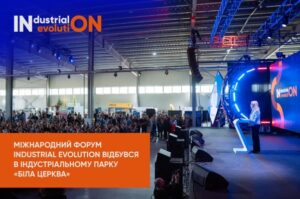
On April 24, Bila Tserkva Industrial Park hosted the international forum “Industrial Evolution: Production turns on the economy” was held in Bila Tserkva Industrial Park. The event brought together more than 1000 participants – representatives of Ukrainian manufacturing companies, the government, international partners and investors – to discuss how to restore Ukraine’s industry, attract investment and launch a new industrial economy.
In four panel discussions, leading experts discussed key issues of industrial development in Ukraine: prospects for industrial growth, the role of industrial parks, investment mechanisms, innovation, and effective interaction between the state and business.
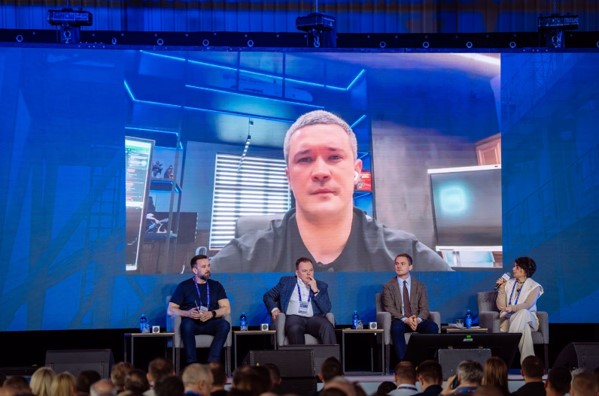
The first panel discussion “The Road to a Strong Economy” was attended by Mykhailo Fedorov, Vice Prime Minister of Ukraine for Innovation, Education, Science and Technology Development and Minister of Digital Transformation of Ukraine, Viktor Mykyta, Deputy Head of the Presidential Office, Ruslan Kravchenko, Head of the State Tax Service, and Kostiantyn Yefymenko, President of Biopharma Plasma.
“If we want to see Ukraine among the top 30 countries in the world in terms of GDP, we must develop technologies and innovations: microelectronics, chips, drones and other breakthrough areas. That is why we have created the WINWIN Strategy for Digital Development of Innovations in Ukraine until 2030, which unites 14 areas – from fintech to AI. We are already working on various tools to create conditions for the development of innovations in Ukraine: incentives, regulatory fast tracks, access to financing, and mechanisms for opening new markets. After all, digitalization, technology, and innovation should become the foundation of our economic development,” said Mykhailo Fedorov.
In his speech, Vasyl Khmelnytsky, the initiator of the forum and founder of UFuture holding, emphasized that industrial parks are the key to economic growth and the return of Ukrainians home.
“It is possible to bring our people back from abroad. We need to create competitive opportunities in Ukraine – quality education, jobs, decent wages, living standards and services. An industrial park is just such a point of economic growth and a magnet for innovation, investment and talent. The support of industrial parks by the state and local communities is an investment. Last year, we transferred UAH 18 million in taxes to the local budget, this year – UAH 25 million, and next year – UAH 50 million. In 20 years, we will have paid more than a billion. And this is only the local level. Today, we are laying the foundation for the future 15-20 years ahead,” Vasyl Khmelnytsky said.
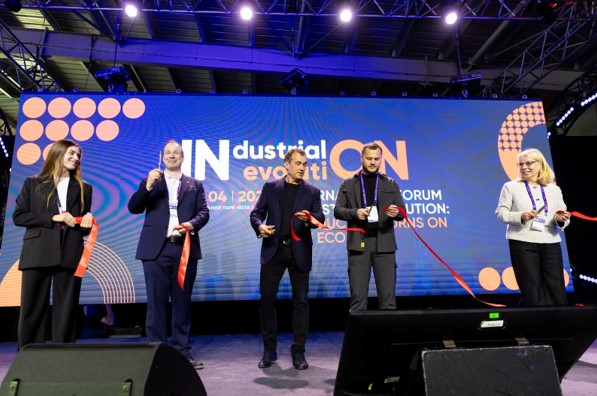
The forum also saw the opening of a new plant by Peikko Group (Finland), a leading European manufacturer of solutions for monolithic and prefabricated construction. The enterprise, built on the territory of the industrial park, is an example of foreign business confidence in the potential of Ukrainian industry. The launch of the plant means new jobs, technology transfer and an additional impetus for the development of the production cluster in Bila Tserkva.
“We are investing in Ukraine because of your talent and excellent engineering skills. You have a lot of good know-how and production, a lot of demanding consumers, which is good. And you have a sales market that functions in such a difficult environment, but still works. And this is enough for us to open our production here. It was a risk worth taking. The question was not “why in Ukraine?” but “why not in Ukraine?” And I could not find any reasons why not. That is why we, a European company, are here today. And I would like to emphasize that Ukraine’s place is in Europe,” said Topi Paananen, CEO of Peikko Group, at the ribbon-cutting ceremony for the plant’s opening.
In addition, Minister of Community and Territorial Development Oleksiy Kuleba and Viktor Mykyta met with business representatives from different regions during the forum. The conversation was dynamic and constructive.
The event featured a Made in Ukraine expo zone, which presented modern technologies and innovations that are already changing production, urban infrastructure and industrial logistics. Among the solutions presented were automation equipment, construction and infrastructure equipment, machinery for the utility sector, systems for electric mobility, welding, ventilation and material processing, as well as components for industrial and automotive electronics.
The forum showed that despite the war, the Ukrainian industry is not stopping, but is looking for ways to develop and partner. The event has become a space for networking, presenting solutions and finding common ground between business, investors and the government.



