
According to Experts Club, nearly half of Ukrainians—49.7%—had a positive view of Greece in August 2026, while only 3.9% of respondents expressed a negative view. At the same time, 44.2% of those surveyed held a neutral position. Compared to March, positive assessments have declined slightly, but the overall balance of attitudes remains distinctly positive, reports the Experts Club Information and Analytical Center.
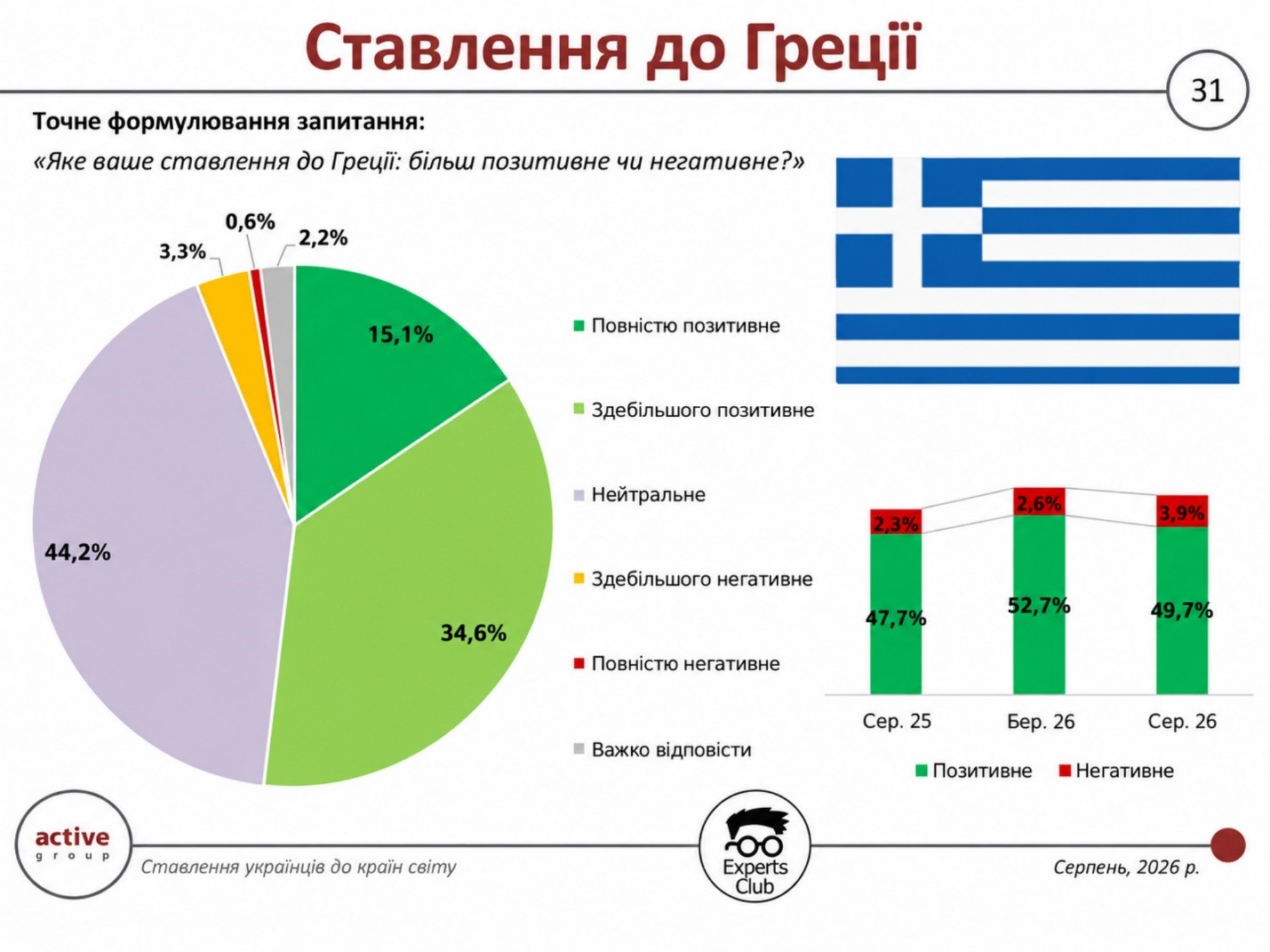
According to the results of the August survey, 15.1% of Ukrainians have a completely positive attitude toward Greece, and 34.6% have a mostly positive attitude. 44.2% of respondents have a neutral attitude. 3.3% view the country mostly negatively, 0.6% completely negatively, and another 2.2% were undecided.
The balance between positive and negative assessments stands at plus 45.8 percentage points. Thus, positive attitudes toward Greece outnumber negative ones by nearly 13 to 1; however, a large proportion of neutral responses remains a distinctive feature of public perception of the country.
In March 2026, 52.7% of respondents had a positive attitude toward Greece: 16.8% were completely positive and 35.9% were mostly positive. A neutral stance was held by 43.1% of those surveyed, while negative assessments accounted for about 2.6%.
Thus, over the course of five months, the share of positive assessments decreased by 3 percentage points—from 52.7% to 49.7%. Negative attitudes increased by approximately 1.3 percentage points—to 3.9%—while neutral attitudes rose by 1.1 percentage points. The balance between positive and negative attitudes, respectively, narrowed from approximately plus 50.1 to plus 45.8 percentage points.
Despite this trend, there has been no sharp shift in attitudes toward Greece. More than nine out of ten respondents view the country positively or neutrally, while the share of unequivocally negative responses remains negligible.
Oleksandr Pozniy, director of the research firm Active Group, commented on the results of the previous wave, drawing attention specifically to the significant proportion of neutral assessments regarding Greece.
“The results regarding Greece show that Ukrainians do not form strong opinions where interaction is less intense. In such cases, we see a combination of a moderately positive attitude with a large proportion of neutral responses. This means that the country’s image is still in the process of forming,” Pozniy noted.
The new wave of the survey generally confirms this pattern: the neutral group not only remains very large but has also increased slightly. At the same time, negative attitudes account for less than 4% of respondents, suggesting that Ukrainian society continues to hold a predominantly positive-neutral perception of Greece.
The survey was conducted in August 2026 using self-administered online questionnaires in the SunFlowerSociology panel among 800 Ukrainian citizens aged 18 and older. In the previous survey wave in March, 800 respondents were also surveyed; the sample was representative by age, gender, and region, with a maximum theoretical margin of error of ±3.5 percentage points for indicators at the 50% confidence level.
ACTIVE GROUP, EXPERTS CLUB, GREECE, international relations, PUBLIC OPINION, SOCIOLOGY, SOUTHERN EUROPE, UKRAINE

According to Experts Club, Italy and Spain have the highest levels of positive attitudes among Ukrainians among the Southern European countries included in the study—70.1% and 65.2%, respectively. At the same time, a significant portion of respondents hold a neutral stance toward Greece and Slovenia, while attitudes toward Serbia remain the most mixed. This is evidenced by the results of the third wave of the study “Ukrainians’ Attitudes Toward Countries Around the World,” conducted by Active Group in collaboration with Experts Club, reports the Experts Club Information and Analytical Center.
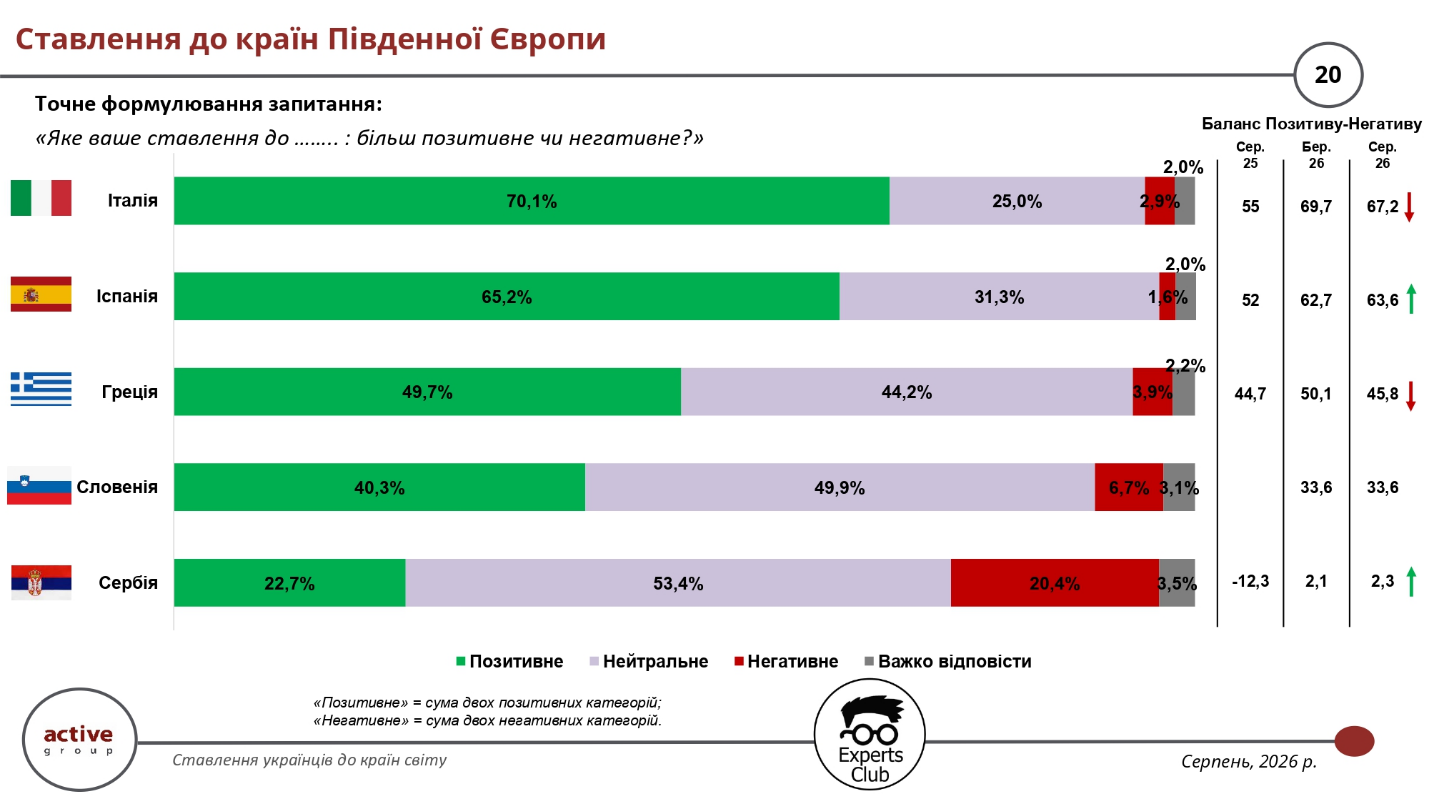
Italy has the best result in the regional group: 70.1% of respondents view it positively, 25% neutrally, 2.9% negatively, and another 2% were undecided. The balance of positive and negative assessments stands at 67.2 percentage points. In March 2026, it was slightly higher—69.7 percentage points—but compared to August 2025, when the figure stood at 55 percentage points, attitudes remain significantly more favorable.
Spain is viewed positively by 65.2% of respondents, neutrally by 31.3%, and negatively by only 1.6%. The balance stands at 63.6 percentage points, compared to 62.7 percentage points in March and 52 percentage points in August of last year. Thus, among the Southern European countries surveyed, Spain is the one showing consistent growth in the balance compared to previous waves.
49.7% of Ukrainians view Greece positively, 44.2% neutrally, and 3.9% negatively. The balance of positive and negative assessments stands at 45.8 percentage points, compared to 50.1 percentage points in March 2026 and 44.7 percentage points in August 2025. This indicates a relatively stable perception of the country, with positive and neutral assessments predominating.
Regarding Slovenia, 40.3% of respondents expressed a positive attitude, while nearly half—49.9%—took a neutral stance. 6.7% view the country negatively, and the balance stands at 33.6 percentage points, the same as in March 2026.
The most contrasting results in the group were recorded for Serbia. 22.7% of Ukrainians view it positively, 20.4% negatively, and the majority, 53.4%, hold a neutral position. The balance stands at plus 2.3 percentage points. At the same time, the trend has improved compared to August 2025, when the indicator was negative—minus 12.3 percentage points.
Maksym Urakin, founder of Experts Club, deputy director of the Interfax-Ukraine news agency, and candidate of economic sciences, emphasized the need for foreign partners to communicate more actively with Ukrainian society.
“The first recommendation is to regularly showcase concrete achievements and specific actions. The second is to be open to questions and inquiries from the media and the public,” Urakin noted.
According to him, sociological data can help diplomatic missions and businesses assess public perception and build bilateral relations more effectively.
Oleksandr Pozniy, director of the research firm Active Group, highlighted the need to combine public awareness with the development of practical economic cooperation.
“We need to do more than just raise general awareness. First and foremost, business associations, the Ministry of Economy, and the Ministry of Foreign Affairs need to take action,” Pozniy noted.
According to him, the most promising areas are those where Ukraine can deepen bilateral ties and increase exports.
In a broader context, the study shows that Ukrainians’ attitudes toward most Southern European countries remain positive or neutral. Italy and Spain score particularly high, while public opinions regarding Serbia are significantly more polarized, although the balance has improved over the past year.
The survey was conducted in August 2026 using self-administered online questionnaires in the SunFlowerSociology panel among 800 Ukrainian citizens aged 18 and older. The sample is representative by age, gender, and region, and the stated maximum theoretical margin of error for indicators at the 50% confidence level is ±3.5 percentage points. This is the third wave of the study, following surveys conducted in August 2025 and March 2026.
ACTIVE GROUP, EXPERTS CLUB, GREECE, ITALY, SERBIA, SLOVENIA, SOCIOLOGY, SOUTHERN EUROPE, SPAIN, UKRAINE

Foreign investors poured approximately 1.02 billion euros into Greek real estate in the first half of 2026, a 6.7% increase compared to the same period last year, according to data from the Bank of Greece.
At the same time, the growth in foreign investment is occurring against the backdrop of a sharp decline in the number of new applications under the Golden Visa program. This indicates that foreign buyers’ interest in Greek real estate is becoming less dependent on the possibility of obtaining a residence permit.
In the second quarter of 2026, the volume of foreign capital directed toward real estate purchases in Greece amounted to approximately 515.8 million euros. This is 11.2% less than in the second quarter of 2025; however, thanks to a strong first quarter, the result for the entire half-year remained higher than last year’s.
The primary source of these statistics is the Bank of Greece, which separately publishes quarterly and annual data on non-residents’ direct investments in Greek real estate. The statistics include real estate purchases by foreign investors as part of foreign direct investment. Bank of Greece
At the same time, the Greek Ministry of Migration and Asylum has recorded a decline in activity under the Golden Visa program. From January through June 2026, 2,551 new applications were submitted, compared to 4,553 during the same period a year earlier. Thus, the figure fell by approximately 44%. Ekathimerini
The decline in the number of applications is linked, in particular, to stricter program requirements. In the most popular regions—including Attica, Thessaloniki, Mykonos, and Santorini—the minimum threshold for a standard real estate purchase to qualify for a Golden Visa has been raised to 800,000 euros. In most other regions, it stands at 400,000 euros. A separate threshold of 250,000 euros has been retained for certain properties that are being converted from commercial to residential use or are subject to restoration.
However, statistics show that foreign capital continues to flow into the market even without a direct link to the immigration program.
Throughout 2025, foreign investors invested approximately €2.05 billion in Greek real estate. This was less than the record €2.75 billion in 2024, but remained one of the highest figures in recorded history. Between 2019 and 2025, the total inflow of foreign capital into Greek real estate reached approximately €12.4 billion. Ekathimerini
By comparison, the Bank of Greece reported that in 2024 alone, net inflows from real estate purchases by non-residents reached €2.75 billion, up from €2.13 billion a year earlier—an increase of 28.9%. Bank of Greece
The shift in demand means that foreign buyers are increasingly viewing Greek real estate not only as a means of obtaining a residence permit but also as an investment asset in its own right. Demand is driven by the tourism market, long-term rentals, rising housing prices in the most attractive regions, and international investors’ interest in hotel and commercial properties.
Foreign capital continues to be particularly active in Athens and Attica, Thessaloniki, Crete, Rhodes, and other tourist islands.
At the same time, Greek authorities continue to discuss further changes to the Golden Visa program amid a shortage of affordable housing. The growth in foreign demand and short-term rentals has become one of the arguments for raising investment thresholds and introducing additional restrictions on the use of purchased real estate.
Thus, preliminary data for 2026 indicate noticeable changes in the Greek market: the number of investors directly seeking to obtain a Golden Visa is declining, yet the total volume of foreign capital in real estate continues to grow for now.
foreign investor, golden visa, GREECE, INVESTMENTS, REAL ESTATE

According to Fixygen, Greece plans to introduce a 10% tax on capital gains from cryptocurrency transactions, Reuters reports.
The corresponding bill was submitted for public comment on October 8. The bill is expected to be submitted to parliament for consideration in November.
Earlier, in June, the possibility of setting the tax rate at 15% was discussed. The new version of the bill provides for a tax exemption on income from cryptocurrency transactions amounting to less than 500 euros per year.
Currently, Greece lacks a comprehensive legal framework for taxing cryptocurrency transactions. At the same time, there is no unified system for taxing income from crypto assets within the European Union.
According to Reuters, capital gains tax rates on cryptocurrency transactions in European countries range from approximately 8% to 30%.
Greek authorities have previously noted that they cannot accurately assess the size of the domestic cryptocurrency market, as a significant portion of investors use foreign platforms.
Consequently, the government does not yet have precise estimates of potential additional budget revenues following the introduction of the new tax.

According to the Relocation project, Greece has proposed discontinuing the granting of residence permits to foreign investors for the purchase of real estate and refocusing the “Golden Visa” program on direct investments in the country’s economy.
This initiative was put forward by Nikos Androulakis, leader of the main opposition party PASOK, amid the ongoing housing crisis. Androulakis believes that the current model effectively encourages the sale of Greek real estate to foreign investors and further impacts housing affordability for the local population.
However, PASOK’s proposal does not call for Greece to completely stop granting residence permits in exchange for investment. The party proposes removing real estate from the list of assets eligible for a “Golden Visa” and redirecting foreign capital toward investment instruments that promote economic growth.
For now, this is solely a political initiative by the opposition. PASOK holds 34 seats in Greece’s 300-seat parliament, so the proposal does not automatically mean a change to the current program.
Currently, the minimum real estate investment required to obtain a Greek Golden Visa depends on the region and the type of property.
In Attica, Thessaloniki, Mykonos, and Santorini, as well as on islands with a population of over 3,100, the minimum threshold is 800,000 euros. In most other regions of the country, it is set at 400,000 euros.
A reduced threshold of 250,000 euros applies to certain categories of properties, including real estate being converted from commercial to residential use and certain buildings requiring restoration. For standard investments of 400,000 euros and 800,000 euros, there is a requirement to purchase a single property with an area of at least 120 square meters.
Greek authorities have tightened the conditions of the Golden Visa program several times in recent years amid rising housing costs. In addition to raising the minimum investment thresholds, real estate purchased under the program can no longer be used for short-term rentals.
The stricter rules have already affected demand. According to the Greek Ministry of Migration and Asylum, in the first half of 2026, foreign investors submitted 2,551 new applications for the Golden Visa—44% fewer than the 4,553 applications filed during the same period in 2025.
At the end of the first half of the year, there were 32,702 active investor residence permits in Greece, issued under the program since its launch. Another 7,368 applications from previous periods remained pending.
The decline in interest in the Golden Visa has not yet led to an overall drop in foreign investment in Greek real estate. In the first quarter of 2026, the inflow of foreign capital into the real estate market reached 511.6 million euros, an increase of 43.4% compared to 356.8 million euros a year earlier. This indicates that demand for Greek properties among foreigners remains strong even without the incentive of obtaining a residence permit.
Between 2019 and 2025, foreign investors poured approximately €12.4 billion into Greek real estate. In 2025, the volume of foreign investment totaled €2.05 billion, compared to €2.75 billion in 2024.
The Golden Visa program has been in effect in Greece since 2014 and allows citizens of non-EU countries to obtain a five-year renewable residence permit provided they meet the investment requirements. The question of the future role of real estate in this program takes on particular significance against the backdrop of rising housing costs and the government’s efforts to increase the supply of properties available for long-term rent.
https://relocation.com.ua/greece-proposes-to-exclude-real-estate-from-the-golden-visa-program/
golden visa, GREECE, INVESTMENTS, REAL ESTATE, RESIDENCE PERMIT

In August 2026, Ukraine significantly reduced purchases of motor gasoline from the southern direction: imports from Romania decreased by approximately one third, while those from Greece fell by 40%, according to calculations by the Experts Club analytical center and data from the A-95 Consulting Group.
Supplies of Romanian gasoline amounted to 23.4 thousand tonnes compared with 34 thousand tonnes in July.
Imports from Greece decreased to 15 thousand tonnes from 24.9 thousand tonnes a month earlier.
Thus, total supplies from the two countries decreased over the month from approximately 58.9 thousand to 38.4 thousand tonnes.
“The main reason for the significant drop in imports from the south was the price factor. In August, when the market was no longer threatened by a shortage, companies reduced purchases of more expensive fuel from Romania and Greece,” the A-95 Consulting Group reported.
A similar trend was also observed in the diesel fuel market.
At the same time, the bulk of Ukrainian gasoline imports continued to arrive from the northwestern direction. In August, Lithuania supplied 51.8 thousand tonnes of gasoline, while Poland supplied 40.1 thousand tonnes.
These two countries accounted for about 60% of total imports.
Overall, gasoline supplies from abroad in August amounted to 152 thousand tonnes, which is 7% less than a year earlier. Since the beginning of 2026, Ukraine has imported 1.12 million tonnes of gasoline — 16% more than in January-August 2025.
The decline in purchases from the southern direction shows that after supply stabilized, Ukrainian traders began more actively redistributing flows in favor of cheaper European sources.



