

Yevgen Osipov, CEO of the agricultural holding “Kernel,” anticipates—in a stress scenario—a 12-million-metric-ton decline in grain production in Ukraine next year due to a possible reduction in planted acreage by farmers, if no solution is found within the next six months to resume exports, according to a correspondent for the Interfax-Ukraine news agency.
“It is difficult to make such forecasts today. We hope that some solutions will be found in the next six months. If no practical solution is found, then, objectively speaking, the area under cultivation will be reduced. In such a stress scenario, we estimated this would result in a shortfall of 12 million metric tons of grain next year,” he said at the “Forbes Ukraine” Economic Resilience Forum in Kyiv on Wednesday.
According to Osipov, with seaports closed, Ukraine will be able to export only about 20 million metric tons of the 50 million metric tons of agricultural products needed—that is, 40% of the required volume—so companies are having to pivot to other business models.
“Based on our own experience with the most recent export corridors, about 50% of the operations were inefficient; we need to find new ways. Because right now, for businesses, it’s a matter of building a new business model. In other words, the old business model doesn’t work there anymore. That’s why, for our part, we’re focusing on processing and exporting processed products,” Osipov noted.
According to him, under its new business model, “Kernel” is focusing on exporting smaller volumes of products with higher added value, while retaining the ability to purchase oilseeds from Ukrainian farmers, pay them, and export processed products.
Osipov also added that, due to security and logistical constraints as well as external factors, it is currently not realistic to expect that the Danube ports will be able to handle the same volume of shipments that Ukraine had in 2022–2023.
As previously reported, in its September report, the U.S. Department of Agriculture (USDA) raised its estimate for this year’s wheat production in Ukraine by 0.6 million metric tons compared to the August forecast—to 26 million metric tons—and its estimate for other grains (excluding wheat and corn) by 0.5 million metric tons, to 7.29 million metric tons, and maintained its corn production forecast at 31.8 million metric tons. Thus, the USDA estimates Ukraine’s total grain production this year at 65.09 million metric tons.

Agricultural holding company Kernel has signed a €100 million loan agreement with the Danish Export and Investment Fund (EIFO) to finance the construction of its first wind energy project—a 94.5 MW wind farm with energy storage systems in central Ukraine.
“For Kernel, this is a logical continuation of our long-term strategy to develop renewable energy and strengthen the business’s energy resilience. A stable energy supply for our assets allows us to fulfill international contracts,” said Yevgen Osipov, CEO of the Ukrainian company, as quoted in a press release published on Tuesday.
It is noted that the financing is being provided under a special EIFO program to support investments in Ukraine, and the agreement was signed with the participation of Denmark’s Minister of Business and Competitiveness, Martin Lidegaard.
According to the press release, the wind farm will consist of 21 state-of-the-art wind turbines to be supplied and installed by the Danish company Vestas—one of the world’s leaders in the wind energy sector. The project also includes the installation of industrial energy storage systems, which will help balance electricity production during peak load hours.
“EIFO’s financing sends an important signal to the international investment market. This agreement confirms that even amid a full-scale war, Ukraine remains a country where large-scale private investment projects can be implemented,” Osipov added.
It is noted that the development of renewable energy is one of Kernel’s strategic priorities alongside its core agricultural business; in particular, the agricultural holding is installing solar panels at its grain elevators and building a 106-MW solar power plant in southern Ukraine. In late April of this year, the European Bank for Reconstruction and Development (EBRD) provided the agricultural holding with $45 million in financing for this solar power plant, the total cost of which is estimated at $86 million.
EIFO (Export and Investment Fund of Denmark) is Denmark’s national export and investment agency. Since the start of the war, EIFO has financed more than 30 projects in Ukraine. The Kernel project is the second wind energy project in Ukraine financed by EIFO and is part of broader support for the Ukrainian energy sector.
Vestas is one of the world’s leading companies in the wind energy sector, with over 203 GW of installed capacity worldwide. In Ukraine, Vestas has 888 MW of wind capacity that is either already installed or currently under construction.
Kernel Agricultural Holding is the world’s largest producer and exporter of sunflower oil, Ukraine’s largest grain exporter, the operator of an extensive network of logistics assets, and a leading producer of grains and oilseeds in Ukraine. It is one of the largest producers and sellers of bottled oil in Ukraine. It is engaged in the cultivation and sale of agricultural products.
For the first nine months of fiscal year 2026 (beginning July 1, 2025), Kernel saw its net profit decline by 5% to $208 million, revenue increase by 0.4% to $3.092 billion, and EBITDA rise by 1% to $403 million.
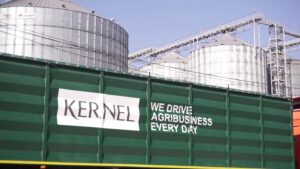
“Kernel,” one of Ukraine’s largest agricultural holdings, reduced oilseed processing by 32% in the fourth quarter of fiscal year 2026 (FY, April–June 2026) reduced oilseed processing by 32% compared to the same period last year—to 645,000 metric tons, the company reported in its operating report on Monday.
“The total volume of oilseed processing for FY 2026 amounted to 3.185 million metric tons, which is 8% less than in FY 2025, due to limited availability of sunflower seeds on the domestic market as a result of one of the worst sunflower harvests in Ukraine in the last decade,” the document states.
At the same time, Kernel noted that this decline was partially offset by the processing of alternative oilseeds, particularly soybeans and rapeseed.
According to the report, sales of edible oil in the fourth quarter fell by 12% to 338,000 metric tons, reflecting a decline in oilseed processing volumes during the quarter.
“However, sales remained relatively high thanks to the sale of vegetable oil inventories accumulated in previous quarters. Total sales of edible oil for fiscal year 2026 reached 1.407 million metric tons, which is 2% more than in fiscal year 2025,” the report states.
Bottled sunflower oil accounted for 14,000 metric tons of the quarterly total, compared to 19,000 metric tons in the previous quarter.
At the same time, the volume of grain stored in elevators (silos) from April through June of this year totaled 320,000 metric tons, compared to just 34,000 metric tons during the same period last year. As a result, the Group’s total grain intake for the 2026 marketing year reached a record high of 4.341 million metric tons, which is 60% more than in the 2025 marketing year.
“The year-over-year growth was primarily driven by a higher share of corn in the Group’s 2025 harvest mix, which led to an increase in grain processing volumes, as well as a rise in grain intake from third-party suppliers,” the document states.
Kernel’s grain exports from Ukraine in the last quarter of fiscal year 2026 totaled 2.011 million metric tons, which is 33% more than in the previous quarter and more than double the figure for the corresponding period of the previous year. “This was driven by an increase in grain supply on the domestic market, as farmers accelerated grain sales toward the end of the season. Total grain exports from Ukraine for fiscal year 2026 reached 6.265 million metric tons, which is 15% more than in fiscal year 2025,” the report notes.
Transshipment through export terminals in the fourth quarter of fiscal year 2026 totaled 2.699 million metric tons, which is 3% more than in the previous quarter and 49% higher than in the fourth quarter of fiscal year 2025. Of this volume, grain accounted for 80%, edible oils for 12%, and the remainder consisted of vegetable meal.
“For the year, Kernel’s terminals handled a record 9.587 million metric tons of agricultural products, a 5% increase from the previous year, thanks to significant grain exports in the second half of the fiscal year,” the document states.
Kernel Agricultural Holding is the world’s largest producer and exporter of sunflower oil, Ukraine’s largest grain exporter, the operator of an extensive network of logistics assets, and a leading producer of grains and oilseeds in Ukraine. It is one of the largest producers and sellers of bottled oil in Ukraine. It is engaged in the cultivation and sale of agricultural products.
For the first nine months of fiscal year 2026, Kernel reported a 5% decline in net income to $208 million, while its revenue increased by 0.4% to $3.092 billion and EBITDA rose by 1% to $403 million.
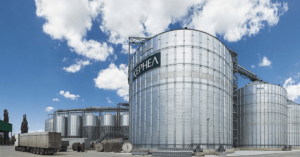
The Kernel agricultural holding’s elevator network, in fiscal year 2026 (FY, July 2025–June 2026) accepted more than 1 million metric tons of grain from third-party agricultural producers for the first time following the implementation of a new business model, under which the company opened its elevators for commercial storage and logistics services, the holding’s press service reported.
“Thanks to a shift in our approach to partnerships and our willingness to share our infrastructure, we were able to attract record volumes of grain,” the press service quoted Serhiy Shcherban, head of Kernel’s storage department, as saying.
According to him, competing in this market requires not just available storage space, but a guarantee of prompt acceptance, legally sound terms, and predictable logistics.
According to Kernel’s report for the first nine months of 2026 FR, the volume of grain and oilseeds accepted into the elevator network increased by 50% compared to the same period in the 2025 fiscal year—reaching 4.02 million metric tons. This includes 2.29 million metric tons accepted in January–March of this year, compared to just 0.09 million metric tons in January–March of last year.
According to the 2025F report, Kernel owns Ukraine’s largest private network of grain storage facilities, with a one-time storage capacity of 2.2 million metric tons.
The company explained that previously, the elevator network primarily served the holding’s own needs, but now it also works with independent agricultural producers. To this end, the agricultural holding revised its pricing policy, expanded its range of services, and introduced digital monitoring of grain movement—from electronic queuing to receipt and shipment.
In addition, Shcherban assured that during the current season, the company will pass on to third-party clients only the increase in electricity costs, while Kernel will cover all other additional operating expenses itself.
The Kernel agricultural holding is the world’s largest producer and exporter of sunflower oil, Ukraine’s largest grain exporter, the operator of an extensive network of logistics assets, and a leading producer of grains and oilseeds in Ukraine. It is one of the largest producers and sellers of bottled oil in Ukraine. It is engaged in the cultivation and sale of agricultural products.
According to results for the first nine months of fiscal year 2026 (July 2025–March 2026), Kernel’s net profit decreased by 5% to $208 million, while its revenue increased by 0.4% to $3.092 billion, and EBITDA rose by 1% to $403 million.
agricultural producer, GRAIN, GRAIN ELEVATOR, KERNEL, LOGISTICS

Over the course of a year since the launch of the Open Agri platform, the Kernel agricultural holding has attracted approximately 480 small and medium-sized agricultural producers who cultivate more than 255,000 hectares of land; the amount of financing secured through the project has exceeded $16 million, the holding’s press service told the Interfax-Ukraine news agency.
“Today, farmers need more than just a buyer for their harvest; they need a strong partner who can help optimize costs and minimize risks. At Open Agri, we have combined expertise, financing, and legal protection, as well as practical services for farm development,” the press service quoted Open Agri project manager Igor Kotsel as saying.
It is noted that platform participants gain access to agronomic expertise, laboratory testing, legal and accounting support, as well as financing programs for future harvests.
According to reports, more than 120 farms have already conducted soil analyses and received customized nutrient maps.
“Kernel” plans to expand the project and increase the number of partner farms by the end of 2026, the press release states.
Open Agri is a platform for the company’s collaboration with small and medium-sized agricultural producers.
Kernel previously reported that it has invested 1 billion hryvnia in the development of Ukrainian communities over the past four years. Specifically, as part of the “My Community: Together with Kernel” program, 67 local initiatives have been funded over two years with more than 10 million hryvnia.
Kernel Agricultural Holding is the world’s largest producer and exporter of sunflower oil, Ukraine’s largest grain exporter, the operator of an extensive network of logistics assets, and a leading producer of grains and oilseeds in Ukraine. It is one of the largest producers and sellers of bottled oil in Ukraine. It is engaged in the cultivation and sale of agricultural products.
According to results for the first nine months of fiscal year 2026 (July 2025–March 2026), Kernel’s net profit decreased by 5% to $208 million, while its revenue increased by 0.4% to $3.092 billion, and EBITDA rose by 1% to $403 million.
AGRICULTURAL PRODUCERS, FARMERS, FINANCING, KERNEL, Open Agri
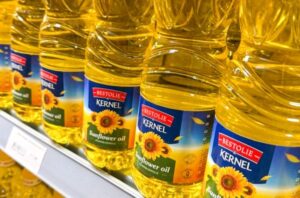
Agricultural holding Kernel is expanding its presence in the European consumer market: in the Netherlands, just a year and a half after launching its own sunflower oil brand, Bestolie&Kernel, sales have already reached 5.5 million liters, the company’s press service reported on Monday.
“The European market is very competitive and ‘closed’ to new brands. It is dominated by large international FMCG companies and supermarket chains’ private labels. Getting on the shelf is difficult, and staying there is even harder,” the release quotes Serhiy Neroshchyn, director of the marketing and sales department for packaged products at Kernel, as saying.
The company noted that it previously produced oil for the Dutch food distributor Fangoo&Zon Impex under a private label, whereas the launch of its own Bestolie&Kernel brand in 2024 allowed the company to build a complete value chain—from the Ukrainian field to the European consumer.
“Kernel” is responsible for production and quality control at all stages—from seed to finished oil—as confirmed by ISO 9001 and ISO 22000 certifications, while Fangoo&Zon Impex handles distribution in the local market.
Since its launch, the company has also expanded its product range, adding new packaging formats and frying oil for the HoReCa segment.
“Kernel” estimates its share of global sunflower oil exports at 10%. Kernel sells refined sunflower oil in Ukraine under its own brands, “Stozhar” and “Shchedry Dar,” and exports it under its own Kernel brands to 12 European countries, as well as to Jordan, Lebanon, Bangladesh, Guinea, under the Le Blanc and Premi brands in Egypt, the Middle East, and South Asia, as well as under its partners’ private labels.
Fangoo&Zon Impex is a Dutch company specializing in the import and distribution of food products and FMCG goods in the Benelux countries.
Kernel Agricultural Holding is the world’s largest producer and exporter of sunflower oil, Ukraine’s largest grain exporter, an operator of an extensive network of logistics assets, and a leading producer of grain and oilseeds in Ukraine. It is one of the largest producers and sellers of bottled oil in Ukraine. It is engaged in the cultivation and sale of agricultural products.
According to results for the first nine months of fiscal year 2026 (July 2025 – March 2026), Kernel saw its net profit decline by 5% to $208 million, while its revenue increased by 0.4% to $3.092 billion, and EBITDA by 1% to $403 million.



