
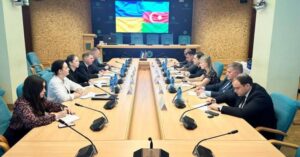
UkraineInvest, Ukraine’s agency for attracting and supporting investment, and Azerbaijan’s Agency for the Promotion of Exports and Investments (AZPROMO) have signed a memorandum of understanding aimed at expanding investment cooperation between the two countries, according to the Ukrainian Embassy in Azerbaijan.
The document was signed in Baku during the 2nd Azerbaijan International Investment Forum by AZPROMO Executive Director Yusif Abdullayev and UkraineInvest Executive Director Marina Khlistun, according to the Ukrainian Embassy in Azerbaijan.
The parties intend to foster direct contacts between businesses in both countries and create conditions for the implementation of joint investment projects.
Ukraine, in particular, is interested in attracting Azerbaijani capital to the country’s reconstruction projects. Potential areas of cooperation include infrastructure, energy, transportation and logistics, the agricultural sector, industry, and technology.
Yuriy Gusev, Ukraine’s ambassador to Azerbaijan, praised the efforts of the leadership and teams at AZPROMO and UkraineInvest in translating the two countries’ strategic partnership into concrete joint investment projects.
AZPROMO also confirmed the signing of the memorandum. According to the Azerbaijani agency, the document between AZPROMO and UkraineInvest was part of a package of 11 agreements signed during the international investment forum.
In total, the agreements concluded during the forum cover construction and development, the digital economy, renewable energy, industry, agriculture, pharmaceuticals, finance, water management, sports, and investment promotion.
The II Azerbaijan International Investment Forum took place in Baku on September 25–26, 2026, under the patronage of Azerbaijani President Ilham Aliyev. The event was organized by the Ministry of Economy of Azerbaijan and AZPROMO in strategic partnership with The European House – Ambrosetti.
UkraineInvest is the state agency responsible for attracting and supporting investment. The organization assists foreign and Ukrainian investors, provides consulting, analytical, and informational support, and participates in promoting Ukraine’s investment projects in international markets.
Italian Foreign Minister Antonio Tajani confirmed that a new aid package for Ukraine is being prepared, as well as the continuation of the Italian government’s commitments regarding Ukraine’s security, recovery, and defense.
According to the website of the Italian Ministry of Foreign Affairs and International Cooperation, Tajani made these remarks during a phone call with Ukrainian Foreign Minister Andriy Sybiga on the occasion of the 35th anniversary of Ukraine’s restoration of independence.
During the conversation, Tajani condemned the ongoing Russian attacks on Ukrainian territory and reaffirmed the Italian government’s full support for the Ukrainian people.
“The minister reaffirmed the government’s commitment to maintaining maximum pressure on Moscow, as demonstrated by Prime Minister Giorgia Meloni’s participation today in the Coalition of the Willing. Tajani confirmed that the government’s commitment to Ukraine’s security, reconstruction, and defense remains firm, in particular thanks to a new Italian aid package currently being prepared, as well as support through EU sanctions,” the statement reads.
Separately, the parties discussed food security and maritime safety. Tajani emphasized the importance of the Black Sea and the entire Mediterranean for global food security and ensuring the continuity of Ukrainian grain exports.
He reaffirmed Italy’s readiness to cooperate with Kyiv, in particular by exploring avenues for collaboration with MED9+ initiatives regarding the Strait of Hormuz, underscoring the interconnection between maritime security, economic stability, energy flows, and food security.
The conversation also touched on Ukraine’s recovery. According to the Italian Ministry of Foreign Affairs, Italy has already allocated approximately 3.2 billion euros to support Ukraine’s recovery and reconstruction, in part through contributions from Italian companies.

During her one-day visit on August 15, the Secretary-General of UN Tourism, Sheikha Nasser Al-Nuwais, expressed her support for the Ukrainian people and announced a series of international initiatives to support tourism in Ukraine; She cited medical tourism, IT, and digital technologies as promising areas for development, according to a statement from the press service of the State Agency for Tourism Development of Ukraine (SATD) to the Interfax-Ukraine news agency.
“Ukraine should leverage its strengths, such as medical tourism, IT, and digital technologies, as these are precisely what will enable it to establish a solid foundation for attracting foreign tourists in the future. Bringing together all stakeholders in the tourism sector and the government under one roof can offer great potential,” noted Sheikha Al-Nuwais, whose remarks were quoted in the statement.
She noted that ten years have passed since the Secretary-General of UN Tourism last visited Ukraine, and this visit is an opportunity to renew the partnership “and look to the future together.”
“Recovery efforts cannot wait for peace to arrive. They begin right now. UNESCO and UN Tourism. Culture and tourism. Side by side with Ukraine. The path to the future belongs to Ukraine. But Ukraine will not walk it alone. UN Tourism will be by its side. And our work begins right now,” emphasized Sheikha Al-Nuwais.
During the meeting with representatives of the industry and the innovation and technology community, the Secretary-General of UN Tourism paid special attention to international coordination and the exchange of experiences regarding the recovery of the tourism sectors after the crisis. Potential areas of cooperation include the safety of tourist destinations, accessibility, barrier-free travel, and inclusivity.
In turn, GART Chairwoman Natalia Tabaka noted that this visit demonstrates that Ukraine remains on the global tourism radar and that its recovery is a key focus of the international agenda.
“For us today, tourism is first and foremost about preserving and restoring people—their emotional and physical well-being—strengthening identity, and supporting communities. And we are grateful for the support shown to Ukraine and for the willingness to stand by us during this historic time for us,” Tabaka said.
During the visit, UNWTO announced a special category of its “Safe Destinations Challenge” initiative for Ukraine. This initiative provides technical support to member states in five different regions, one of which is Ukraine. The initiative aims to find innovative solutions for the safety, resilience, and recovery of tourist destinations, especially following periods of crisis and disasters, according to the statement.
“Amid a full-scale war, the Ukrainian tourism sector has learned to operate under constant risks—from air raid alerts and missile attacks to evacuations, crisis communications, and ensuring people’s safety. It is precisely this extensive experience that can serve as the foundation for new international solutions in the field of safe and sustainable tourism,” noted Sheikha Al-Nuwais.
As part of her visit, the UN Tourism Secretary-General visited two UNESCO World Heritage sites—St. Sophia Cathedral and the Kyiv-Pechersk Lavra—where she took part in celebrations marking the Lavra’s 975th anniversary.
Sheikha Al-Nuwais also presented awards to the winners of the UN Tourism “Best Tourist Villages of Ukraine” competition for 2024 and 2025. Specifically, the awards went to the Kolochava community (Zakarpattia Oblast) and the Urych community (Lviv Oblast).

The European Union has transferred an additional 30 million euros to the Ukraine Energy Support Fund, thereby increasing its total contribution to the fund to 279 million euros, according to Ukraine’s First Deputy Prime Minister and Minister of Energy Denys Shmyhal.
“The funds received through this financial instrument are helping us restore energy infrastructure damaged by Russian attacks, purchase urgently needed equipment for our energy companies, and ensure a reliable energy supply, first and foremost for critical infrastructure,” – Shmyhal was quoted as saying by the Ministry of Energy’s press service on its Telegram channel on Saturday.
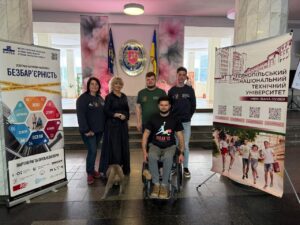
In Ukraine, accessibility is increasingly viewed not as a formal requirement for infrastructure, but as a systemic prerequisite for veterans and people with disabilities to return to active life, work, education, and participation in community development.
This is discussed in an article on the Events.org.ua platform dedicated to the All-Ukrainian Accessibility Week, which took place in May 2026.
The initiative arose from the personal experience of veteran Vadym Honcharenko, call sign “Kinolog,” who uses a wheelchair after being wounded. His son, Artem Goncharenko, and the project team emphasize that for people with disabilities, barriers include not only obvious obstacles but also dozens of small design choices in urban spaces: stairs with no alternative, dangerous ramps, curbs, narrow doors, a lack of elevators, or improperly designed tactile paving.
According to the organizers, it is precisely this experience that shows accessibility cannot be achieved through a “trial-and-error” approach by people with disabilities themselves. Every flawed architectural or service-related decision can pose a risk of falls, injuries, additional pain, or complications for them.
As part of the All-Ukrainian Accessibility Week, the focus was not on declarations but on practical actions. The initiative was joined by Kyiv National University of Construction and Architecture, Igor Sikorsky Kyiv Polytechnic Institute, Ivan Pul’uj Ternopil National Technical University, National University of Life and Environmental Sciences of Ukraine, the National University of Physical Education and Sports of Ukraine, the Drohobych National Pedagogical University, the Kyiv City Employment Service, the KNUBA Institute for Veterans, the Veterans Cluster of Ukraine, the Agency for the Reconstruction of Ukraine, business partners, and civil society organizations.
In May and June, a training course titled “Rights of People with Disabilities” also began; the organizers stated that its goal was not only to raise awareness but also to change approaches to decision-making. The program emphasized non-discriminatory procedures, appropriate communication, and a practical understanding of the needs of people with disabilities.
A separate module was dedicated to assessing the accessibility of urban spaces. On May 26, in the Teremky-2 neighborhood, participants, together with people in wheelchairs, followed actual routes to identify where formal accessibility measures were failing and which solutions required immediate change. Based on the results of this work, preliminary design solutions for KNUBA and NUFVSU were developed in collaboration with the Mlyn group of companies and the Shaw architectural firm.
Another area of focus was the topic of Smart City. The organizers emphasize that a smart city without accessibility becomes a service available only to a portion of its residents. Therefore, digital solutions, navigation, transportation, and urban services must be designed with the needs of veterans, people with disabilities, older adults, parents with children, and other population groups in mind.
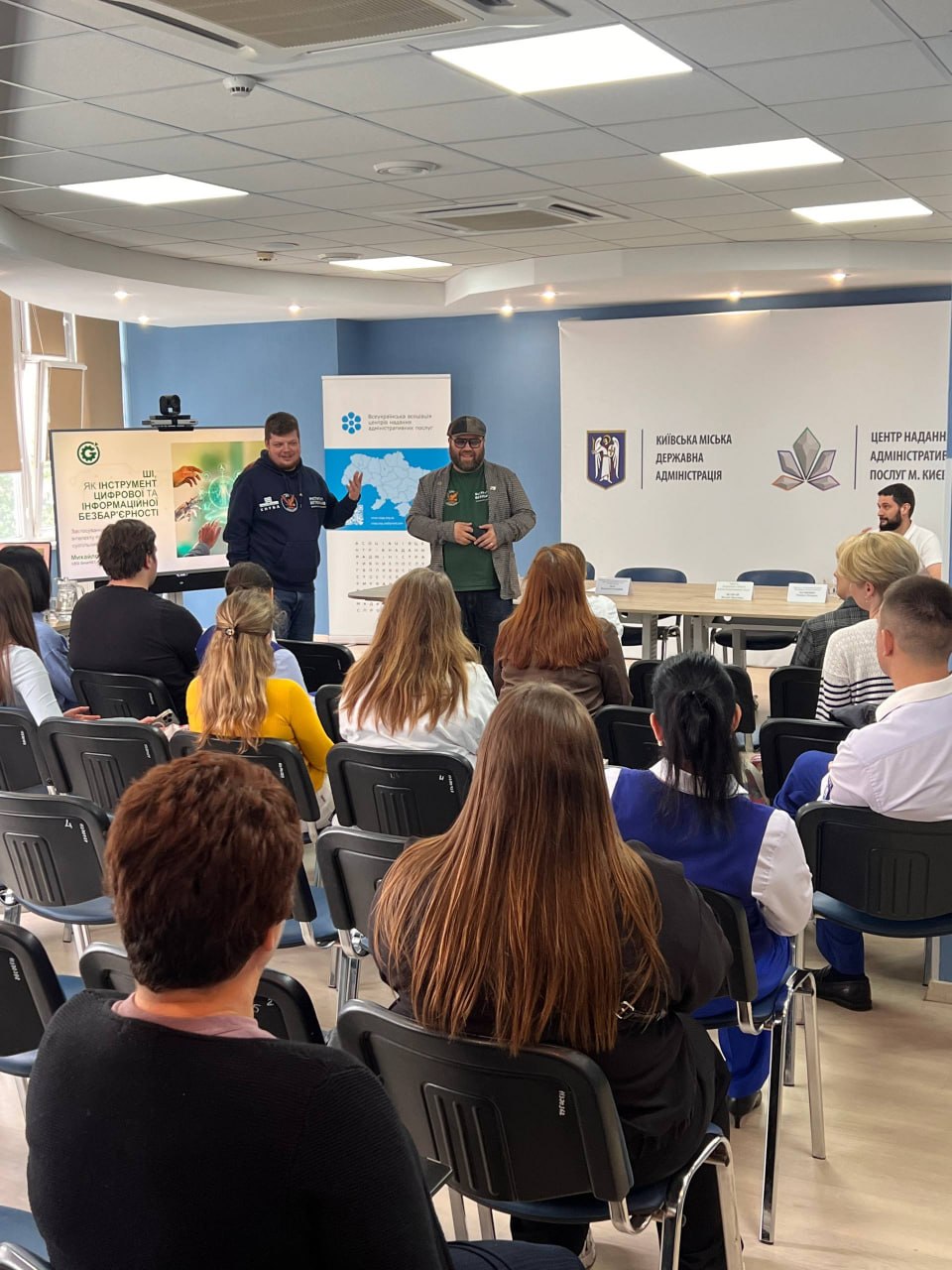
A separate training session was held for employees of Kyiv’s Administrative Service Centers (ASC) on working with veterans and people with disabilities, crisis communication, and the use of AI tools in service delivery. The organizers also identified the following training areas: safety and first aid.
Neurologist Denys Boichuk led practical training sessions on first aid and how to respond to epileptic seizures. Participants in the initiative emphasize that accessibility applies not only to physical spaces but also to people’s readiness to act appropriately in critical situations.
According to the organizers, Ukraine already possesses the expertise, partnerships, and practical experience needed to develop an accessible environment; however, such efforts cannot be limited to isolated events. They must become an integral part of daily decision-making in the areas of management, education, architecture, and services.
The article also notes that the “Architecture of Resilience” Veterans Institute at KNUBA and the Veterans Cluster of Ukraine continue to develop educational opportunities for veterans, defenders, and their family members. These include training, retraining, courses, second higher education, master’s programs, doctoral studies, psychological support, rehabilitation, and participation in projects aimed at Ukraine’s recovery.
Partner universities in the initiative include KNUBA, the National University of Physical Education and Sports of Ukraine, the Western Ukrainian National University, Poltava Polytechnic, the Precarpathian National University, NUBiP, the Drohobych Pedagogical University, Igor Sikorsky Kyiv Polytechnic Institute, Ivan Pul’uj Ternopil National Technical University, and the University of Educational Management.
The organizers emphasize that “tuition-free education” refers to participation in state compensation programs, grants, scholarships, and support from employers. Admissions take place during the standard dates of the main admissions campaign.
The All-Ukrainian Accessibility Week demonstrated that, for post-war Ukraine, accessibility should not be a separate social initiative, but rather an integral part of economic recovery, the labor market, education, urban planning, and service policy. Given the number of veterans and people returning to civilian life after injuries, such decisions will have a direct impact on employment, quality of life, and communities’ capacity for recovery.
accessibility, BARRIER-FREE, disability, GONCHARENKO, RECOVERY, ветеран

More than EUR20 million is expected to be raised for JSC “Ukrzaliznytsia” during the Ukraine Recovery Conference (URC 2026) as part of the business component, which will involve the signing of certain documents, Deputy Prime Minister for Recovery and Minister of Community and Territorial Development Oleksiy Kuleba said in an interview with the “Interfax-Ukraine” news agency.
According to him, the ministry, as part of its resilience efforts, will present situation centers that have been deployed throughout the country. These are centers where dispatchers coordinate air raid alerts or any other threats online 24/7, making decisions regarding the suspension of trains, the evacuation of people, or changes to freight routes.
“This is very serious work that helps us minimize damage and save the lives of passengers and employees, despite constant attacks,” Kuleba emphasized.
The Deputy Prime Minister for Recovery also noted that Ukrzaliznytsia and the port sector are bearing the brunt of the impact amid constant enemy shelling.
“The Russians are doing this entirely deliberately, knowing that in this way they can destroy our export potential so that we cannot ship out what we produce,” Kuleba stressed.
Earlier reports indicated that since the beginning of this year alone, the enemy has launched more than 1,500 attack drones at Ukrainian ports.
In addition, since the start of the full-scale invasion, 966 port infrastructure facilities and more than 200 civilian vessels have been damaged or destroyed.
Furthermore, 257 civilians have been injured or killed as a result of attacks on Ukrainian ports.
“Ukrzaliznytsia,” for its part, noted that during the first quarter of 2026, the enemy carried out 541 strikes on railway infrastructure and rolling stock.
The Ukraine Recovery Conference (URC 2026) will take place on June 25–26 in Gdańsk, Poland. The Ukrainian delegation will be led by Ukrainian Prime Minister Yulia Svyrydenko.



