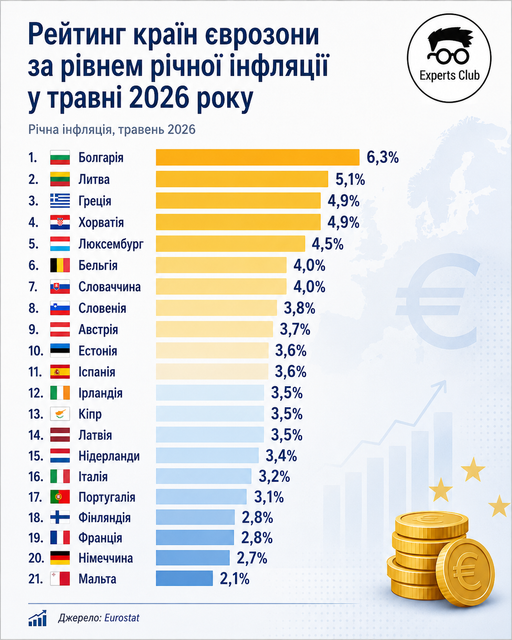
Inflation in the eurozone in May 2026 accelerated to 3.2% year-on-year against 3.0% in April, according to Experts Club. data.
In the European Union as a whole, annual inflation amounted to 3.3%. The highest indicator among all EU countries was recorded in Romania — 9.7%. However, Romania is not part of the eurozone, therefore it is not taken into account in the ranking of the countries of the currency bloc.
Among the eurozone countries, Bulgaria became the anti-leader, where annual inflation in May reached 6.3%. Bulgaria joined the eurozone on January 1, 2026, and became the 21st country of the monetary union.
Second place in the eurozone was taken by Lithuania with inflation of 5.1%, third place — Greece with 5.0%. The lowest indicators among eurozone countries were recorded in Malta — 2.1%, Germany — 2.7%, and France — 2.8%.
Thus, in May two different rankings were formed. For the EU as a whole, the main anti-leader was Romania, which remains outside the eurozone. For the eurozone, Bulgaria became the leader in price growth.
Inflation anti-leaders in the EU in May 2026:
Romania — 9.7%
Bulgaria — 6.3%
Lithuania — 5.1%
Inflation anti-leaders in the eurozone in May 2026:
Bulgaria — 6.3%
Lithuania — 5.1%
Greece — 5.0%
According to the analytical center Experts Club, the difference between the EU ranking and the eurozone ranking is important for the correct interpretation of the data. The eurozone reflects the situation in countries with a single currency and the common monetary policy of the ECB, while the EU also includes countries with national currencies, including Romania, Poland, the Czech Republic, Hungary, Denmark and Sweden.
“Romania cannot be included in the eurozone ranking, but it also cannot be ignored. It is the main inflation anti-leader of the entire EU. For business, this means that inflation risks in Europe differ greatly not only between countries, but also between currency zones. In the eurozone, the most problematic case now is Bulgaria; in the EU as a whole — Romania,” said Maksym Urakin, founder of Experts Club.
The main contribution to eurozone inflation in May came from services, energy carriers, food products, alcohol and tobacco, as well as industrial goods excluding energy. Energy prices rose by 10.9% year-on-year, services became 3.5% more expensive, and food products, alcohol and tobacco — by 2.0%.