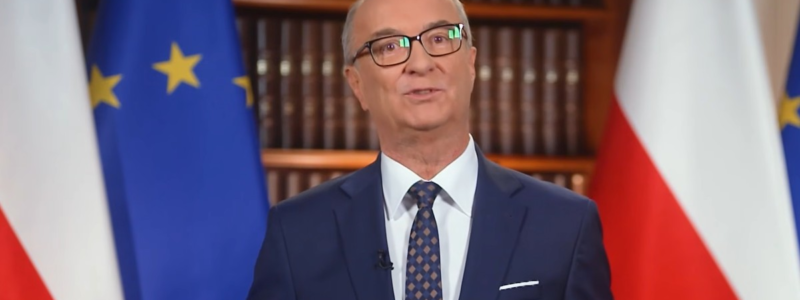
Marshal of the Polish Sejm Włodzimierz Czarzasty has stated that Ukraine’s accession to the European Union will require the Ukrainian side to reconsider controversial chapters of its own history, including its assessment of the mass killings of Poles in Volhynia during the Second World War.
Czarzasty made the statement on August 10 in Szczawnica following a meeting with Chairman of the Verkhovna Rada of Ukraine Ruslan Stefanchuk, the Polish Press Agency PAP reported.
Czarzasty stressed that he personally supports Ukraine’s future membership in the EU but believes that European integration entails not only economic benefits but also the acceptance of a certain system of values and historical responsibility.
“The EU is about democracy and values; it is not merely an ATM,” the Marshal of the Sejm said, adding that it is also necessary “to call genocide genocide.” In his opinion, no nation can escape its own history.
The main subject of the historical dispute remains the mass killings of the Polish population in Volhynia and Eastern Galicia in 1943–1945, responsibility for a significant portion of which the Polish side places on the Organization of Ukrainian Nationalists and the Ukrainian Insurgent Army.
In Poland’s state historical policy, these events are officially classified as genocide. As early as 2016, the Sejm enshrined this interpretation in a parliamentary resolution, and in 2025 Poland went further: by law, it designated July 11 as the National Day of Remembrance of Poles — Victims of the Genocide Committed by the OUN and UPA in the Eastern Territories of the Second Polish Republic. The law was adopted unanimously by the Sejm and subsequently approved by the Senate.
The Polish side demands three things from Ukraine above all: recognition of the genocidal nature of the crimes, the opportunity to search for and exhume the remains of Polish victims without obstruction, and the dignified burial and commemoration of those killed. Poland’s Institute of National Remembrance regards the depoliticisation of exhumations as one of the key conditions for genuine historical reconciliation.
Warsaw therefore no longer views the issue solely as a dispute among historians. In recent years, it has become part of the state’s remembrance policy and is increasingly being linked by Polish politicians to the issue of Ukraine’s European integration.
Official Kyiv does not deny the mass killings of the Polish population or the need to honour the memory of those killed. However, it avoids accepting the Polish formula of sole responsibility on the part of Ukraine and the official classification of the entire Polish-Ukrainian conflict of that period as a genocide of Poles.
The Ukrainian Institute of National Remembrance predominantly uses the terms “Volhynia Tragedy” and “Ukrainian-Polish confrontation.” In July 2026, UINR head Oleksandr Alforov stated during a joint Ukrainian-Polish commemoration that the tragic events of 1943 must be remembered and that relations between the two nations should be built on mutual respect and acknowledgement of past mistakes.
The Ukrainian side also points out that not only Poles but also Ukrainians were killed in the Polish-Ukrainian confrontation, including as a result of retaliatory actions by Polish armed formations and the policies of the Polish state. Notably, in July 2026, Polish Ambassador to Ukraine Piotr Łukasiewicz also publicly stressed the need to take Ukrainian victims into account.
When the Polish Sejm legislatively designated July 11 as a day of remembrance for the “victims of the genocide committed by the OUN and UPA” in June 2025, Ukraine’s Ministry of Foreign Affairs called the decision unilateral and warned that such steps did not contribute to achieving mutual understanding and reconciliation. Kyiv proposed focusing on the joint work of historians, searches, exhumations and the dignified commemoration of all victims.
Despite the political dispute over terminology, substantial progress has been made in practical matters over the past year. Ukraine resumed issuing permits to the Polish side for search and exhumation work. In 2026, investigations were conducted, in particular, in the former villages of Ostrivky and Volia Ostrovetska in Volhynia, while on August 7, Ukraine’s interdepartmental commission approved new exhumation work in Huta Peniatska in the Lviv region and in the village of Uhly in the Rivne region.
Work in Ostrivky and Volia Ostrovetska was completed on August 7, and the remains discovered there are to be reburied. Thus, one of the most acute practical issues that had complicated relations between Warsaw and Kyiv for several years has gradually begun to move forward.
Following his meeting with Stefanchuk, Czarzasty also called for political and historical conflicts not to be transferred to relations between Polish and Ukrainian societies. According to him, a permanent channel of communication must be maintained between the parliaments of the two countries and mutual trust must be restored. At the same time, he stressed that “without a secure Ukraine, there is no secure Poland” and expressed support for Ukraine’s membership in the EU and Poland’s participation in the country’s post-war reconstruction.