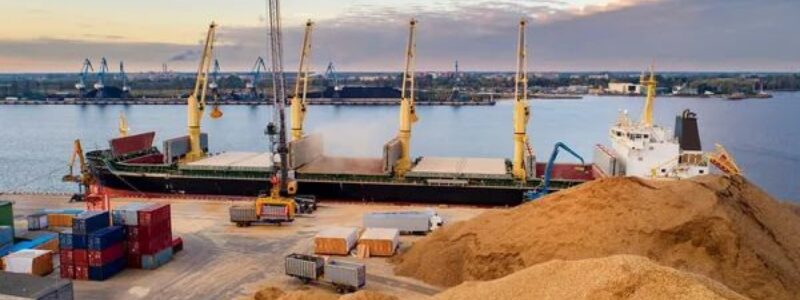
The suspension of the maritime corridor since late July has led to a drop in grain exports from Ukraine: from August 1 to 12, exports totaled 590,000 metric tons, or 30% of demand, Agriculture Minister Taras Vysotsky said at a briefing in Kyiv on Friday.
“From August 1 to 12, we exported 590,000 metric tons. That’s about 30% of the required volume. We expect to be able to reach 50% going forward… taking into account all the relevant impacts on international trade balances,” the minister said.
He clarified that of these 590,000 metric tons, about 40% were exported by rail, about 40% via the Danube region, about 10% by road, and the remaining 10% consisted of several ships that were still able to leave Ukrainian ports in early August.
“If we subtract those, we can say that as of today, 45% is exported by rail, 45% via the Danube region, and about 10% by road,” the minister stated.
At the same time, he emphasized that there is potential to partially increase exports, but even so, without the resumption of operations at the Black Sea ports, exports will amount to no more than 50% of demand.
According to Vysotsky, due to the drought, the Danube route is currently unable to operate at full capacity; reaching its full potential—about 1.5 million metric tons per month—will be possible closer to the end of the year.
The minister also reported that Ukraine currently has sufficient permanent storage facilities for grain, but in November, after the corn harvest, there may be a storage capacity shortfall of 8 to 11 million metric tons, which they hope to cover using temporary storage facilities and silo bags.
According to Vysotsky, a request for $10 million in funding for the temporary storage of 2–2.5 million metric tons has already been sent to international partners. In addition, a similar request to the World Bank for $25 million—covering more than 6 million metric tons of grain—is being finalized.
He noted that it is currently difficult to predict how quickly maritime exports can be resumed.
“We see that every day there are various rumors… gossip about different proposals (regarding a maritime ceasefire)… As always, we must rely first and foremost on ourselves. By ‘ourselves,’ I mean the military… As of today, the only way to enable exports is through military security… This is a very important area; the military is working on it, but so far, they cannot report any progress on their end. Therefore, as of today, exports from the ports of Greater Odesa are suspended. We are focusing on alternative logistics channels,” stated the head of the Ministry of Agrarian Policy.
Regarding the U.S. Department of Agriculture’s downward revision this week of its forecast for grain exports from Ukraine this marketing year by 2.21 million metric tons—to 37.77 million metric tons—Vysotsky noted that, overall, the figures remain within the range of the typical annual balance.
“We do not rule out that this could be the case. We are still only a month and a half into the marketing year. We understand that, provided there is some recovery during a certain period, we can make up the shortfall. Therefore, from our point of view, this balance is currently based on the annual cycle—no more, no less—rather than on an assessment of the current situation,” the minister said.
He noted that this year’s total harvest of grains and oilseeds is expected to exceed 80 million metric tons, of which domestic consumption and adequate carryover stocks will account for up to 20 million metric tons.
“The baseline volume of exports of grains, oilseeds, and processed products could reach up to 60 million metric tons. However, given how logistics are currently developing, we understand that there is a possibility this trend will continue throughout the year, and exports will amount to no more than 30 million metric tons,” Vysotsky said, outlining the worst-case scenario.