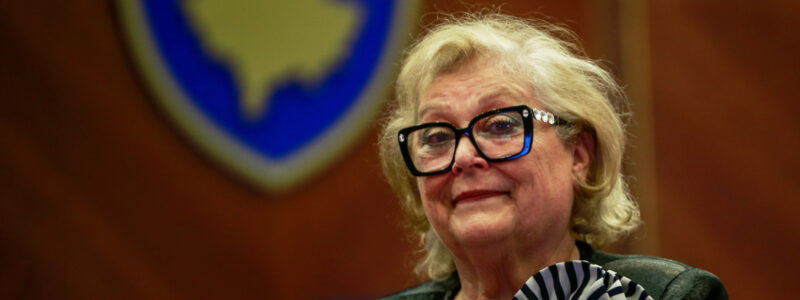
According to Serbian Economist, the Kosovo Parliament has elected economist and academic Justina Široka Pula as the new president. Eighty-one members of the 120-seat parliament voted for her candidacy, allowing the procedure to be completed in the first round and avoiding early parliamentary elections.
The vote took place late in the evening on October 6, effectively in the final minutes before the constitutional deadline. Had a president not been elected, parliament would have been dissolved, and Kosovo would have had to hold new early elections.
Shiroka Pula emerged as a compromise candidate supported by Prime Minister Albin Kurti’s ruling “Self-Determination” movement and the opposition Democratic Party of Kosovo. Prior to her election, she headed the Kosovo Academy of Sciences and Arts and had previously served as Minister of Economy.
Immediately before the presidential vote, parliament also approved legislative changes limiting the powers of the Special Chambers for Kosovo in The Hague, which hear cases involving war crimes committed by former leaders of the Kosovo Liberation Army. This issue was part of a political compromise between the major parties.
The President of Kosovo has primarily ceremonial powers but plays a prominent role in foreign policy and serves as commander-in-chief. Shira Pula became the third woman to hold this office, following Atifete Jahjagi and Vjosa Osmani.
Serbia does not recognize Kosovo’s independence, which was declared in 2008, and continues to regard Kosovo and Metohija as its autonomous province. Kosovo’s independence is also not recognized by a number of major powers, including Russia and China, which are permanent members of the UN Security Council. It is also not recognized by India, Brazil, and a number of European countries, including Spain. Ukraine has not established diplomatic relations with Kosovo and does not recognize its independence.
https://t.me/relocationrs/3825