Ukrainians’ attitudes toward Hungary have improved significantly compared to March 2026, but negative views still outnumber positive ones. In August, 22.9% of respondents viewed the country positively, 35.6% negatively, and another 37.4% took a neutral stance. This is evidenced by the results of the third wave of a survey conducted by Active Group and Experts Club, according to the Experts Club Information and Analytical Center. Experts.news
According to the results of the August survey, 6.3% of Ukrainians view Hungary entirely positively, while 16.6% view it mostly positively. A neutral attitude was expressed by 37.4% of respondents. At the same time, 28.8% view the country mostly negatively, 6.8% view it entirely negatively, and another 4.1% were undecided.
The balance of positive and negative assessments in August stands at minus 12.7 percentage points. Based on this indicator, Hungary remains among the countries with a negative balance of public opinion; however, the trend over the past five months has shifted significantly in a positive direction. In the survey’s overall ranking, China had a lower balance in August at minus 25.4 percentage points, and India at minus 14.3 percentage points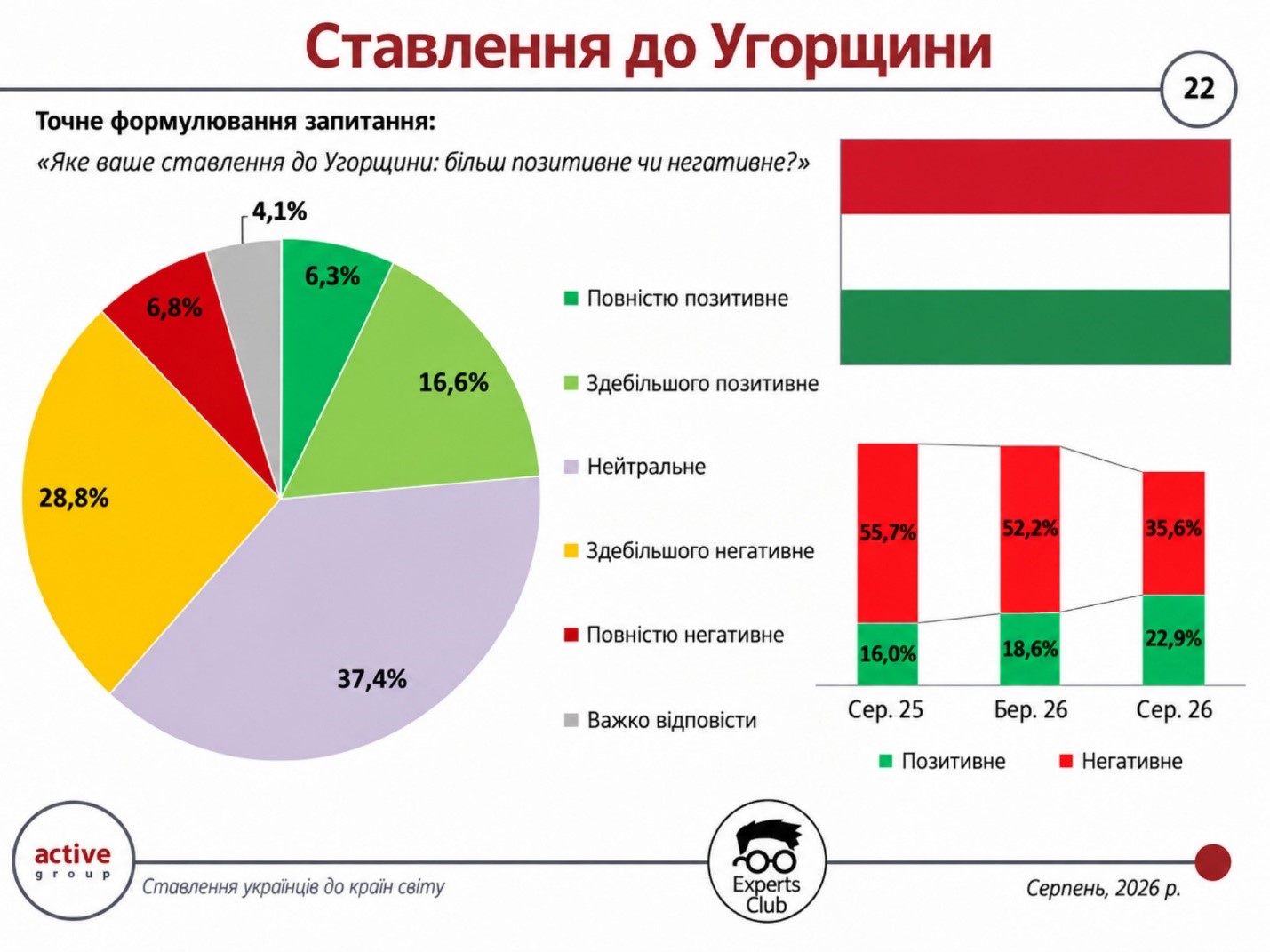
In March 2026, the situation was noticeably more negative. At that time, 4.9% of respondents viewed Hungary entirely positively, and 13.8% viewed it mostly positively—meaning that positive assessments totaled 18.6%. A total of 52.2% of respondents viewed the country negatively: 34.3% viewed it mostly negatively and 17.9% viewed it entirely negatively. 27.3% held a neutral position.
Thus, between March and August, the share of positive assessments increased by 4.3 percentage points—from 18.6% to 22.9%—while negative assessments fell by 16.6 percentage points—from 52.2% to 35.6%. At the same time, the share of neutral responses rose by 10.1 percentage points—to 37.4%.
The shift in the balance is even more pronounced: in March, it stood at minus 33.6 percentage points, and in August, at minus 12.7 percentage points. Thus, the gap between positive and negative assessments narrowed by 20.9 percentage points. At the same time, a significant portion of the former negative sentiment did not directly shift to positive assessments—it was the group of respondents with a neutral attitude that increased significantly.
Oleksandr Pozniy, director of the research company Active Group, commenting on previous waves of the survey, drew attention to the connection between public assessments and international politics as well as perceptions of support for Ukraine.
“This survey confirms the general trend in public sentiment in Ukraine, which has intensified since the start of the full-scale war. Ukrainians clearly associate the support received primarily from European Union countries and the United Kingdom with a positive attitude toward them,” Pozniy noted. Speaking specifically about Hungary, he emphasized: “These results are not surprising—the official rhetoric from Budapest and Bratislava often diverges from Ukraine’s interests and is viewed as pro-Russian, which inevitably influences public opinion.”
The new wave shows a significant softening in assessments of Hungary compared to March. At the same time, it is still too early to speak of a predominantly positive perception: negative responses remain about one and a half times more common than positive ones, and respondents with a neutral attitude now constitute the largest single group.
The survey was conducted in August 2026 using an online self-administered questionnaire via the SunFlowerSociology panel among 800 Ukrainian citizens aged 18 and older. The sample is representative by age, gender, and region; the maximum theoretical margin of error for indicators at the 50% confidence level is ±3.5 percentage points.
ACTIVE GROUP, EUROPE, EXPERTS CLUB, HUNGARY, international relations, Pozniy, PUBLIC OPINION, SOCIOLOGY, UKRAINE

Related: