October 17–18 of this year Li Qiang, Premier of the State Council of the People’s Republic of China, paid an official visit to the Republic of Uzbekistan with the aim of further strengthening the comprehensive strategic partnership between the two countries, expanding trade, economic, and investment cooperation, and implementing the agreements reached at the highest level.
On October 17, President of the Republic of Uzbekistan Shavkat Mirziyoyev received the Chinese delegation. The parties discussed the practical implementation of the agreements reached during the meeting of the two countries’ leaders in Bishkek in August 2026 and noted the intensification of contacts between parliaments, governments, regions, and business circles. Uzbekistan reaffirmed its commitment to the “One China” policy.
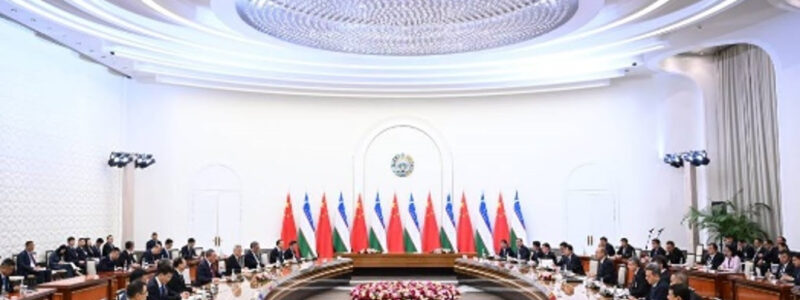
On the same day, talks between Uzbekistan’s Prime Minister Abdulla Aripov and Li Qiang took place at the “Uzbekistan” International Forum Palace. The main focus was on developing cooperation in industry, energy, agriculture, transportation, digital technologies, and other promising sectors.
Over the past five years, the volume of bilateral trade has tripled, reaching nearly 18 billion U.S. dollars by the end of 2025. The volume of Chinese direct investment in Uzbekistan’s economy in 2025 amounted to 17 billion U.S. dollars. There are more than 6,500 enterprises with Chinese capital operating in the country, and the portfolio of promising joint projects is estimated at approximately 60 billion U.S. dollars.
The parties emphasized the importance of constructing the China–Kyrgyzstan–Uzbekistan railway, which is expected to expand the region’s transport connectivity and create additional opportunities for trade. Other priorities include the development of renewable energy, the chemical industry, automotive manufacturing, metallurgy, geology, infrastructure, peaceful nuclear energy, artificial intelligence, robotics, and machine tool manufacturing.
Special attention was given to the development of tourism, cultural, and educational exchanges, particularly increasing the frequency of flights between cities in the two countries. Uzbekistan Culture Days in China and the reciprocal opening of cultural centers are planned for the near future. Cooperation within the framework of the Shanghai Cooperation Organization and the “Central Asia–China” format was also discussed.
Following the talks, bilateral memorandums of cooperation were signed in the fields of industry, energy, customs administration, healthcare, e-commerce, and mass media. A symbol of the strengthening of friendly ties was the decision to name one of Tashkent’s streets “Beijing.”