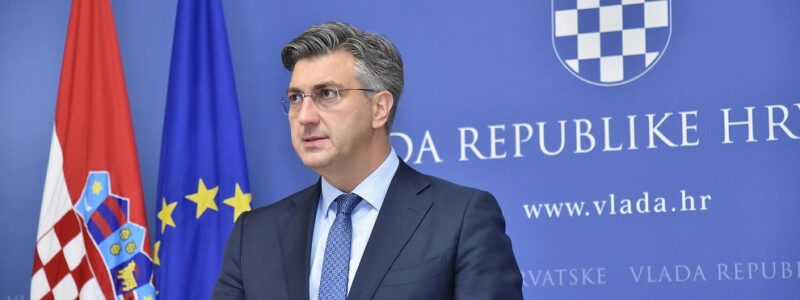
Croatian Prime Minister Andrej Plenković accused the country’s president, Zoran Milanović, and the left-wing opposition of blocking the participation of Croatian military personnel in international missions to train and support the Ukrainian army. According to him, because of these decisions, the Croatian Armed Forces have lost the opportunity to gain valuable experience in military cooperation with Ukraine.
Plenković made this statement on November 10, 2026, during a speech in the Croatian Parliament (Sabor), while presenting a report on the results of the European Council meeting held on October 15–16, according to the Croatian news agency Hina.
The prime minister noted that the Croatian army is not participating in the European Union’s military training mission, EUMAM Ukraine, through which more than 100,000 Ukrainian servicemen have already received training.
“We missed the boat,” Plenković said, commenting on the decision not to participate in international military aid programs for Ukraine.
According to the Croatian prime minister, the Ukrainian army is currently one of the best-trained and most experienced in Europe thanks to the practical application of modern technologies and combat operations.
Plenković believes that the lack of participation in relevant programs limits the Croatian military’s ability to learn from the experience of the Ukrainian Armed Forces and adapt its own training system to modern conditions.
“The Croatian army is essentially unaware of what is currently happening in the field of military cooperation regarding support for Ukraine,” the prime minister noted.
He called this situation a serious shortcoming of the country’s defense policy.
Apart from the European mission EUMAM, Croatia does not participate in the activities of the NATO Security Assistance and Training Mission for Ukraine (NSATU), as President Milanović, in his capacity as Supreme Commander-in-Chief, has not approved the relevant decision.
Milanović had previously opposed the involvement of Croatian military personnel in such programs, arguing that it risked dragging the country into the war between Russia and Ukraine. He has repeatedly emphasized that Croatian military personnel should not be deployed to Ukrainian territory.
Plenković refuted these arguments, noting that the countries participating in the military training of Ukrainian forces conduct such activities primarily outside Ukraine.
According to him, refusing to participate in the missions contradicts the position of the Croatian government, the General Staff, and the Ministry of Defense.
The EU has extended its military training mission for Ukraine until 2028
The Croatian prime minister’s statements came the day after the Council of the European Union decided to extend the mandate of the EUMAM Ukraine military training mission for another two years.
According to an official statement from the Council of the EU dated November 9, 2026, the mission will continue its work until November 15, 2028. Nearly EUR300 million has been allocated for its activities over the next two years.
The EUMAM Ukraine program was established in October 2022 to train Ukrainian military personnel on the territory of EU member states.
It encompasses individual, collective, and specialized military training, as well as the coordination of training programs and the provision of necessary equipment.
Since the mission began, more than 100,000 Ukrainian military personnel have undergone training.
The new EU decision also provides for the establishment of a mission presence in Ukraine to coordinate directly with Ukrainian military leadership and international partners. EUMAM’s main training activities take place within the European Union.
Disagreements Have Arisen in the European Union Regarding Funding for Ukraine
During his speech, Plenković also reported on disagreements among EU member states regarding further funding for Ukraine.
According to him, Slovakia, Hungary, the Czech Republic, and Bulgaria stated at the October meeting of the European Council that they were unwilling to participate in the annual funding of aid to Ukraine.
The Croatian prime minister criticized the position of these countries, noting that they receive more funds from the EU budget than they contribute to it, yet are unwilling to participate in the joint financing of Ukraine’s needs.
He also drew attention to the position of Germany, which provides approximately 20% of the EU budget’s funding. According to Plenković, German Chancellor Friedrich Merz is linking future budget agreements within the EU to the issue of financial support for Ukraine.
Plenković emphasized that there remains a consensus among EU member states on the need to achieve peace in Ukraine, but approaches to further military and financial aid differ.
Croatia has been a member of the European Union since 2013 and of NATO since 2009. Since the start of the full-scale Russian invasion, the country’s government has supported providing military, financial, and humanitarian aid to Ukraine. The issue of Croatian military participation in international training missions remains a point of disagreement between the government and the country’s president.
Sources: Hina / N1 Hrvatska, November 10, 2026; Council of the EU, decision on the extension of EUMAM Ukraine dated November 9, 2026.