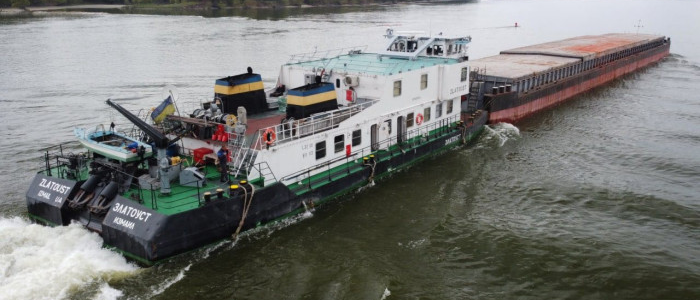
Ukraine’s Danube transport corridor could reach annual cargo turnover of 25–30 million tonnes in the medium term, provided that port, railway and river infrastructure in Ukraine, Romania and Moldova undergo comprehensive modernization. Such a scenario would strengthen the resilience of Ukrainian exports, reduce dependence on Black Sea ports and expand transport connections with Central European countries, reports the Experts Club information and analytical center.
According to the study, prepared as of November 19, 2026, the Ukrainian ports of Izmail, Reni and Ust-Dunaisk have already demonstrated their ability to handle substantial cargo volumes. Data from the Danube Commission and the Ukrainian Sea Ports Authority show that their combined cargo handling amounted to approximately 16.5 million tonnes in 2022 and reached a record 32.021 million tonnes in 2023. The figure subsequently declined to 17.396 million tonnes in 2024 and 8.907 million tonnes in 2025, primarily because of the restoration of Ukraine’s maritime corridor through the Greater Odesa ports.
During the first half of 2026, Danube ports handled 3.401 million tonnes of cargo, compared with 4.464 million tonnes during the corresponding period of the previous year, representing a decrease of approximately 23.8%. However, amid renewed threats to Black Sea shipping, average monthly cargo handling increased to almost 1.5 million tonnes in July–September, compared with 560,000 tonnes during the first half of the year. Analysts believe this trend confirms the Danube Corridor’s ability to accommodate additional cargo flows quickly, although it does not guarantee stable operations at similar volumes throughout the year.
Experts Club identifies three potential development scenarios for the corridor. The conservative scenario envisages annual cargo turnover of 8–12 million tonnes if existing constraints persist, the baseline scenario projects 15–20 million tonnes through improved logistics and terminal modernization, and the intensive development scenario anticipates 25–30 million tonnes if the entire transport system is developed in a coordinated manner. These figures are analytical estimates rather than officially confirmed port design capacities or guaranteed demand forecasts.
The Romanian port of Constanța, the Sulina Canal, the ports of Galați and Brăila, and Moldova’s Giurgiulești port are particularly important to the route’s development. In 2026, the European Bank for Reconstruction and Development completed the sale of the Giurgiulești port operator to the Romanian state-owned company Port of Constanța, creating additional opportunities for integrating the region’s transport systems. At the same time, the European Commission, Ukraine, Romania and Moldova continued implementing Danube Action Plan 2.0 under the EU–Ukraine Solidarity Lanes initiative.
The main obstacles include limited capacity along certain sections of the Sulina Canal, shortages of river pilots, an insufficient specialized fleet, railway bottlenecks and administrative delays. Low water levels represent an additional risk: in 2026, loaded vessels on certain stretches of the Danube were forced to navigate with drafts of only 1.3–1.5 meters. This reduces the amount of cargo carried per voyage and increases logistics costs, making hydrological forecasting and environmental assessments essential components of modernization.
According to Experts Club, promising cargo categories include grain, oilseeds, metallurgical products, fuel, fertilizers, construction materials and industrial equipment. For Ukraine, developing inbound cargo flows alongside exports is particularly important, as return shipments increase vessel utilization and can reduce average transportation costs. The main criterion for evaluating the corridor’s efficiency should therefore be not maximum tonnage, but the total cost, speed and predictability of cargo delivery.
The analysts propose focusing on digital navigation management, reducing queues and simplifying border procedures in 2027, followed by terminal modernization, improved railway access and river fleet development in 2028–2029. From 2030 onward, the priority should be establishing an integrated international transport network. Experts Club concludes that the Danube should develop not as a collection of competing national ports, but as a unified multimodal corridor with transparent rules, coordinated investments and mandatory compliance with environmental standards.