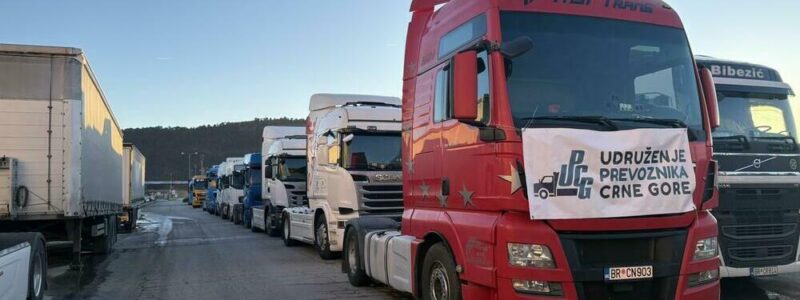
According to The Serbian Economist, Serbian truckers, together with their colleagues from Montenegro, Bosnia and Herzegovina, and North Macedonia have announced their intention to begin blocking freight border crossings into the European Union starting September 14, 2026, if a solution to the issue of professional drivers’ stay in the Schengen Area has not been found by that time.
This was reported by the Serbian association of international carriers, “Međunarodni transport.” According to the association, drivers from the Western Balkan countries continue to be detained, deported, and turned back at the borders for exceeding the permitted length of stay in the Schengen Area. The association claims that several dozen Serbian drivers are turned back at the borders every day, and there have been more than 50 such cases in the past week alone.
Before the blockade begins, the carriers intend to make one more attempt to reach an agreement with European authorities. On August 31, from 12:00 p.m. to 2:00 p.m., a peaceful protest will take place in Belgrade in front of the EU delegation at 40/V Vladimira Popovića Street. Similar protests are planned in front of the EU delegations in Montenegro, Bosnia and Herzegovina, and North Macedonia.
In addition, another meeting between representatives of the transport companies and the European Commission is scheduled for September 1. If it does not lead to a concrete decision, starting September 14, transport companies from the four countries intend to begin protests at border crossings.
The cause of the conflict is the 90/180 rule in effect in the Schengen Area, under which a third-country national may stay in the Schengen Area for no more than 90 days within any 180-day period. This is sufficient for the average tourist, but international carriers argue that professional drivers are physically unable to make regular trips to the EU under such a restriction.
The rule itself existed previously, but with the introduction of the Electronic Entry/Exit System (EES), enforcement has become significantly stricter. The system automatically records the entries and exits of third-country nationals and, as of April 10, 2026, is fully operational at the external borders of the Schengen Area, with the exception of Ireland and Cyprus. The possibility of “losing” some days between passport stamps has effectively disappeared.
At the same time, the European Commission officially acknowledges the existence of the problem. The EU Visa Policy Strategy, adopted on January 29, 2026, states that a number of mobile professions, particularly truck drivers serving European businesses, may need to stay in several Schengen countries for more than 90 days within a 180-day period.
The European Commission has stated that it will seek a solution, including the possibility of introducing special EU-wide rules regarding extended short-term stays. However, a specific mechanism has not yet been approved.
For Serbia, this issue is particularly acute due to the significant dependence of its exports on road transport to the EU. Carriers warn that some drivers are already refusing to make trips to EU countries.
This will be the second major regional protest by carriers in 2026. Starting on January 26, drivers from Serbia, Montenegro, Bosnia and Herzegovina, and North Macedonia simultaneously blocked freight terminals at the borders with the EU. In Serbia, the protest lasted five days and was called off on January 30 after the European Commission included the issue of professional drivers in its new visa strategy.
The economic impact of the previous blockade was significant. According to estimates by the Serbian Chamber of Commerce and Industry, the restrictions affected about 93% of exports from the four Western Balkan countries, and potential business losses were estimated at up to 92 million euros per day.
For Ukraine, a potential blockade is also significant, although its impact will be considerably less than for Serbia and other Western Balkan countries. The main truck traffic between Ukraine and the EU passes directly through Poland, Slovakia, Hungary, and Romania, so a blockade of the Serbian borders will not halt Ukrainian-European trade.
However, the issue could directly affect Ukrainian trucks traveling to Serbia, Bosnia and Herzegovina, Montenegro, North Macedonia, Albania, and Greece, as well as carriers that use Serbia as a transit country. If the protest follows the January scenario and the Batrovci freight terminal on the border with Croatia, the Horgos terminal on the border with Hungary, the border crossings with Romania, and the Gradina terminal on the border with Bulgaria are blocked, Ukrainian carriers will find themselves in the same lines as other international trucks.
The most vulnerable routes may be those from Ukraine through Hungary or Romania to Serbia and onward to Montenegro, Bosnia, and North Macedonia, as well as transit toward the Adriatic and the southern Balkans. Rerouting cargo through Romania and Bulgaria or other border crossings is not always possible and entails additional mileage, fuel costs, and longer delivery times.
This is a particularly sensitive issue for Ukrainian logistics due to the economy’s heavy reliance on land transport corridors. According to the European Commission, in July 2026, the “Solidarity Lanes”—established after the start of the full-scale war—accounted for approximately 90% of Ukraine’s imports and 95% of its non-agricultural exports, although only a portion of these shipments is related to the Balkan route. Therefore, a strike in the Western Balkans alone is not capable of paralyzing Ukrainian foreign trade, but for companies that work specifically with the Balkans, it could significantly increase logistics costs.
A separate issue concerns Ukrainian professional drivers themselves. Ukraine has a special agreement with the EU on road transport, which has been extended until March 31, 2027. It liberalizes bilateral and transit freight transport and allows Ukrainian carriers to operate within the EU without some of the former licensing restrictions.
However, this agreement primarily regulates carriers’ access to the market, not the length of stay of a specific driver in the Schengen Area. Therefore, a Ukrainian driver entering the Schengen Area as a third-country national on a short-term stay and who does not hold a long-term visa, residence permit, or other relevant status must generally also comply with the 90-day limit within a 180-day period. The European Commission notes that holders of long-term visas and residence permits are not subject to this restriction.
https://t.me/relocationrs/3545