
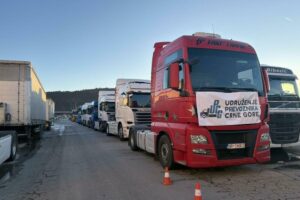
According to The Serbian Economist, Serbian truckers, together with their colleagues from Montenegro, Bosnia and Herzegovina, and North Macedonia have announced their intention to begin blocking freight border crossings into the European Union starting September 14, 2026, if a solution to the issue of professional drivers’ stay in the Schengen Area has not been found by that time.
This was reported by the Serbian association of international carriers, “Međunarodni transport.” According to the association, drivers from the Western Balkan countries continue to be detained, deported, and turned back at the borders for exceeding the permitted length of stay in the Schengen Area. The association claims that several dozen Serbian drivers are turned back at the borders every day, and there have been more than 50 such cases in the past week alone.
Before the blockade begins, the carriers intend to make one more attempt to reach an agreement with European authorities. On August 31, from 12:00 p.m. to 2:00 p.m., a peaceful protest will take place in Belgrade in front of the EU delegation at 40/V Vladimira Popovića Street. Similar protests are planned in front of the EU delegations in Montenegro, Bosnia and Herzegovina, and North Macedonia.
In addition, another meeting between representatives of the transport companies and the European Commission is scheduled for September 1. If it does not lead to a concrete decision, starting September 14, transport companies from the four countries intend to begin protests at border crossings.
The cause of the conflict is the 90/180 rule in effect in the Schengen Area, under which a third-country national may stay in the Schengen Area for no more than 90 days within any 180-day period. This is sufficient for the average tourist, but international carriers argue that professional drivers are physically unable to make regular trips to the EU under such a restriction.
The rule itself existed previously, but with the introduction of the Electronic Entry/Exit System (EES), enforcement has become significantly stricter. The system automatically records the entries and exits of third-country nationals and, as of April 10, 2026, is fully operational at the external borders of the Schengen Area, with the exception of Ireland and Cyprus. The possibility of “losing” some days between passport stamps has effectively disappeared.
At the same time, the European Commission officially acknowledges the existence of the problem. The EU Visa Policy Strategy, adopted on January 29, 2026, states that a number of mobile professions, particularly truck drivers serving European businesses, may need to stay in several Schengen countries for more than 90 days within a 180-day period.
The European Commission has stated that it will seek a solution, including the possibility of introducing special EU-wide rules regarding extended short-term stays. However, a specific mechanism has not yet been approved.
For Serbia, this issue is particularly acute due to the significant dependence of its exports on road transport to the EU. Carriers warn that some drivers are already refusing to make trips to EU countries.
This will be the second major regional protest by carriers in 2026. Starting on January 26, drivers from Serbia, Montenegro, Bosnia and Herzegovina, and North Macedonia simultaneously blocked freight terminals at the borders with the EU. In Serbia, the protest lasted five days and was called off on January 30 after the European Commission included the issue of professional drivers in its new visa strategy.
The economic impact of the previous blockade was significant. According to estimates by the Serbian Chamber of Commerce and Industry, the restrictions affected about 93% of exports from the four Western Balkan countries, and potential business losses were estimated at up to 92 million euros per day.
For Ukraine, a potential blockade is also significant, although its impact will be considerably less than for Serbia and other Western Balkan countries. The main truck traffic between Ukraine and the EU passes directly through Poland, Slovakia, Hungary, and Romania, so a blockade of the Serbian borders will not halt Ukrainian-European trade.
However, the issue could directly affect Ukrainian trucks traveling to Serbia, Bosnia and Herzegovina, Montenegro, North Macedonia, Albania, and Greece, as well as carriers that use Serbia as a transit country. If the protest follows the January scenario and the Batrovci freight terminal on the border with Croatia, the Horgos terminal on the border with Hungary, the border crossings with Romania, and the Gradina terminal on the border with Bulgaria are blocked, Ukrainian carriers will find themselves in the same lines as other international trucks.
The most vulnerable routes may be those from Ukraine through Hungary or Romania to Serbia and onward to Montenegro, Bosnia, and North Macedonia, as well as transit toward the Adriatic and the southern Balkans. Rerouting cargo through Romania and Bulgaria or other border crossings is not always possible and entails additional mileage, fuel costs, and longer delivery times.
This is a particularly sensitive issue for Ukrainian logistics due to the economy’s heavy reliance on land transport corridors. According to the European Commission, in July 2026, the “Solidarity Lanes”—established after the start of the full-scale war—accounted for approximately 90% of Ukraine’s imports and 95% of its non-agricultural exports, although only a portion of these shipments is related to the Balkan route. Therefore, a strike in the Western Balkans alone is not capable of paralyzing Ukrainian foreign trade, but for companies that work specifically with the Balkans, it could significantly increase logistics costs.
A separate issue concerns Ukrainian professional drivers themselves. Ukraine has a special agreement with the EU on road transport, which has been extended until March 31, 2027. It liberalizes bilateral and transit freight transport and allows Ukrainian carriers to operate within the EU without some of the former licensing restrictions.
However, this agreement primarily regulates carriers’ access to the market, not the length of stay of a specific driver in the Schengen Area. Therefore, a Ukrainian driver entering the Schengen Area as a third-country national on a short-term stay and who does not hold a long-term visa, residence permit, or other relevant status must generally also comply with the 90-day limit within a 180-day period. The European Commission notes that holders of long-term visas and residence permits are not subject to this restriction.
https://t.me/relocationrs/3545

According to the Serbian business publication Parametar, trucking companies in Serbia, Bosnia and Herzegovina, Montenegro, and North Macedonia are demanding that the European Union propose a concrete solution by September 1, 2026, to the problem of restrictions on professional drivers’ stays in the Schengen Area. Otherwise, the carriers are prepared to stage coordinated protests again and block freight terminals at the borders with the EU.
The decision was agreed upon by representatives of transport associations from the four countries at a regional meeting in Skopje. However, September 1 is not automatically the start date for the blockade. The carriers intend to wait for negotiations with the European Commission and discussions on the EU’s new visa strategy, after which they will decide on further actions.
The carriers’ main complaint concerns the 90/180 rule. Third-country nationals who benefit from the visa-free regime may stay in the Schengen Area for no more than 90 days within any 180-day period. This restriction also applies to professional drivers from the Western Balkans.
Carriers consider this approach unfair, since drivers do not enter the EU as tourists but regularly cross the border while delivering international cargo and return to their home countries after their trips.
“Our drivers leave every two, three, or five days, depending on the route, and then return. They don’t want to leave their home countries; they want to work for our companies. But 90 days isn’t enough for professional work,” said Nejo Mandić, president of the Serbian Association of International Carriers.
According to estimates by regional transport organizations, the problem affects about 100,000 professional drivers in four countries. Stricter enforcement of the limit has become particularly noticeable following the introduction of the European Entry/Exit System (EES), which automatically records the entry and exit of third-country nationals.
There is already a precedent for this threat to carriers. In late January 2026, drivers from Serbia, Bosnia and Herzegovina, Montenegro, and North Macedonia simultaneously blocked more than 20 freight crossings into the Schengen Area. The borders between Serbia and Bosnia and Herzegovina with Croatia, between North Macedonia and Greece and Bulgaria, as well as the port of Bar in Montenegro, were blocked.
The economic impact was significant. Marko Čadež, president of the Serbian Chamber of Commerce and Industry, estimated at the time that the blockade affected about 93% of the four countries’ exports, with total losses amounting to approximately 92 million euros per day.
According to his assessment, individual companies faced fines and losses of 10,000–50,000 euros per day per company due to their inability to fulfill contractual obligations. Moreover, the problems were not limited to Balkan manufacturers—European companies with factories, suppliers, and customers in the region also suffered from the delays.
If a new regional blockade were to occur on a similar scale, economic losses could again amount to tens of millions of euros daily.
For Serbia, the most vulnerable sector is the industry oriented toward European supply chains. Automotive components, electrical equipment, rubber products, metal products, food, and other goods are often transported by truck on a scheduled basis and must reach the customer at a strictly defined time.
Even a brief halt in traffic leads to a buildup of cargo in warehouses, disruptions to production cycles, and the risk of penalties from European buyers.
A prolonged blockade is particularly dangerous for manufacturers of perishable goods. During the January protests, carriers reported that Lidl alone had planned to deliver approximately 120 truckloads of meat, dairy products, fruits, and vegetables from Europe to Serbia within a single week. The traffic blockade directly threatened these deliveries.
The transport companies themselves are suffering double losses: while a truck is idle, it continues to incur costs for leasing, driver salaries, insurance, and other payments, but generates no revenue. Industry associations also warn that the inability to fully utilize drivers on EU routes could lead to the loss of contracts to carriers from EU countries.
The economic damage will not be limited to the Western Balkans. A significant portion of businesses in Serbia, North Macedonia, and Bosnia and Herzegovina are directly integrated into the production chains of EU companies.
Delays in the supply of components could affect factories in Germany, Italy, Austria, Slovenia, Hungary, and other countries. The reverse flow of European goods to the Balkans is also coming to a halt.
In addition, an important land transport corridor connecting Central Europe, Turkey, and onward to the Middle East runs through Serbia and North Macedonia. During the January protests, Reuters noted that the blockade was disrupting traffic along precisely this strategic route.
Following the January protests, the European Commission acknowledged that the established regime creates problems for highly mobile professions, particularly international drivers, artists, and athletes. The EU’s new visa strategy, adopted in January, provides for the possibility of finding a more flexible mechanism for these categories of workers.
However, an automatic exemption for professional drivers from the 90/180 rule has not yet been implemented.
Carriers are insisting on either special status for international drivers or a system of professional visas or other permits that would allow them to stay in the Schengen Area for more than 90 days without the risk of detention, deportation, or a travel ban.
Thus, September 1 becomes a key date for the Western Balkans’ transport market. If Brussels proposes a workable mechanism for professional drivers, a new blockade can be avoided. If an agreement cannot be reached, carriers from the four countries have already agreed on the possibility of joint action.
The issue of restrictions on professional drivers’ stays in the Schengen Area also affects Ukraine.
Ukrainian long-haul truck drivers employed by carriers registered in Ukraine, when entering the Schengen Area under the visa-free regime, are also generally subject to the 90-day rule within an 180-day period, unless they hold a separate long-term status or a residence permit. In its visa strategy dated January 29, 2026, the European Commission explicitly acknowledged that the current system creates problems for mobile professions, specifically mentioning truck drivers who serve EU businesses.
At the same time, the EU-Ukraine Road Transport Agreement, in effect until March 31, 2027, simplifies access for Ukrainian carriers to the EU market and eliminates the need for a number of permits for bilateral and transit transport, but does not in itself constitute an exception to Schengen migration rules.
Therefore, Ukraine has a genuine interest in the very same solution demanded by carriers in the Western Balkans: to distinguish between a professional driver’s working hours on an international route and a regular tourist stay, or to establish a special regime for such drivers.

The Italian government’s call to restrict the application of Schengen rules to Spain following a mass migrant surge from Morocco into the Spanish city of Ceuta has received support from some European politicians but has drawn sharp criticism from Madrid and raised questions about the legal feasibility of such a move.
According to Spain’s Ministry of the Interior, approximately 50,000 people may have entered Ceuta beginning on the morning of July 30. The head of the local government, Juan Jesús Vivas, estimated the number of arrivals at 60,000. About half of them subsequently returned to Morocco voluntarily. According to various estimates, between 34 and 41 people died while attempting to cross the border.
Spain deployed military personnel and additional police units to Ceuta. Prime Minister Pedro Sánchez called the mass border crossing a violation of the country’s territorial sovereignty and announced that the return of individuals who had entered Spanish territory illegally would be expedited. Madrid stated that it is coordinating with Moroccan authorities.
Italian Prime Minister Giorgia Meloni stated that Rome is prepared to take extraordinary measures to protect its borders, including considering “suspending the Schengen Area with Spain.”
Italian Foreign Minister Antonio Tajani and Transport Minister Matteo Salvini also called for the reinstatement of border controls with Spain. Tajani linked the events in Ceuta to Madrid’s decision to legalize the status of hundreds of thousands of migrants who had previously been in the country without proper status.
Finnish Interior Minister Mari Rantanen supported the Italian initiative, stating that Spain had allegedly failed to fulfill its obligation to protect the Schengen Area’s external border. Danish Prime Minister Mette Frederiksen called for consideration of possible restrictions but did not announce a specific decision by her government.
Swedish Prime Minister Ulf Kristersson stated only that Stockholm is prepared to take the necessary measures if events in Ceuta begin to affect security or the migration situation in Sweden. This is not the same as supporting Spain’s exclusion from the Schengen Area.
As of the evening of July 31, there is no reliable official confirmation that Austria has specifically supported the exclusion or suspension of Spain’s Schengen membership. Therefore, reports of a coordinated position among all four countries cannot be fully confirmed.
At the same time, France has ordered stricter border checks with Spain. Such measures are legally permissible as a temporary reinstatement of internal border controls but do not imply Spain’s withdrawal from or exclusion from the Schengen Area.
Spanish Foreign Minister José Manuel Albares summoned the Italian ambassador in Madrid and called Tajani’s statements unacceptable.
“This statement is inappropriate coming from the foreign minister of a partner country and friend from whom we expect European solidarity, not partisan demagoguery,” Albares said.
Spanish authorities attribute the crisis to a false interpretation, spread by smugglers, of a Supreme Court ruling that restricted the immediate return of migrants detained at sea near Ceuta and Melilla.
Critics of the Italian initiative also point out that exploiting the migration tragedy for domestic political gain could fuel xenophobic sentiments and replace the necessary discussion on external border security with political statements that are impossible to implement in their proposed form.
Can Spain Be Excluded from the Schengen Area?
Current EU legislation does not provide for a separate procedure that would allow a single state or group of states to simply “exclude” another country from the Schengen Area.
The Schengen Borders Code allows member states to temporarily reintroduce border controls at their internal borders in the event of a serious threat to public order or internal security. The state must notify the European Commission and other Schengen members of this decision. Such controls must be a measure of last resort, temporary, and proportionate.
If serious and persistent deficiencies in the protection of the external border threaten the functioning of the entire Schengen Area, the Council of the EU, upon a proposal from the European Commission, may recommend that one or more countries reinstate internal border controls. The initial duration of such a decision is up to six months, and the total duration generally may not exceed two years. This does not constitute an exclusion of the state from the Schengen Area.
The special status of Ceuta and Melilla must be considered separately. Spain is already required to check the documents of passengers traveling by sea or air from these cities to mainland Spain or other Schengen Area countries. Therefore, entering Ceuta illegally does not, in and of itself, allow for uncontrolled movement throughout Europe.
Consequently, Italy, France, or other countries may temporarily intensify checks on passengers arriving from Spain. However, there is no legal procedure for unilaterally excluding Spain from the Schengen Area.
Calls for such a step are currently primarily political in nature and have not been formalized as an official proposal by the European Commission or a decision by the Council of the EU.

According to Serbian Economist, associations of truckers from Serbia, Montenegro, Bosnia and Herzegovina, and North Macedonia have announced their intention to start protest actions on January 26, 2026, by blocking freight terminals at border crossings in the direction of Schengen countries. The planned actions were reported by regional media outlets, citing statements from the relevant associations.
The carriers cite the practical application and future tightening of controls in connection with the introduction of the Entry/Exit System (EES) as the reason for their actions. According to them, professional drivers from non-EU countries will effectively be subject to the 90-day rule within a 180-day period for short stays in the Schengen area, just like ordinary tourists. Carriers warn that with the “strict” application of the rules from spring 2026, some drivers may quickly exhaust their stay limit, which will create risks for supply chains and freight traffic between the EU and the Western Balkans region.
The European Commission has stated that it is monitoring the situation and is in contact with its Western Balkan partners, while pointing out that the rules for short stays in Schengen are “clear” and that practical decisions at the external borders are the responsibility of the member states.
EES is an automated EU IT system for registering the entry and exit of non-EU citizens on short-term trips, including recording document and biometric data, with the aim of improving the efficiency of external border controls and detecting overstays. The European Commission has announced that the system is being implemented in stages, with full deployment at all border crossing points planned for April 10, 2026, when electronic records are to finally replace stamps in passports.
If blockades are implemented at freight terminals, queues and delays are possible in a number of EU-Western Balkans directions, which may affect the timing of commercial deliveries in the region and throughout Europe.
Blockade, Bosnia, CARGO, Macedonia, MONTENEGRO, Schengen, SERBIA, Trucking company



