
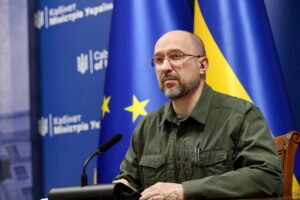
Prime Minister of Ukraine Denys Shmyhal, following the results of the Spring Meetings in Washington (the United States), announced that Ukraine would receive additional support of more than $5 billion from France, Germany, and the UK.
“Following the results of negotiations with the finance ministers of the G7 countries at the Spring Meetings, we received assurances of additional support of more than $5 billion for Ukraine. In particular, we agreed on additional support packages with France, Germany, and the UK,” Shmyhal told reporters at a briefing in Washington.
According to him, Switzerland will also provide Ukraine with CHF 1.8 billion over the next six years. And Denmark, in turn, creates a special fund and plans to fill it with EUR 1 billion.
In addition, Spain, Ireland, Japan, Lithuania, Latvia, Iceland, and the Netherlands will provide additional support to Ukraine.
“All this will help win and ensure the resilience of our economy,” the Ukrainian prime minister said.
As reported, Shmyhal met with the finance ministers of the UK, Germany, and France on the sidelines of the Spring Meetings in Washington. At the meeting, the head of government raised issues of financial support for Ukraine and interaction within the Multi-agency Donor Coordination Platform.
Germany will provide more than EUR 3 billion in additional funding this year and more than EUR 5 billion in long-term defense support.
France also plans to provide EUR 2 billion as part of long-term financing.

“In August 2022, we entered the premises of the first building of our all-Ukrainian clinic for the first time. In October, renovation work began here and in April, after a record 5 months, we opened the doors of the first building of the Superhumans Center,” the statement reads.
“Superhumans is not just a clinic, not just a network of clinics, it’s a philosophy and rightly so. The rebuilding of a country begins with the rebuilding of each individual, military or civilian. Child or adult. And when we see the creation of such a center, we see the creation of a place of strength,” said First Lady Elena Zelenskaya, the center’s ambassador, at the opening.
“For me, it’s a personal obligation, my way of giving thanks to those we win. The military and civilians who paid for our country’s freedom with their own health will receive at Superhumans the most advanced technology, the best medical expertise from around the world, an individualized itinerary – everything they need to get back to active life,” said Superhumans co-founder Andrew Stavnitzer.
“We are honored to be part of this extraordinary effort to help world-class Ukrainians who have been terribly injured in this war – they are truly ‘Superhumans.’ Russia’s full-scale invasion of Ukraine is a war against civilians.
Many men, women, and children will lose life or limb, even long after the war is over, due to the sheer number of mines in large parts of Ukraine. This center is a step toward giving Ukrainians a chance to rebuild their lives and their country,” said Howard G. Buffett, chairman and CEO of the Howard G. Buffett Foundation.
The Superhumans Center is a comprehensive medical facility that will prosthetically treat and rehabilitate patients, primarily those who have been injured as a result of Russian aggression.
The first phase of the center, a prosthetic workshop and part of the rehabilitation center, were opened April 14. According to Vladimir Golovatsky, deputy medical center, more than sixty medical specialists will work in the center. Annually about 3 thousand patients will be treated there.
Investment in the launch of the Superhumans rehabilitation medical center in Lviv is estimated at $54 million, Superhumans CEO Olga Rudneva said earlier.
The first stage of the project includes repairs of premises, purchase of equipment, a year of medical team salaries and purchase of materials for prosthetics.
The second and third phases include the launch of all the buildings of the hospital, the start of the educational center on the basis of Superhumans, and expansion to other regions of Ukraine, in particular, to Kharkiv.
The project has already been supported by the Howard Buffett Foundation, the Richard Branson Virgin Unite Foundation, Cargill, Payoneer, Freedom Finance, Loro Piano, Mastercard, SD Capital and others.
A memorandum of cooperation was signed between Superhumans and the Ministry of Health. Health Minister Viktor Lyashko noted that the joint goal is to provide Ukrainians who suffered war injuries with the world’s best expertise.
Ottobock, a German manufacturer of technologies for manufacturing various types of prostheses, orthoses and exoskeletons, is working with the Superhumans project to launch a laboratory for the production of prostheses. Ossur, a leading manufacturer of bionic and other prostheses from Iceland, is also advising the team on starting its own production of prostheses.
The project is being created at the initiative of Ukrainian businessman Andrei Stavnitser. Another of its founders is Philip Grushko.
Ukraine’s negative balance of foreign trade in goods in January-February 2023 increased 3.4 times compared to the same period in 2022 – to $3.713 billion from $1.083 billion, the State Statistics Service (Gosstat) reported on Friday.
According to her data, exports of goods from Ukraine during this period compared to January-February 2022 decreased by 42.8% – to $6.459 billion, imports – by 17.9%, to $10.172 billion.
The State Statistics Committee specified that seasonally adjusted exports rose 4.8% to $3.543 billion in February-2023 compared to January-2023, while imports rose 3.2% to $5.79 billion.
The seasonally adjusted foreign trade balance in February-2023 was negative at $2.248 billion, while in the previous month it was also negative at $2.23 billion.
The January-February 2023 import coverage ratio for exports was 0.64 (January-February 2022 – 0.91).
The State Statistics Committee specified that foreign trade operations were conducted with partners from 206 countries.

Farmers in Romania and Bulgaria staged protests on Friday against the European Union’s decision to exempt agricultural products from Ukraine, which has oversupplied local markets and contributed to lower prices, the Associated Press (AP) reported on Friday.
“Farmers in Romania and Bulgaria organized protests on Friday over the European Union’s stance on excessive supplies of Ukrainian agricultural products that have flooded local markets and weakened prices,” AP reports.
Protests were held in Bucharest and other cities in Romania. In Bulgaria, farmers blocked several border crossings.
“There are less than three months left before the new harvest and there is a danger that the products will not be able to be sold above the production price,” AP quoted Liliana Peron, executive director of the Romanian Farmers Association, as saying.
In recent weeks, Polish farmers have also been protesting against the EU’s duty-free supplies of Ukrainian grain to European markets, forcing the country’s Agriculture Minister Henryk Kowalczyk to resign.
Last year, the EU abolished customs tariffs for Ukraine to allow for freer grain supplies.
On Monday, the European Commission announced its desire to help the population of Ukraine by organizing the export of Ukrainian grain, but it is making sure that the EU market does not suffer too much from Kyiv’s support measures.

Switzerland is ready to provide long-term support and intends to allocate for Ukraine at least another $1.7 billion over the period until 2028, Swiss Info reports citing Foreign Minister Ignazio Cassis.
“Swiss Foreign Minister Ignazio Cassis stressed that his country is ready to provide long-term support to Ukraine and that Bern intends to allocate at least another 1.5 billion Swiss francs ($1.7 billion) to Kiev over the period until 2028,” the website said Thursday.
It noted that “this support will be provided as part of the overall international cooperation strategy announced by the Swiss Ministry of Foreign Affairs (EDA) on Wednesday, April 12, 2023.”
“With the 300 million francs already allocated by Bern for 2023 and 2024, Switzerland will provide a total of at least 1.8 billion francs in support to Ukraine over the next six years,” it said.
In addition, the foreign minister speaking at the meeting of the World Bank Group (WBG) and the International Monetary Fund (IMF) in Washington stressed the importance of the Lugano Declaration, adopted on July 5, 2022 in Lugano.
The declaration provides seven principles for Ukraine’s recovery process: partnership, focus on reform, transparency, democratic participation, multi-stakeholder engagement, equity and sustainability.
Cassis notes that “this document contains important guiding principles of international support for Ukrainian reforms.”
Before the conference in Washington, D.C., the Swiss foreign minister held consultations with Ukrainian Prime Minister Denis Shmygal.

A Falcon 9 rocket on Saturday (Kiev time) launched into orbit with a group of 51 research mini-satellites as part of the Transporter 7 mission, the carrier company SpaceX said.
The satellite group includes satellites from NASA, U.S. companies and research centers, as well as a number of foreign countries.
The launch took place from the SLC-4E launch pad at U.S. Space Force Base Vandenberg in California on Friday at 23:48 U.S. Pacific Coast Time (Saturday at 09:48 Kiev time).
As part of the launch, the first reusable stage of the Falcon 9 launch vehicle, which is in its tenth use, is scheduled to make a controlled vertical landing at Vandenberg Base about eight minutes after liftoff.



