

Asia-Pacific region (APR) stock indices are steadily rising on Tuesday, with the exception of the Japanese indicator.
The markets of China and Hong Kong are rising following a jump in developer shares after restrictions on the sector were eased the day before.
China Securities Regulatory Commission (CSRC) said on Monday it had lifted a multi-year ban on listed developers to sell shares in the domestic market in order to raise funds to pay debts and M&A deals.
The decision was made to support a “stable and sustainable” development of the sector, the CSRC said.
“These measures are likely to accelerate the consolidation of real estate companies,” said China Index Holdings expert Liu Shui.
Shares of major Chinese real estate developer Country Garden Holdings Co. jumped 8.2 percent in Hong Kong trading.
China Vanke gained 12.2% in Hong Kong and 10% in Shenzhen, Gemdale gained 5.1% and 10% in Hong Kong and Shanghai respectively and Greenland Holdings gained 5.3% and 10%.
The Shanghai Composite stock index rose 2% in trading, the Shenzhen Composite rose 2.2% and Hong Kong’s Hang Seng gained 4%.
The Chinese market is also supported by growing expectations of traders that Beijing will ease quarantine restrictions after last weekend’s mass protests in the country.
“Expectations are growing that China’s zero-tolerance COVID-19 policy is over, and that’s improving traders’ sentiment,” notes Kiyong Song, a Societe Generale analyst in Hong Kong, cited by Bloomberg.
The value of securities of Chinese alcohol producer Kweichow Moutai rose by 5.4%. On the eve, the company announced its intention to pay a special dividend of 21.91 yuan ($3.06) for the first time since its shares were listed on the stock exchange in 2001.
Japan’s Nikkei 225 stock index was losing 0.5 percent in trading amid weak statistical data.
Japan’s retail sales rose in October for the eighth month in a row, but the rate of increase slowed compared to September and was worse than analysts’ expectations.
According to the Ministry of Economy, Trade and Industry, retail sales rose 4.3% last month compared with October 2021. They were up 4.8% in September. Experts polled by Trading Economics predicted an average increase of 5 percent.
Retail sales rose 0.2% from the previous month after climbing 1.5% in September.
Unemployment in Japan in October remained at 2.6%, while analysts expected its reduction to 2.5%.
Leaders of the decrease are shares of technological companies: SoftBank Group securities fell by 1.4%, Tokyo Electron – by 1.2%, Keyence Corp. – by 1.6% and Advantest – by 1.7%.
Shares of Toyota Motor (-1.2%), Sony Group (-1%), Mitsubishi Corp. (-0.9%) also fell in price.
The Australian S&P/ASX 200 added 0.3% on Tuesday, while South Korea’s KOSPI gained 0.9%.
BHP Group shares gained 2.1%, Rio Tinto – 3.5% and Pilbara Minerals – 1.6%.
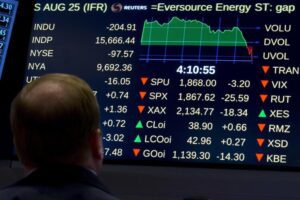
Western European stock indexes are rising in trading on Tuesday, recovering from a fall the day before.
Investors welcomed the news that Chinese authorities plan to actively encourage vaccination against coronavirus among the adult population. Experts believe that such a measure may prove to be key to the removal of anti-Covids restrictions.
At the same time, the market expects that yesterday’s mass protests in Chinese cities may prompt authorities to relax restrictions. “We don’t assume that China will publicly abandon its zero-tolerance coronavirus policy, but we are hoping for some regional easing,” said Jefferies analyst Mohit Kumar.
The Stoxx Europe 600 composite index of the region’s largest companies was up 0.44% to 439.77 points by 11:00 a.m. Ksk.
Germany’s DAX is up 0.24%, Britain’s FTSE 100 is up 0.88%, France’s CAC 40 is up 0.34%, Italy’s FTSE MIB is up 0.28% and Spain’s IBEX 35 is up 0.14%.
Traders are waiting for the publication of important statistical data from European countries. At 12:00 noon the European Commission is scheduled to publish a composite index of confidence in the euro area economy for November. At 15:00 KSC the German Federal Statistical Office (Destatis) will release a preliminary report on consumer price changes in November.
Meanwhile, inflation in Spain slowed in November to its lowest since January thanks to a slower rise in fuel and electricity prices. Consumer prices, calculated in accordance with EU standards, in the country this month rose by 6.6% year on year, compared with 7.3% in October, showed the preliminary data of the Spanish statistics office INE. Experts polled by The Wall Street Journal, on average, expected a rise of 7.4%.
Shares of British airline easyJet PLC fell by 2.4%. Despite the fact that the air carrier cut its pre-tax loss in fiscal 2022, the figure was worse than experts expected.
French energy company Electricite de France (EDF) SA received a new credit line worth 2.2 billion euros, which is expected to increase the company’s financial flexibility in the coming years. EDF stock quotes are stable in trading in France.
The stock of British pharmaceutical AstraZeneca PLC is up 0.6%. The company announced the purchase of biotech Neogene Therapeutics Inc. for $320 million.
Shares of Dutch semiconductor equipment maker ASM International N.V. (+6.5%), British insurance company Prudential PLC (+5%) and mining company Rio Tinto PLC (+3.7%) are emerging as growth leaders among Stoxx 600 components.

Oil prices are rising sharply on Tuesday morning, recovering from a decline in the previous session, during which quotations reached lows of almost a year.
The cost of January Brent futures on London’s ICE Futures Exchange stands at $85.16 a barrel by 7:12 a.m. CST, up $1.97 (2.37%) from the previous session’s closing price. At the close of trading on Monday those contracts have fallen by $0.44 (0.5%) to $83.19 per barrel.
The price of WTI futures for January at electronic trades of the New York Mercantile Exchange (NYMEX) is $78.87 per barrel by that time, which is $1.53 (1.98%) above the final value of the previous session. The day before contract went down in price by $0.96 (1.3%) to $77.24 per barrel.
In trading on Monday, Brent fell to its lowest level since January and WTI dropped to its lowest point since last December, according to Dow Jones Market Data. The reason for the fall were mass protests against lockdowns, which took place over the weekend throughout China, including Beijing, Shanghai, Xinjiang and Wuhan.
Experts are concerned that unexpectedly mass protests in China, which is the world’s largest oil importer, could provoke a tough reaction from the authorities of China, notes Bloomberg.
However, then American traders returned to the market after a long weekend and oil prices have moved away from the session lows.
“The last few days have been difficult for oil due to a combination of low volumes, sluggish trading and concerns about reduced demand due to lockdowns in China,” Colin Cieszynski, senior analyst at SIA Wealth Management, wrote.
The market’s attention is now focused on the next OPEC+ meeting on December 4 and on negotiations regarding the introduction of a price ceiling on Russian oil in response to Russia’s continuation of a full-scale war against Ukraine. European Union countries again failed to reach a consensus on Monday, as some countries found the proposed price cap of $62 a barrel too high, Bloomberg reported, citing informed sources.

The dollar is actively declining against major world currencies Tuesday morning after speeches by members of the U.S. Federal Reserve (Fed).
The ICE index, which shows the U.S. dollar against six currencies (euro, Swiss franc, yen, Canadian dollar, pound sterling and Swedish krona), is down 0.4 percent, as is the broader WSJ Dollar Index.
The Fed may slow the pace of interest rate hikes, but it has no plans to interrupt the process itself just yet, Federal Reserve Bank (FRB) Cleveland President Loretta Mester told the Financial Times.
“It’s very easy to focus only on good news, but we don’t want to succumb to self-delusion. The cost of a hasty stop is too high,” she noted.
Mester is among the voting members of the Federal Open Market Committee (FOMC) in 2022, which decides interest rate levels.
In November, the Fed raised the rate by 75 basis points (bps) for the fourth consecutive meeting. The rate is now at its highest since January 2008 at 3.75-4% per annum. The Fed is expected to raise the cost of borrowing by 50 basis points in December.
The euro/dollar pair is trading at $1.0387 by 7:40 kk against $1.0340 at the close of Monday’s session; the euro is adding about 0.45%.
The dollar/yen exchange rate is down 0.2% at 138.66 yen from 138.93 yen at the end of last session.
The pound is up 0.4%, trading at $1.2005 versus $1.1960 the day before.

Ukrainian President Vladimir Zelensky held meetings with the foreign ministers of Estonia, Iceland, Latvia, Lithuania, Norway, Finland and Sweden, who arrived on a visit to Kiev.
“Met with the foreign ministers of Estonia – Urmas Reinsalu, Iceland – Tordis Kolbrun Gylfadottir, Latvia – Edgars Rinkevics, Lithuania – Gabrielius Landsbergis, Norway – Anniken Uitfeldt, Finland – Pekka Haavisto and Sweden – Tobias Billström,” Zelensky wrote in Telegram Monday.
“This visit is an important signal of strong support and solidarity of partner countries with Ukraine, especially in times of serious challenges. I thank the Baltic and Nordic countries for their invariably active and effective assistance to Ukraine in defending its territorial integrity and independence,” the Ukrainian head of state added.

The Kyiv analytical center “Club of Experts” together with the consulting company “Club of Exporters of Ukraine” and the information portal Open4business launched a new project to help Ukrainian businesses achieve success in international markets.
According to the founders of the project, at the first stage, a series of video courses will be created on the YouTube platform, with the help of which it will be possible to get acquainted with the peculiarities of doing business in the EU countries, importing and exporting goods, European certification rules, etc.
“Thanks to our project, businesses will be able to receive prompt advice and assistance from our representatives both in Europe and in Ukraine,” said Maxim Urakin, founder of the Club of Experts.
According to Evgenia Litvinova, CEO of the Ukrainian Exporters Club, the business project will include not only a series of training videos, but also the possibility of providing specialized advice to those companies that want to quickly and cost-effectively enter the European and global markets.
“For each consulting assignment of our client, we carefully select a project team, which is formed from internal and external experts who are specialists in the required industries. The presence of good contacts and reputation within the country, both in industries and with various government agencies, allows us to quickly and efficiently implement projects,” Litvinova said.
For individual advice on doing business in the EU and other countries of the world, you can fill out the online form at the link:
https://docs.google.com/forms/d/e/1FAIpQLSeit-dG6SJ9E9QtDSZ4ggqQEmn1RHyAMKfDqO90Db4cDn1ZEA/viewform
Project partners:
Exporters Club: https://people2people.com.ua/ru/
Portal Open4business: https://open4business.com.ua
Expert club channel: https://www.youtube.com/@user-nz9lh8yg9g
BUSINESS, BUSINESS_IN_EU, CLUB_EXPERTS, CLUB_EXPORTERS, HELP_BUSINESS, URAKIN, ЛИТВИНОВА



