

Ukraine will need disposable and mobile granaries with a total capacity of up to 20 million tons for the storage of crops this season, thanks to public-private partnerships, the necessary equipment has already been contracted.
However, Ukraine’s purchases of alternative granaries have depleted their stocks on the world market, Mykola Solsky, Minister of Agrarian Policy and Food, said on Wednesday.
“Ukraine may have taken away all disposable crop storage systems that are now available on the world market, they mainly go to Ukraine. Therefore, the Ukrainian market and the state have secured themselves, and I hope that there will be no particular problems with crop storage,” he said. Solsky during the All-Ukrainian telethon.
At the same time, most of the funds for storing the harvest were purchased by Ukrainian agribusiness privately.
“Judging by our monitoring of the market and communication with its participants, 15-19 million tons of one-time storage was contracted by the business, and with the help of international funds and through the UN FAO, a tender was purchased and held this month at the initiative of the Ministry of Agro-Industrial Complex for about 6 million tons of one-time storage,” the minister said.
According to him, the day before, a separate tender was held from the United States Agency for International Development (USAID) for the purchase of mobile silos for Ukraine to store more than 1 million tons of crops, as well as equipment for loading and unloading them.
As reported, on August 15, 2022, President of Ukraine Volodymyr Zelensky signed bill No. 7548-1 on exemption from taxation of import duties on goods used for the storage of grains and oilseeds.
The import of mobile granaries will make it possible to save the harvest of this season, since in the conditions of the military invasion of the Russian Federation, by the end of 2022, a deficit of 10-15 million tons of elevator capacities is expected in Ukraine.
In mid-June, the Ministry of Agrarian Policy announced that Ukraine would soon receive the first batch of sleeves for temporary storage of crops – mobile granaries, the need for which arose due to a shortage of elevator capacities.
To address this issue, the agency turned to the governments of the United States, Canada, the UK and the EU.

As of the end of August 2022, Ukraine has accumulated 13 billion cubic meters of gas in its underground storage facilities (UGS). m of natural gas, said the head of the GTS Operator of Ukraine Serhiy Makogon in an interview with Interfax-Ukraine.
“Now there are 13 billion cubic meters of gas in underground storage facilities. By October 15, according to forecast calculations, there will be about 14.4 billion cubic meters of gas. With such reserves, it is realistic to get through a mild winter, since today gas consumption has significantly decreased,” he said.
At the same time, the head of the operator noted, the military threat factor increases the risks of a stable heating season, so additional imports would be appropriate.
“As a GTS operator, we can assure that the transport routes for receiving gas from Poland, Slovakia and Hungary are ready to import in the amount of 54 million cubic meters per day. We hope that colleagues from Naftogaz will be able to take advantage of these opportunities to purchase gas,” Makogon said. .
As reported, as of the end of July, gas reserves in Ukraine’s UGS facilities reached 12 billion cubic meters. m.

Ukrainian farmers have received 50 combines, 49 tractors and various farming equipment as charity assistance under the Harvest of Victory project funded by American philanthropist Howard Buffett, and mobile granaries are also on their way to Ukraine.
According to a Wednesday statement on the website of the Agrarian Policy and Food Ministry of Ukraine, on August 30, Ukrainian farmers and representatives of the ministry met with Buffett at the Khreschatyk metro station in Kyiv, which is temporarily closed for passengers.
The Howard G. Buffett Foundation has already allocated $90 million for Ukrainians in the territories that had been liberated from the Russian occupation, notably, for the spring sowing campaign there.
During the meeting, Buffett said that today assistance and investment in Ukraine’s agriculture is a contribution to food safety of millions of people all over the world, adding that the problems Ukraine is facing today are the problems of not only Ukrainians, but also of the U.S., the EU and other states, according to the ministry.
The philanthropist also said that his foundation is also working on programs of assistance for small farmers for the next year. It also supports the investigation into the consequences of Russia’s aggression for agriculture, as well as the development of a damage recovery mechanism.
Buffett said that he saw in the pictures and videos how the Russian troops and the war in general affect the fields. The farmers are unable to collect harvest safely. When Russia tries to hit the world by limiting food resources, this is a crime against the whole world, he stressed.
In turn, Agrarian Policy and Food Deputy Minister of Ukraine Taras Vysotsky thanked the guest for his support to Ukraine, and especially its agricultural sector.
The parties discussed the issues of irrigation, possible introduction of the No-Till technology in Ukraine, food security, as well as further steps to prevent worsening of the situation with food security in the world and a negative impact of the war on the environment.

The coking division of PJSC “Dneprovsk Metallurgical Plant” (former “Dneprokoks”), which is part of DCH Steel of the DCH group of businessman Alexander Yaroslavsky, in January-July of this year reduced the production of metallurgical coke by 52.4% compared to the same period last year – to 135 .2 thousand tons.
As a representative of the company told the Interfax-Ukraine agency, in July the enterprise produced 18.3 thousand tons of metallurgical coke.
At the same time, for 7 months-2022, the output of gross coke with 6% moisture content amounted to 166.2 thousand tons, including 22.7 thousand tons in July.
The plant produced 283.9 thousand tons of coke in January-July 2021, including 41.7 thousand tons in July-2021.
For 7 months-2022, 175 thousand tons of domestic coal were supplied to the enterprise, 37 thousand tons from Russia (before the war), 3 thousand tons from Poland and 24 thousand tons from the Czech Republic.
DMZ specializes in the production of steel, cast iron, rolled products and products from them. On March 1, 2018, the DCH Group signed an agreement on the purchase of the Dneprovsky steel plant from Evraz.
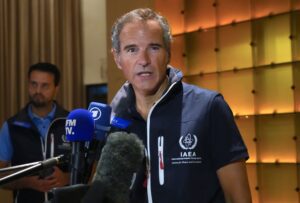
A mission of the International Atomic Energy Agency (IAEA) has arrived in Zaporizhia, Energoatom reported.
“Today, August 31, at about 15:00, the mission of the International Atomic Energy Agency arrived in Zaporizhia,” Energoatom’s Telegram channel says on Wednesday.
As reported, Minister of Energy Herman Haluschenko said Wednesday morning that the IAEA mission had gone to the Zaporizhia nuclear power plant occupied by Russian troops. On Tuesday, IAEA Director General Rafael Grossi met with President Volodymyr Zelensky.
The distance from Zaporizhia to Enerhodar, where the ZNPP is located, is about 120 km.
Since the beginning of the 2022/2023 marketing year (MY, July-June), Ukraine has exported 3.96 million tonnes of grain crops, including 2.49 million tonnes of corn (63% of total supplies), 1.14 million tonnes of wheat (29%) and 310,000 tonnes of barley (12%).
As reported on the website of the Ministry of Agrarian Policy and Food on Wednesday, since the beginning of the current marketing year, the rate of grain exports has been 2.17 times lower than in the same period last year (in July 1-August 31, 2021, some 8.6 million tonnes were exported).
At the same time, according to the ministry, for the period of August 26-31, some 550,000 tonnes of grain crops were supplied to foreign markets (110,000 tonnes daily), while for the previous period, August 19-26, – 430,000 tonnes of grain crops (61,400 tonnes daily), on August 11-19 – 770,000 tonnes (96,200 tonnes daily), and on August 5-11 – 340,000 tonnes of grain crops (48,600 tonnes daily). Thus, the average daily export rates for the past reporting period increased by 1.8 times compared to the previous period.
In general, from the beginning of MY 2022/2023 to August 31, 2022, Ukraine exported 1.14 million tonnes of wheat (four times less compared to the same date in MY 2021/2022), 310,000 tonnes of barley (8.9 times less) , 500 tonnes of rye (25 times less) and 11,900 tonnes of flour (two times less).
In total, 310,000 tonnes of corn, 202,000 tonnes of wheat, 36,000 tonnes of barley, 100 tonnes of rye and 1,800 tonnes of flour were delivered to foreign markets for the period of August 26-31.



