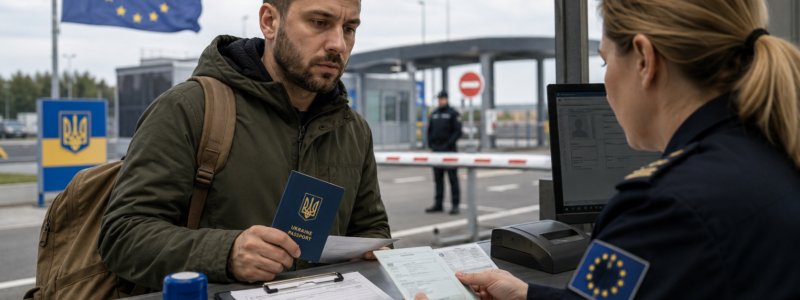
The European Commission is preparing the largest change since 2022 to the temporary protection regime for Ukrainian citizens: newly arriving Ukrainians who are subject to military obligations and do not have permission from the Ukrainian authorities to leave the country will, as a rule, be unable to receive temporary protection in the EU, the Polish newspaper Rzeczpospolita writes.
According to the Experts Club information and analytical centre, Ukrainian citizens will need special confirmation from Ukrainian authorities stating that they are not subject to mobilization in order to enter Poland and other EU countries and subsequently receive temporary protection. Rzeczpospolita clarifies that this requirement may apply not only to men but also to women if they are subject to the relevant Ukrainian military obligations.
The European Commission’s official proposal already confirms the general principle of such changes. On June 26, 2026, the Commission proposed extending temporary protection for people who fled Ukraine for another year, until March 4, 2028, but at the same time stated that temporary protection should generally not be granted to newly arriving persons whom the Ukrainian authorities have not allowed to leave because of military obligations.
The draft decision of the European Commission states that the extension of temporary protection should not undermine Ukraine’s ability to defend itself and that EU member states should take into account Ukraine’s military needs and its legally established conscription obligations. Verification of such requirements should apply only to new arrivals after the decision enters into force, while Ukrainians who have already received temporary protection in the EU should retain this status and the rights associated with it.
Polish Deputy Interior Minister Maciej Duszczyk told Rzeczpospolita that the new restrictions would probably begin to apply as early as July, but would concern not those who already have temporary protection in EU countries, but those who are only seeking to obtain it. He also noted that Poland supports such changes.
According to Rzeczpospolita, Ukraine itself initiated the tightening of the approach, having asked EU countries in early June to restrict the admission of some Ukrainian citizens under the special conditions of temporary protection. The Polish publication links this to Kyiv’s attempts to strengthen mobilization and reduce the outflow of people who may be needed by the Ukrainian army.
Reuters previously reported that the European Commission’s proposal means that newly arriving Ukrainian men of conscription age without permission from the Ukrainian authorities to leave the country will not be able to qualify for temporary protection. According to European Commissioner for Migration Magnus Brunner, the aim of the changes is to balance the need to protect people with Ukraine’s ability to defend itself.
This issue is of particular importance in Poland, as the country remains one of the main reception centres for Ukrainians in the EU. According to Eurostat, as of May 31, 2026, 4.38 million people who had fled Ukraine were under temporary protection in the EU. The largest numbers were in Germany, with 1.283 million, Poland, with 967,505, and Spain, with 267,400.
Rzeczpospolita, citing the Polish Ministry of Digital Affairs, writes that as of June 15 there were more than 218,000 Ukrainian men aged 18–65 with UKR status in Poland. Across the EU, adult men account for 26.8% of temporary protection beneficiaries from Ukraine, or more than 1.17 million people, based on Eurostat’s May estimate.
Poland’s Office for Foreigners previously reported that almost 1 million Ukrainian citizens in the country benefit from temporary protection, while approximately 1.55 million Ukrainians in total have valid grounds for staying in Poland. This estimate includes around 993,000 people with PESEL UKR, 462,000 Ukrainian citizens with temporary residence permits, and 92,000 with permanent residence or EU long-term resident status. These figures do not include Ukrainians staying in Poland under the visa-free regime or on visas.
Rzeczpospolita also writes that the Polish Interior Ministry is finalizing work on amendments to the citizenship law. Among the measures being discussed are increasing the minimum residence period for naturalization to eight years, introducing a language and integration test, and requiring a so-called confirmation of loyalty. According to the publication, this reform will affect Ukrainian citizens to the greatest extent, since for many years they have remained the largest group of foreigners applying for Polish citizenship.
Thus, this is not about ending protection for Ukrainians who are already in the EU, but most likely about introducing new screening of future arrivals. The European Union is effectively trying to combine humanitarian protection for refugees with Ukraine’s military needs, while Poland, which is home to one of the largest Ukrainian communities in Europe, is becoming one of the key participants in this debate.
EXPERTS CLUB, TEMPORARY PROTECTION, UKRAINIANS

Related: