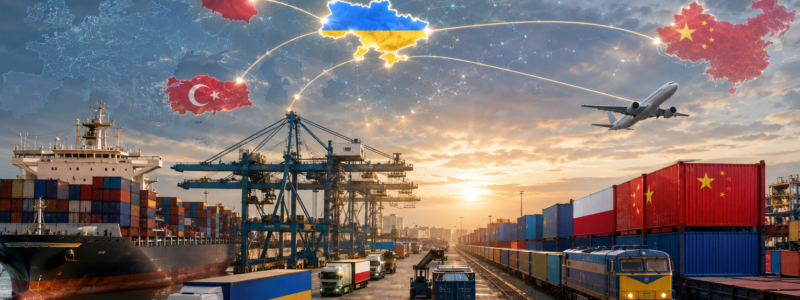
China, Poland and Turkey topped the list of Ukraine’s largest trading partners based on the results of January-May 2026, according to foreign trade in goods data as of May 31, 2026.
According to calculations by the Experts Club analytical center based on the presented statistics, Ukraine’s total trade turnover with all countries of the world in the first five months of 2026 amounted to about $58.1 billion. Imports reached $40.5 billion, exports — $17.6 billion, while the negative balance of trade in goods amounted to about $22.9 billion.
The top 10 trading partners accounted for about $36.1 billion in trade turnover, or approximately 62% of Ukraine’s total trade in goods. At the same time, they accounted for about $27.1 billion in imports and $9.0 billion in exports. This shows that Ukraine’s foreign trade in 2026 remains highly concentrated around several key directions, while the overall balance is formed primarily by imports from the largest economies of Europe, Asia and the United States.
China ranked first by a wide margin. Ukraine’s trade turnover with China in January-May amounted to $11.75 billion. At the same time, imports from China reached $11.09 billion, while Ukrainian exports amounted to only $663.8 million. The negative trade balance with China amounted to $10.43 billion, making the PRC the main source of Ukraine’s trade deficit.
Poland ranks second with trade turnover of $5.85 billion. Ukraine imported $3.88 billion worth of goods from Poland and exported $1.97 billion worth of goods. The balance remained negative and amounted to $1.91 billion. Poland retains its importance as one of Ukraine’s main trade and logistics channels to the EU, especially amid the reorientation of Ukrainian trade following the start of the full-scale war.
Turkey ranked third with trade turnover of $4.21 billion. Imports from Turkey amounted to $2.66 billion, Ukraine’s exports — $1.55 billion, and the negative balance — $1.11 billion. Turkey remains an important trade destination for Ukraine in the Black Sea region, combining the role of a supplier of industrial goods and a market for Ukrainian products.
Germany and the United States also entered the top five. Trade with Germany amounted to $3.68 billion, and with the United States — $2.49 billion. In both cases, Ukraine has a significant deficit: $1.56 billion with Germany and $1.53 billion with the United States. This reflects dependence on imports of equipment, machinery, transport, pharmaceuticals, energy-related and defense-related goods.
Italy ranked sixth, but the structure of its trade differs noticeably from that of other major partners. Trade turnover amounted to $2.17 billion, while imports and exports were almost equal: $1.09 billion and $1.08 billion, respectively. The negative balance with Italy amounted to only $9.5 million, making it one of Ukraine’s most balanced major trading partners.
Hungary, the Czech Republic, the Netherlands and Slovakia ranked seventh through tenth. Trade turnover with Hungary amounted to $1.62 billion, with the Czech Republic — $1.45 billion, with the Netherlands — $1.45 billion, and with Slovakia — $1.42 billion. Among them, the Netherlands stands out: it is the only country in the top 10 with which Ukraine has a positive balance — $213.9 million. This is associated with a higher volume of Ukrainian exports compared with imports.
“The structure of the top ten shows that Ukrainian foreign trade in 2026 remains both European and Asian. The EU is the key space for trade, logistics and exports, but China remains the main supplier of imported goods. The main challenge for Ukraine is not only to increase exports, but also to reduce the asymmetry of trade with its largest partners, especially through products with higher added value,” said Maksym Urakin, founder of the Experts Club analytical center.
It is also important that seven EU countries entered the top 10: Poland, Germany, Italy, Hungary, the Czech Republic, the Netherlands and Slovakia. Their combined role confirms that the European Union remains Ukraine’s basic trade framework. However, even within the EU, the structure is heterogeneous: Poland and Germany generate a large deficit for Ukraine, Italy is almost balanced, while the Netherlands provides a positive balance.
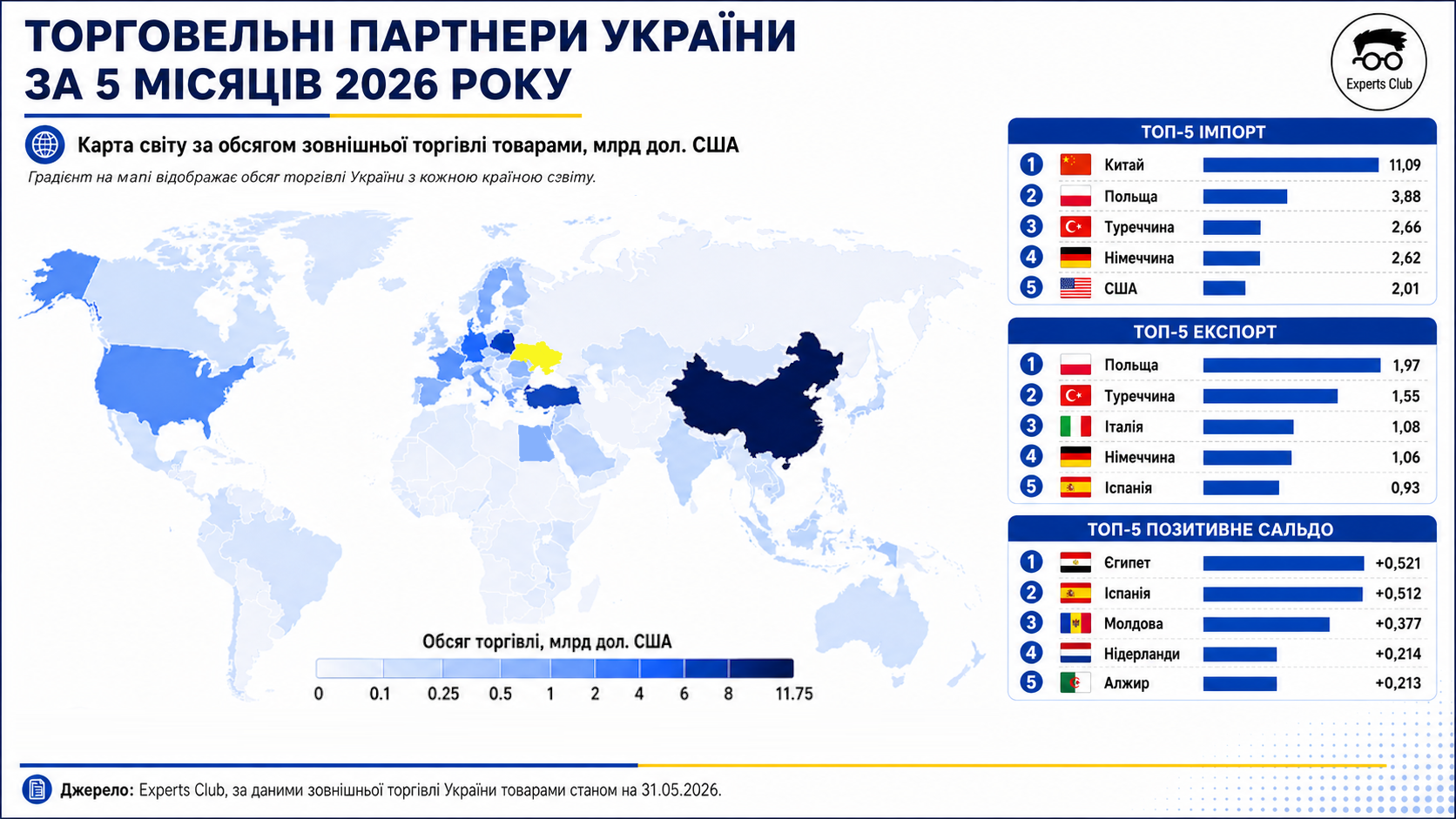
China remains a separate problem for the trade balance. Its share of Ukrainian imports in the first five months of 2026 exceeds a quarter of total imports of goods, while Ukrainian exports to China remain limited. As a result, almost half of Ukraine’s total trade deficit is generated solely in the Chinese direction.
For Ukraine, this means that restoring the foreign trade balance will require not only growth in exports of agricultural and metallurgical products, but also the development of new export niches — mechanical engineering, processing, food products, IT-related goods and industrial cooperation with the EU.
For reference: the Experts Club analytical center used data on Ukraine’s foreign trade in goods by countries of the world as of May 31, 2026. All indicators in the source table are given in thousands of US dollars.
EXPERTS CLUB, FOREIGN TRADE, TRADE BALANCE, TRADING PARTNERS, МАКСИМ УРАКІН