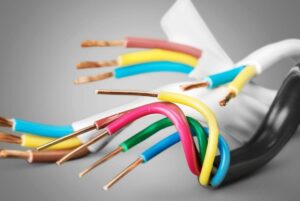
The Ukrainian insulated wire and cable manufacturing sector continues to be one of the industrial segments with a significant trade surplus.
In January–September 2026, Ukraine exported these products worth $1.065 billion, while imports totaled $540.7 million. Thus, the trade surplus reached approximately $524.3 million.
Exports exceeded imports by nearly two to one, which stands in stark contrast to the overall structure of Ukraine’s foreign trade, where imports of goods have significantly exceeded exports in recent years.
However, the trend indicates a gradual narrowing of this surplus.
Exports of wires and cables over the nine-month period remained virtually unchanged compared to last year, while imports rose by 22.7%. According to estimates, imports in January–September 2025 totaled about $441 million, and the trade surplus was approximately $624 million.
Thus, over the year, the trade surplus in wires and cables decreased by approximately $100 million, or 16%.
The European Union remains Ukraine’s main export market. Germany, Poland, and Hungary alone purchased nearly $698 million worth of Ukrainian products, accounting for about two-thirds of total exports.
At the same time, the structure of imports is becoming more Asian-oriented. China increased its shipments by approximately 70%—to $157 million—and took first place among suppliers, ahead of Hungary and Poland.
As a result, a dual trend is emerging: Ukraine continues to be a major supplier of cable products to European industry, but at the same time is rapidly increasing its purchases of certain types of wires, cables, and electrical components from abroad.
By the end of 2025, exports of cable products totaled $1.41 billion, while imports amounted to $590.7 million, meaning the annual surplus exceeded $819 million.
The sustained significant trade surplus makes the production of wires and cables one of the most interesting examples of the Ukrainian manufacturing industry, which is deeply integrated into European production chains. That said, future trends will depend on the state of the European automotive industry, energy infrastructure development, and the ability of Ukrainian companies to maintain production amid the war.
Source: State Customs Service of Ukraine, foreign trade statistics for January–September 2026.
State Customs Service Statistics
China, Poland and Turkey topped the list of Ukraine’s largest trading partners based on the results of January-May 2026, according to foreign trade in goods data as of May 31, 2026.
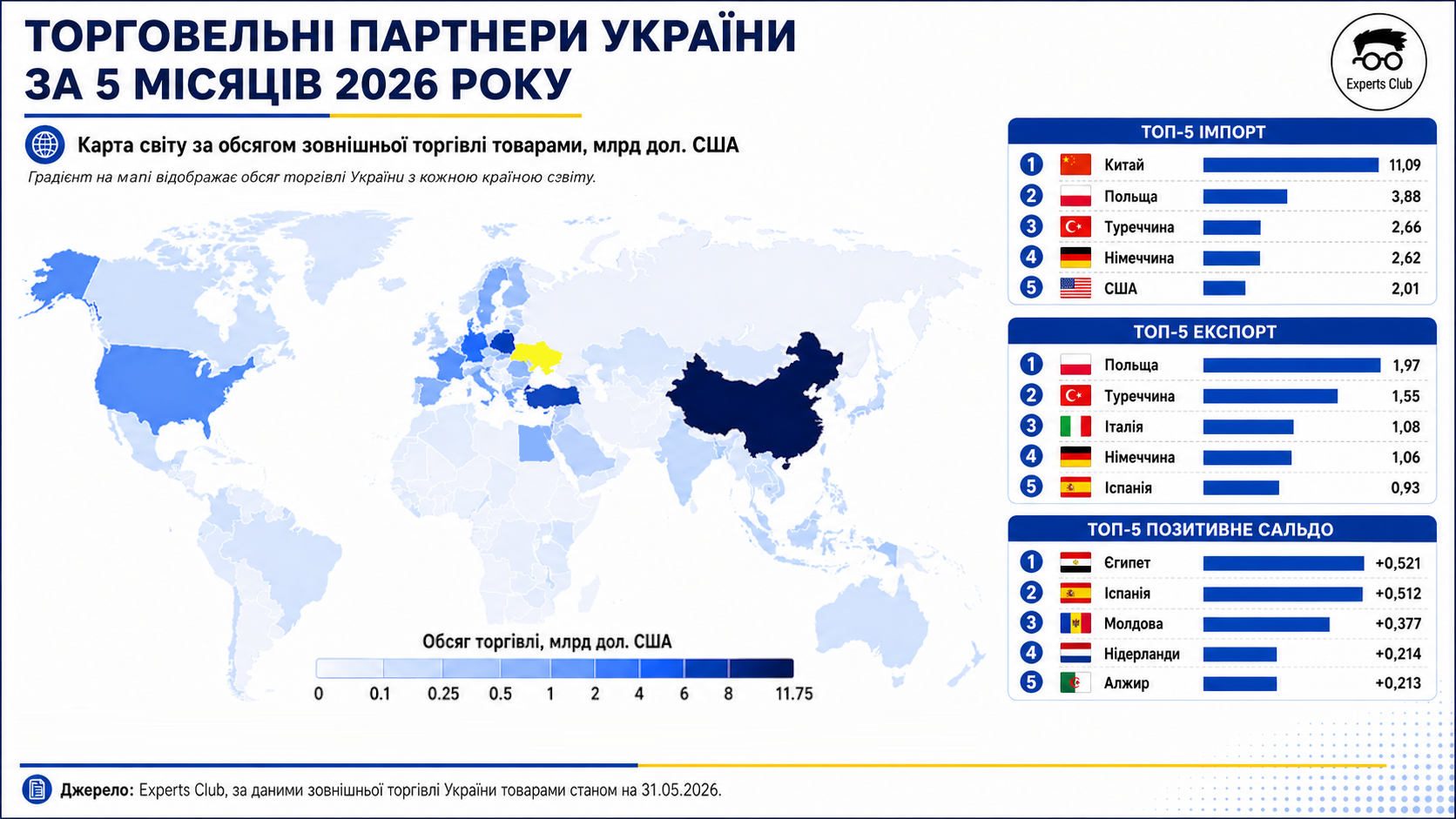
According to calculations by the Experts Club analytical center based on the presented statistics, Ukraine’s total trade turnover with all countries of the world in the first five months of 2026 amounted to about $58.1 billion. Imports reached $40.5 billion, exports — $17.6 billion, while the negative balance of trade in goods amounted to about $22.9 billion.
The top 10 trading partners accounted for about $36.1 billion in trade turnover, or approximately 62% of Ukraine’s total trade in goods. At the same time, they accounted for about $27.1 billion in imports and $9.0 billion in exports. This shows that Ukraine’s foreign trade in 2026 remains highly concentrated around several key directions, while the overall balance is formed primarily by imports from the largest economies of Europe, Asia and the United States.
China ranked first by a wide margin. Ukraine’s trade turnover with China in January-May amounted to $11.75 billion. At the same time, imports from China reached $11.09 billion, while Ukrainian exports amounted to only $663.8 million. The negative trade balance with China amounted to $10.43 billion, making the PRC the main source of Ukraine’s trade deficit.
Poland ranks second with trade turnover of $5.85 billion. Ukraine imported $3.88 billion worth of goods from Poland and exported $1.97 billion worth of goods. The balance remained negative and amounted to $1.91 billion. Poland retains its importance as one of Ukraine’s main trade and logistics channels to the EU, especially amid the reorientation of Ukrainian trade following the start of the full-scale war.
Turkey ranked third with trade turnover of $4.21 billion. Imports from Turkey amounted to $2.66 billion, Ukraine’s exports — $1.55 billion, and the negative balance — $1.11 billion. Turkey remains an important trade destination for Ukraine in the Black Sea region, combining the role of a supplier of industrial goods and a market for Ukrainian products.
Germany and the United States also entered the top five. Trade with Germany amounted to $3.68 billion, and with the United States — $2.49 billion. In both cases, Ukraine has a significant deficit: $1.56 billion with Germany and $1.53 billion with the United States. This reflects dependence on imports of equipment, machinery, transport, pharmaceuticals, energy-related and defense-related goods.
Italy ranked sixth, but the structure of its trade differs noticeably from that of other major partners. Trade turnover amounted to $2.17 billion, while imports and exports were almost equal: $1.09 billion and $1.08 billion, respectively. The negative balance with Italy amounted to only $9.5 million, making it one of Ukraine’s most balanced major trading partners.
Hungary, the Czech Republic, the Netherlands and Slovakia ranked seventh through tenth. Trade turnover with Hungary amounted to $1.62 billion, with the Czech Republic — $1.45 billion, with the Netherlands — $1.45 billion, and with Slovakia — $1.42 billion. Among them, the Netherlands stands out: it is the only country in the top 10 with which Ukraine has a positive balance — $213.9 million. This is associated with a higher volume of Ukrainian exports compared with imports.
“The structure of the top ten shows that Ukrainian foreign trade in 2026 remains both European and Asian. The EU is the key space for trade, logistics and exports, but China remains the main supplier of imported goods. The main challenge for Ukraine is not only to increase exports, but also to reduce the asymmetry of trade with its largest partners, especially through products with higher added value,” said Maksym Urakin, founder of the Experts Club analytical center.
It is also important that seven EU countries entered the top 10: Poland, Germany, Italy, Hungary, the Czech Republic, the Netherlands and Slovakia. Their combined role confirms that the European Union remains Ukraine’s basic trade framework. However, even within the EU, the structure is heterogeneous: Poland and Germany generate a large deficit for Ukraine, Italy is almost balanced, while the Netherlands provides a positive balance.
China remains a separate problem for the trade balance. Its share of Ukrainian imports in the first five months of 2026 exceeds a quarter of total imports of goods, while Ukrainian exports to China remain limited. As a result, almost half of Ukraine’s total trade deficit is generated solely in the Chinese direction.
For Ukraine, this means that restoring the foreign trade balance will require not only growth in exports of agricultural and metallurgical products, but also the development of new export niches — mechanical engineering, processing, food products, IT-related goods and industrial cooperation with the EU.
For reference: the Experts Club analytical center used data on Ukraine’s foreign trade in goods by countries of the world as of May 31, 2026. All indicators in the source table are given in thousands of US dollars.
EXPERTS CLUB, FOREIGN TRADE, TRADE BALANCE, TRADING PARTNERS, МАКСИМ УРАКІН
China remains the undisputed leader among Ukraine’s trading partners in terms of import volume. In the first six months of 2025, Ukraine imported Chinese goods worth US$8.15 billion. This is more than twice the figures for Poland ($3.58 billion) and Germany ($3.18 billion), which ranked second and third, respectively.
High import volumes were also recorded from Turkey ($2.53 billion) and the United States ($2.31 billion). Italy, the Czech Republic, Slovakia, Bulgaria, and France round out the top ten key suppliers with volumes ranging from $1.2 billion to $979 million.
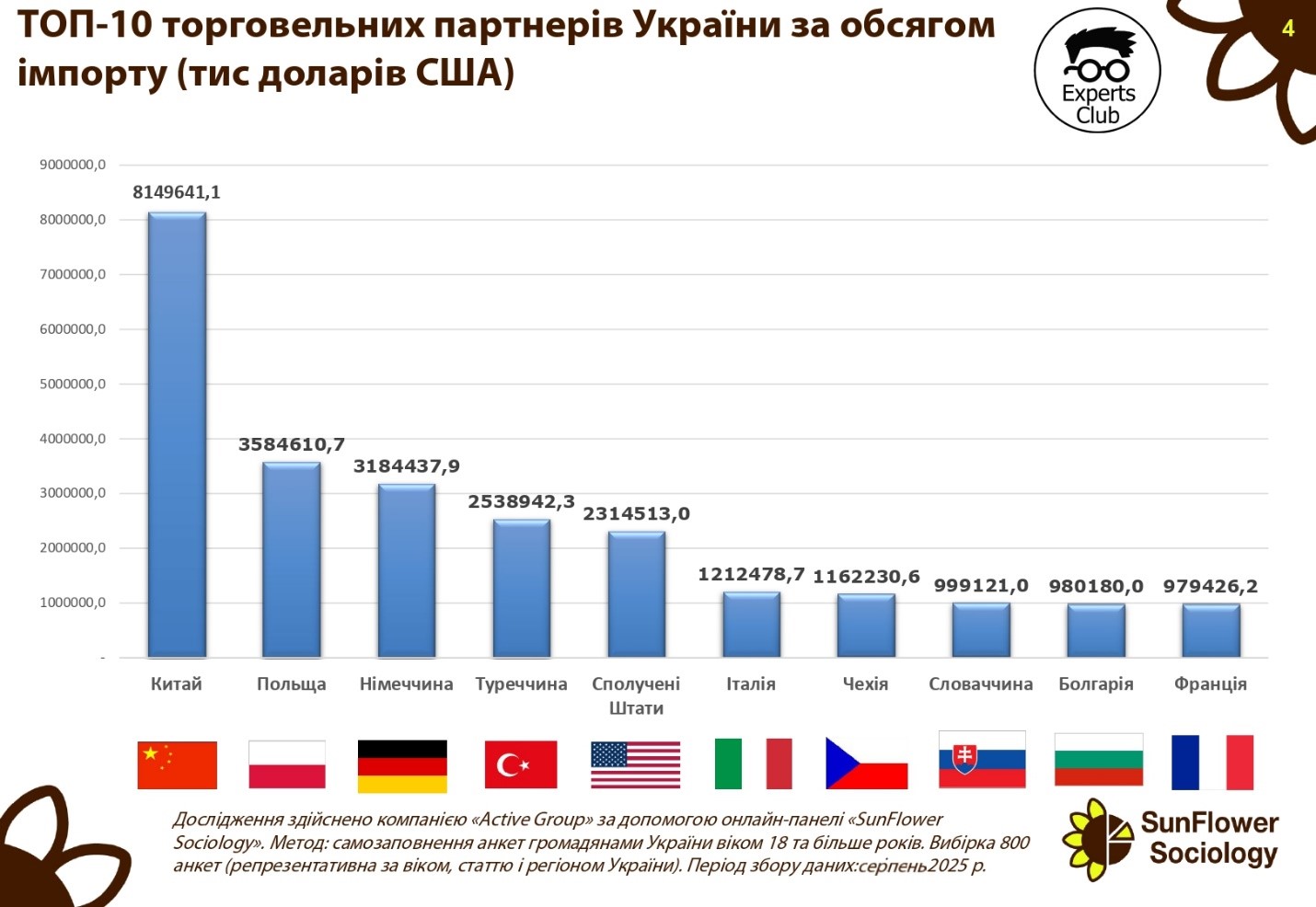
“The formation of such an import structure indicates Ukraine’s excessive dependence on Chinese goods, especially in the electronics, technology, and industrial products segments. Such an imbalance poses risks to economic stability, as any political or logistical restrictions will immediately affect the domestic market,” emphasized Maksim Urakin, founder of Experts Club and economist.
At the same time, experts point to the diversification of supplies from European Union countries. Poland, Germany, Italy, and France together account for more than $8.5 billion in imports, forming a significant segment of the domestic consumer and industrial market.
Economists predict that, provided the hryvnia exchange rate remains stable and import flows continue at current levels, the trade deficit with China will continue to grow. This will require an adjustment of state trade policy towards stimulating domestic production and searching for alternative markets.
ACTIVE GROUP, CHINA, ECONOMY, EU, EXPERTS CLUB, GERMANY, IMPORTS, POLAND, SunFlower Sociology, TRADE BALANCE, TURKEY, UKRAINE, USA, МАКСИМ УРАКИН
2022-2024 goods trade balance forecast (USD bln)

Source: Open4Business.com.ua and experts.news
2022-2024 goods trade balance forecast (USD bln)
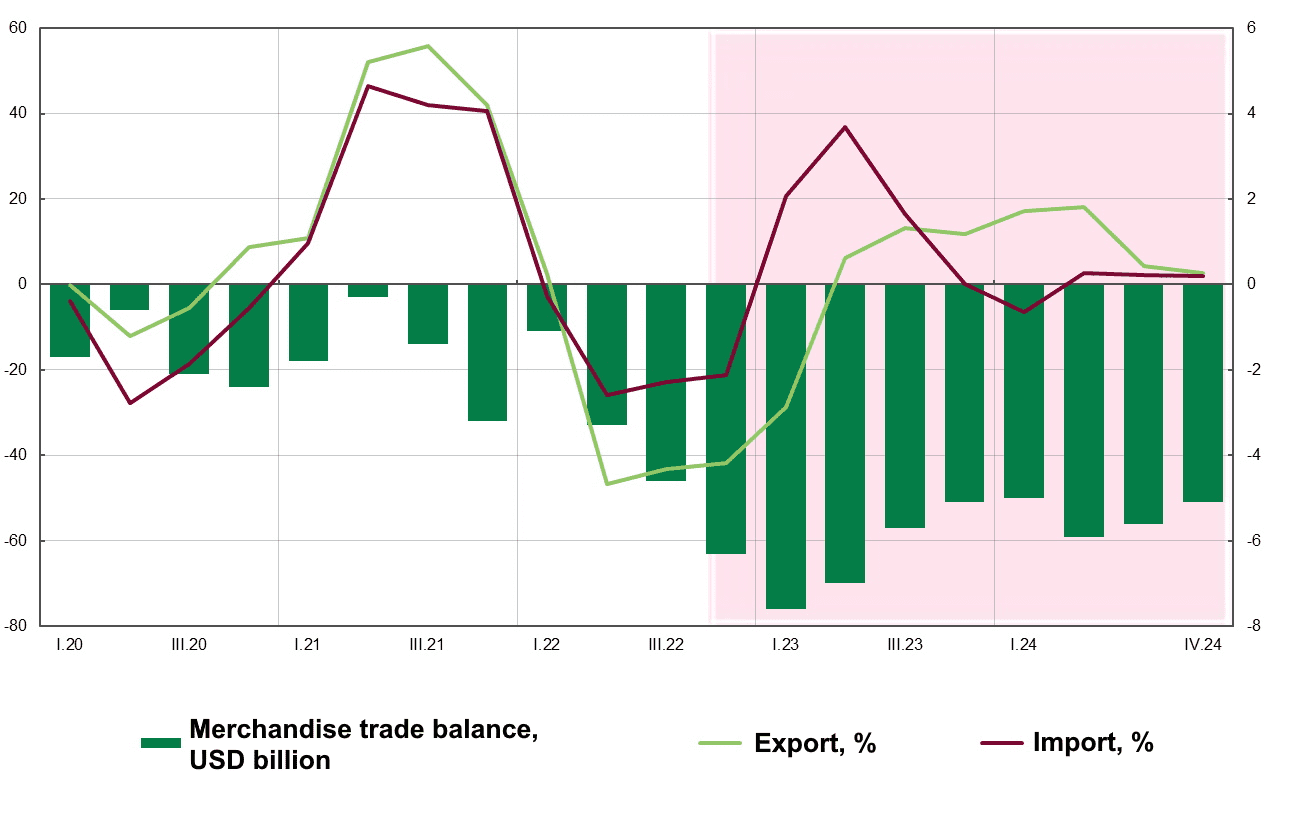
Source: Open4Business.com.ua and experts.news
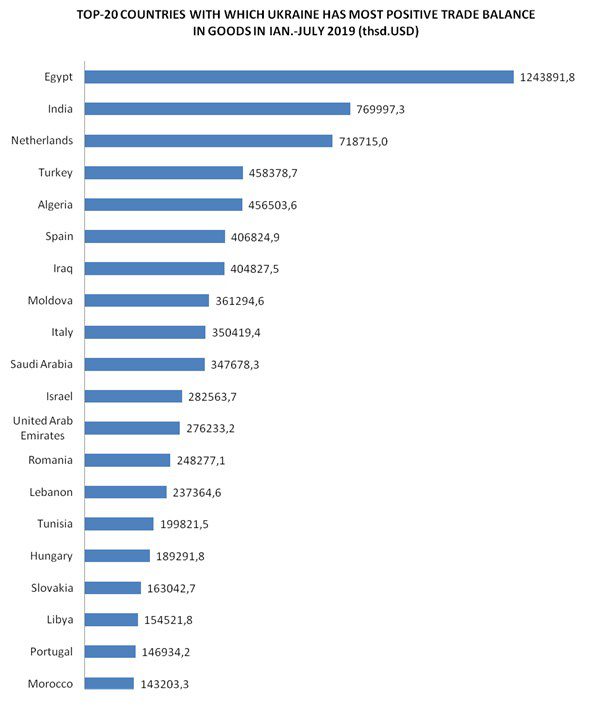
Top-20 countries with which Ukraine has most positive trade balance in goods in Jan-July 2019 (thsd.USD)