Turkey’s residential real estate market continues to show nominal price growth, but taking inflation into account, housing is in fact continuing to become cheaper, according to market data.
According to analysts, the average price per square meter of housing across the country has reached 40.486 thousand Turkish lira, or about $872. The average cost of a residential real estate property is estimated at approximately 5.02 million lira, or about $108.1 thousand.
In nominal terms, housing prices increased by 23.8% year-on-year. However, after adjustment for inflation, the real dynamics moved into negative territory and amounted to about 6.5%.
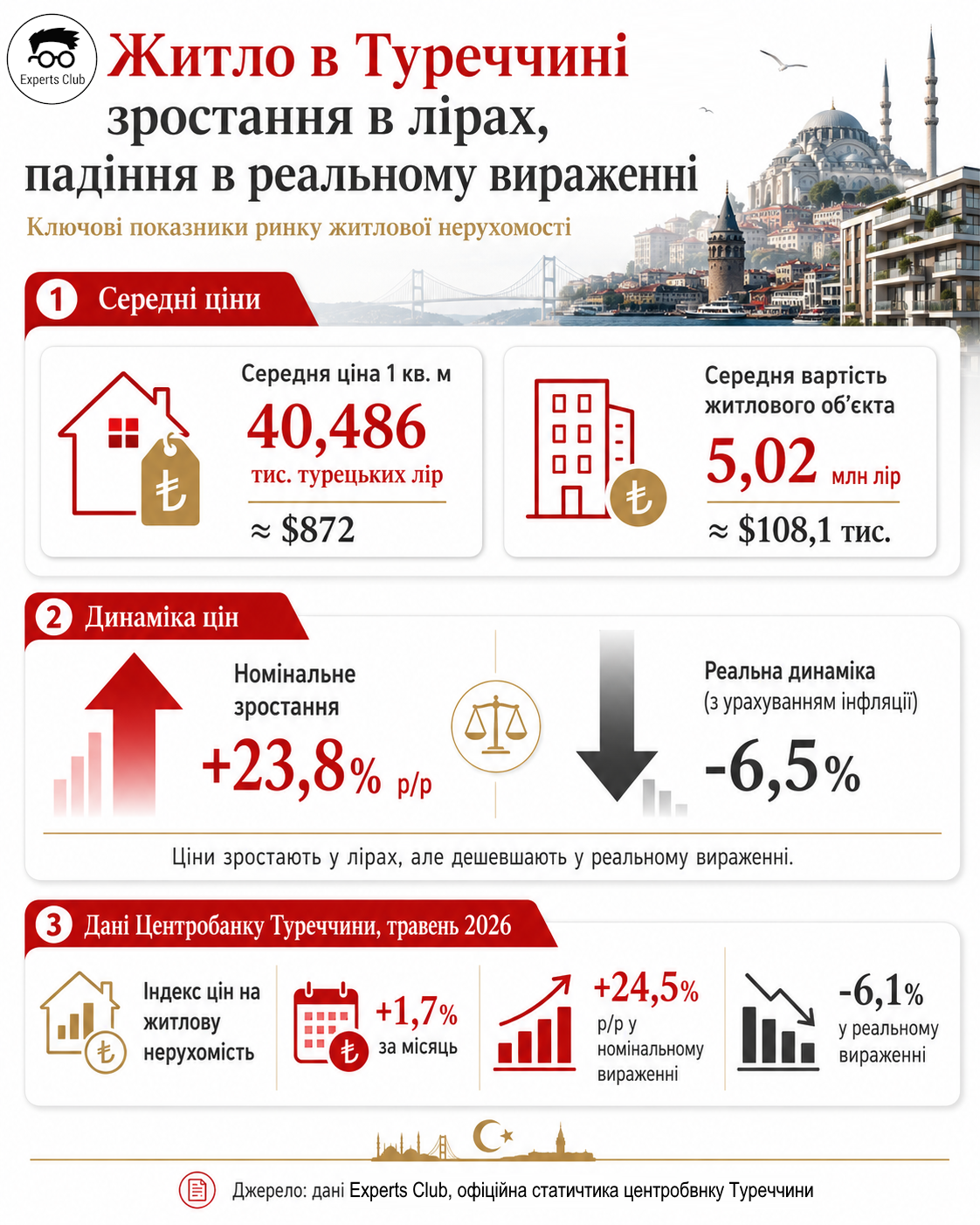
Official statistics from the Central Bank of Turkey confirm this trend. In May 2026, the residential real estate price index increased by 1.7% month-on-month and by 24.5% year-on-year in nominal terms, but declined by 6.1% in real terms.
This means that, for buyers and investors, price growth in lira is not the same as growth in the value of the asset. Against the background of high inflation, real estate may look more expensive in the national currency, but lose purchasing value in real terms.
The average payback period for housing through rental income in Turkey is currently estimated at approximately 13 years. However, the situation differs significantly by region. In large cities and resort locations, housing prices have often grown faster than rental rates, so the yield of such properties is becoming lower.
This gap is especially noticeable in popular tourist regions, including Muğla and parts of the coast, where the cost of land and housing remains high, while rent does not always keep pace with sale prices. In such locations, buying real estate increasingly requires not only calculating potential income, but also assessing the liquidity of the property, maintenance costs and currency risks.
For foreign buyers, the situation has become less clear-cut. After the boom of 2021-2023, the Turkish market no longer looks like a market of guaranteed rapid growth. High interest rates, inflation, the weakening of the lira, changes in residence permit rules and cooling demand from foreigners are making investment decisions more complex.
At the same time, Turkey remains one of the largest real estate markets in the region. Demand is supported by domestic buyers, tenants in large cities, tourist regions, as well as interest in housing as a way to protect savings from inflation. However, the market is becoming more selective: liquidity is being maintained primarily by quality properties in strong locations.
For investors, the main conclusion is that Turkish real estate can no longer be assessed only by nominal growth in lira. It is more important to look at dynamics in foreign currency, real yield adjusted for inflation, maintenance costs, rental demand and resale prospects.
HOUSING PRICES, INFLATION, REAL ESTATE, TURKEY

Related: