
Turkey’s residential real estate market continues to show nominal price growth, but taking inflation into account, housing is in fact continuing to become cheaper, according to market data.
According to analysts, the average price per square meter of housing across the country has reached 40.486 thousand Turkish lira, or about $872. The average cost of a residential real estate property is estimated at approximately 5.02 million lira, or about $108.1 thousand.
In nominal terms, housing prices increased by 23.8% year-on-year. However, after adjustment for inflation, the real dynamics moved into negative territory and amounted to about 6.5%.
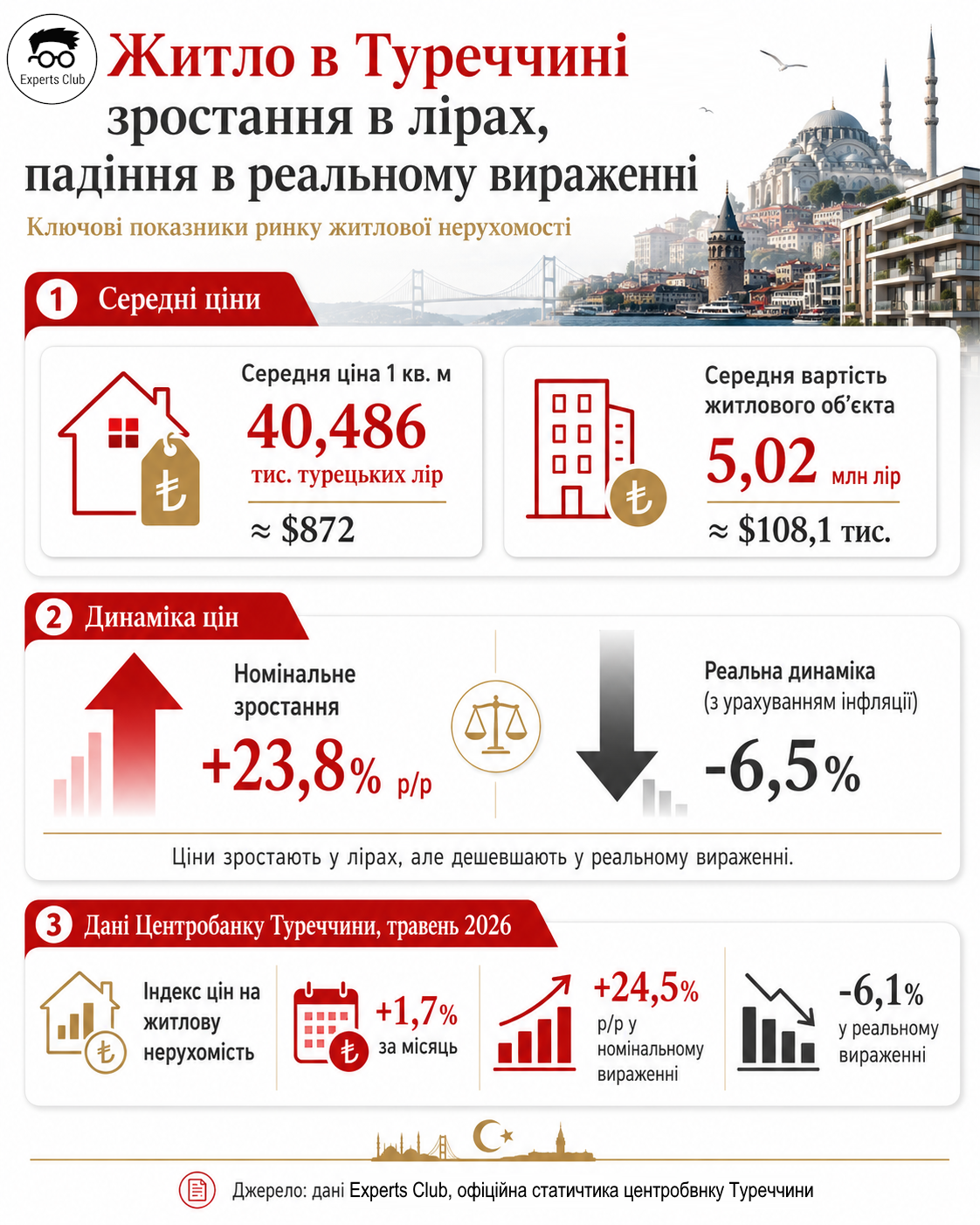
Official statistics from the Central Bank of Turkey confirm this trend. In May 2026, the residential real estate price index increased by 1.7% month-on-month and by 24.5% year-on-year in nominal terms, but declined by 6.1% in real terms.
This means that, for buyers and investors, price growth in lira is not the same as growth in the value of the asset. Against the background of high inflation, real estate may look more expensive in the national currency, but lose purchasing value in real terms.
The average payback period for housing through rental income in Turkey is currently estimated at approximately 13 years. However, the situation differs significantly by region. In large cities and resort locations, housing prices have often grown faster than rental rates, so the yield of such properties is becoming lower.
This gap is especially noticeable in popular tourist regions, including Muğla and parts of the coast, where the cost of land and housing remains high, while rent does not always keep pace with sale prices. In such locations, buying real estate increasingly requires not only calculating potential income, but also assessing the liquidity of the property, maintenance costs and currency risks.
For foreign buyers, the situation has become less clear-cut. After the boom of 2021-2023, the Turkish market no longer looks like a market of guaranteed rapid growth. High interest rates, inflation, the weakening of the lira, changes in residence permit rules and cooling demand from foreigners are making investment decisions more complex.
At the same time, Turkey remains one of the largest real estate markets in the region. Demand is supported by domestic buyers, tenants in large cities, tourist regions, as well as interest in housing as a way to protect savings from inflation. However, the market is becoming more selective: liquidity is being maintained primarily by quality properties in strong locations.
For investors, the main conclusion is that Turkish real estate can no longer be assessed only by nominal growth in lira. It is more important to look at dynamics in foreign currency, real yield adjusted for inflation, maintenance costs, rental demand and resale prospects.
Austria’s residential real estate market has begun to grow again after a prolonged period of falling prices, according to data from Statistik Austria.
According to the statistical office, in 2025, prices for houses and apartments in Austria rose by an average of 2.6% after falling by 2.6% in 2024 and by 2.3% in 2023. Thus, the market showed positive annual growth for the first time in two years.
The recovery accelerated in the second half of 2025. In the fourth quarter, housing prices rose by 3.5% year-over-year and by 0.8% compared to the previous quarter. New housing prices increased by 3.1% over the year, while existing housing prices rose by 3.6%.
The return to growth is linked to the gradual stabilization of the mortgage market, reduced uncertainty following a period of high interest rates, and a decline in new construction supply. After a sharp rise in borrowing costs in 2022–2024, some buyers postponed their purchases, but demand began to gradually return in 2025.
However, the recovery remains highly uneven. According to Global Property Guide estimates, prices continued to decline in some regions, particularly in expensive Alpine and metropolitan areas. In Vienna, the average property price in 2025 was estimated at approximately €779,000, but the annual trend was negative—about -6.6%. In Tyrol, the decline was estimated at -13.7%, and in Salzburg, at -9.1%. At the same time, Carinthia, Styria, and Upper Austria showed growth.
For buyers, this means that the Austrian market is no longer in a phase of widespread decline, but has not yet returned to its previous overheated growth. Location, property quality, energy efficiency, and access to financing have become more important than the expectation of automatic real estate price increases.

Prices for existing housing in Italy rose by 1.5% in the first quarter of 2026 compared to the previous quarter, with the average asking price reaching €1,891 per square meter. This is according to a report by the analytical division of idealista.
According to the source, price increases were recorded in 80% of the country’s administrative centers. The most notable quarterly increases occurred in Belluno (8.7%), Cremona (6.9%), and Lecco (6.4%). Among major cities, Bari, Cagliari, Rome, Bologna, Catania, and Florence showed positive trends, while Naples saw a slight decline of 0.4%.
Milan remains Italy’s most expensive city, as before, with a price of €5,192 per square meter. It is followed by Venice—€4,897 per square meter, Bolzano—€4,869, Florence—€4,602, and Bologna—€3,717. Rome ranks sixth at €3,369 per square meter. The most affordable cities were Caltanissetta—€653 per square meter, Ragusa—€730, and Biella—€752.
At the regional level, price growth has spread across nearly the entire country. A quarterly decline was recorded only in Molise and Basilicata, while the strongest growth was seen in Valle d’Aosta—4%, Veneto—3%, as well as Liguria and Tuscany—2.2% each. Trentino-Alto Adige remains the most expensive region at €3,266 per square meter, while Molise is the least expensive at €911 per square meter.
The market maintains positive momentum across most of Italy, though macroeconomic factors—including interest rates and inflation—may influence it in the coming months. The idealista index itself is based on asking prices published in listings, not on the actual prices of completed transactions. The methodology also excludes auction properties and atypical listings, and the median price is used as the benchmark.

The housing price index in Ukraine in July-September 2023 amounted to 116.2%, while in the same period of 2022 the figure was 114.2%, the State Statistics Service (Ukrstat) reported.
According to it, in the primary market, housing prices in the third quarter of 2023 accelerated growth to 14.6% compared to 11.9% in the third quarter of the previous year. Three-bedroom apartments rose in price the most – by 16%. The price increase for one-bedroom apartments was 15.6%, and for two-bedroom apartments – 12.8%.
In the secondary market, prices accelerated growth to 17.1% in the third quarter of 2023, up from 15.6% in the same period of 2022. Thus, the growth in prices for three-room apartments amounted to 18.5%, two-room apartments – 17.9%, one-room apartments – 14.1%.
Overall, in the first nine months of 2023, housing prices increased by 13.9% compared to the same period in 2022. In the primary market, the growth was 12.2%, in the secondary market – 15.1%.
According to the statistics agency, compared to the previous quarter, housing prices in July-September 2023 increased by 6%, with a 4.5% increase in the primary market and a 6.9% increase in the secondary market.
According to the State Statistics Service, in the third quarter, prices for primary housing increased by 3.6% for one-bedroom apartments compared to the second quarter, by 4.9% for two-bedroom apartments, and by 6% for three-bedroom apartments. On the secondary market, prices rose by 5.1%, 7.5% and 7.6%, respectively.
The State Statistics Service noted that the figures exclude the temporarily occupied territories and part of the territories where military operations are ongoing (or have been ongoing).
The housing price index in Ukraine in the fourth quarter of 2021 amounted to 117.7% compared to the same period in 2020, the State Statistics Service reported.
At the same time, according to its data, prices in the primary market increased by 16.7%. Three-room apartments rose in price most of all – by 18.4%, least of all – one-room apartments (by 16%).
According to the State Statistics Service, in the secondary market, housing has risen in price by 18.4% over the year. One-room apartments increased the least in price – 17.9%, three-room apartments – the most (19.2%).
Compared to the third quarter of 2021, housing prices increased by 3.4%, in the primary market by 3.8%, in the secondary market by 3.1%.



