
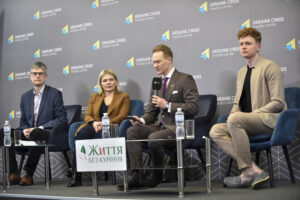
On March 12, the NGO “Life” together with researchers from the Kyiv International Institute of Sociology (KIIS) presented the results of the all-Ukrainian survey “Use of Tobacco and Nicotine Products and Attitudes Towards Anti-Tobacco Measures” conducted in November-December 2023 as part of the regular Omnibus.
According to the survey, 30% of the population in Ukraine currently use tobacco or nicotine products: 43% of men and 20% of women. Daily smokers account for 24.5% of Ukrainians (36% of men, 15% of women).
Surveys show that consumption of tobacco products in Ukraine was actively declining until 2017. However, after the introduction of aggressive advertising of heating tobacco products, e-cigarettes and nicotine products, consumption of tobacco products in Ukraine has not decreased for 7 years. If we look at the structure of smoking, the consumption of tobacco and nicotine products among Ukrainian women has doubled in 7 years. According to the GATS survey, in 2017, 7% of Ukrainian women were daily tobacco users and 1% of e-cigarettes users, and today this figure is 15%. Tobacco and nicotine use is most widespread among young women aged 18-29 years – 37%, of whom 28.4% use it daily and 8.4% use it occasionally. This means that one in three young women is currently addicted to nicotine.
Among daily users, 79% smoke manufactured cigarettes. This is followed by electrically heated tobacco products (18%) and e-cigarettes (14%). The use of HTPs and e-cigarettes is more common among younger respondents: 37% of young people aged 18-29 use electrically heated tobacco products, and 36% use e-cigarettes. Women are more likely than men to use electrically heated tobacco products (27% vs. 13%) and e-cigarettes (25% vs. 11%).
“The survey results demonstrate a clear correlation between the answers of respondents who were most exposed to tobacco and nicotine advertising and the prevalence of use of these products among the youngest population group. Also, for the first time, we observe parity between tobacco and nicotine users among men and women in the 18-29 age group, but while the indicators for men remain stable, there has been a significant increase for the female population,” said Oleksandr Shcherbatiuk, researcher, project coordinator at the Kyiv International Institute of Sociology.
The survey showed that it is the young population that notices tobacco and nicotine advertising the most – 73% of young people aged 18-29. Further, this figure decreases with each age group and falls to 19% among respondents aged 70 and older. This confirms that tobacco and nicotine advertising is aimed at the youngest age group of men and women.
Display of tobacco and nicotine products in points of sale is the main channel for advertising these products – 32% of respondents said they notice it. Banner ads on the Internet (23%) and personal pages on social media (20%) are in second place. Outdoor advertising was seen by 14%. Most often, respondents saw ads for traditional and heated cigarettes (35%), 31% saw ads for tobacco heating devices, 24% saw ads for e-cigarettes, and 10% saw ads for nicotine snus.
“The tobacco industry is bringing back the tobacco epidemic among young people. Tobacco companies’ marketing preys on young women and men. The health of the population and, above all, children and youth is a matter of national security for the restoration of Ukraine’s human capital. Public support for anti-tobacco regulations of up to 80% is a guideline for the Verkhovna Rada of Ukraine to protect Ukrainians from tobacco and nicotine,” said Dmytro Kupyra, Executive Director of the NGO “Life”.
Most Ukrainians support anti-tobacco measures to prevent young people from starting to use tobacco.
The vast majority of respondents support the ban on advertising of brands of electronic smoking devices and e-cigarettes (79%) and the ban on the visible placement of tobacco packs in retail outlets (77%). Two-thirds of respondents support a ban on flavored tobacco products (67%) and tax increases to reduce the affordability of tobacco products for children (65%). The introduction of standardized packaging is supported by 61% of respondents.
“At the end of 2021, the Verkhovna Rada of Ukraine adopted the Anti-Tobacco Law 1978-IX, which implemented the key provisions of European Integration Directive 2014/40/EU. We can already see the results of the adopted changes with the appearance of updated health warnings on cigarette packs. Despite these efforts, the tobacco industry continues to attract young people. With the absolute support of citizens, we will propose to the Parliament the following package of proposals to protect the health of children and youth from illicit tobacco and nicotine products. First of all, it is necessary to eliminate all forms of advertising, including the visible placement of tobacco and nicotine products in points of sale, and to ban flavoring (fruit) additives that are not typical for tobacco products. Such steps are in line with the WHO Framework Convention on Tobacco Control and Ukraine’s European integration commitments,” said Lada Bulakh, MP, member of the Committee on National Health, Medical Assistance and Health Insurance.
The survey results revealed the key reasons for the spread of the tobacco and nicotine epidemic in Ukraine and demonstrated significant public support for the immediate implementation of legislative measures to protect the young population. Smoking in Ukraine is the cause of 130 thousand premature deaths annually from diseases such as heart attack, stroke, cancer and others.

The State Property Fund (SPF) of Ukraine has put up Kholminsky distillery in Chernihiv region for privatization, the press service of the agency reports.
It is specified that the starting price of the lot is UAH 15.35 million. The auction will be held in the Prozorro.Sale system on March 20, with bids accepted until March 19.
Kholma Distillery is an operating enterprise located in the village of Kholma, Koryukiv district, Chernihiv region. Its main activity is distillation, rectification and mixing of alcoholic beverages.
According to the terms of the sale, the buyer of the distillery is obliged to pay off overdue accounts payable for goods, works and services in the amount of UAH 3.5 million and prevent dismissal of employees for six months.
Construction of Kholminsky distillery began in Soviet times. Since 1951, the company has been accepting potatoes for processing. In the 60s of the last century, the plant held a leading position in the industry. Today, it is in need of reconstruction and investment.
The unified property complex includes 101 registered real estate units: production, warehouse, administrative buildings and structures, transformer substations, artesian wells, grain tanks, railroad tracks, etc. The state-owned enterprise has 16 vehicles and special equipment. The distillery also owns 192 items of movable property, including equipment, furniture, inventory, computer and office equipment, etc.
The total area of the six land plots under the complex is 28.36 hectares.
As of October 1, 2023, a part of the company’s real estate with an area of 727.9 sq m was leased. According to the agreement, the lease term is until May 9, 2024.
In addition, the company leased 26 units of technological equipment and a 0.04-hectare land plot in Novhorod-Siverskyi, Chernihiv region, for a period of 30 years.
At the same time, the state-owned enterprise has an object on its balance sheet that is not subject to privatization: a storage facility (radiation shelter – IF-U) with a total area of 93.1 square meters, built in 1974. It is located separately from other buildings.
According to the Fund, distilleries are among the most popular small-scale privatization assets. Since September 2022, the SPF has sold 14 distilleries and raised UAH 965 million to the state budget, with the average price of each property at auction tripling.
The SPF planned to complete the privatization of the alcohol industry in 2023, for which it was planned to hold online auctions for the sale of 26 distilleries across the country. However, some of them did not take place.
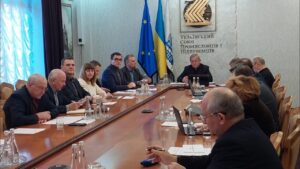
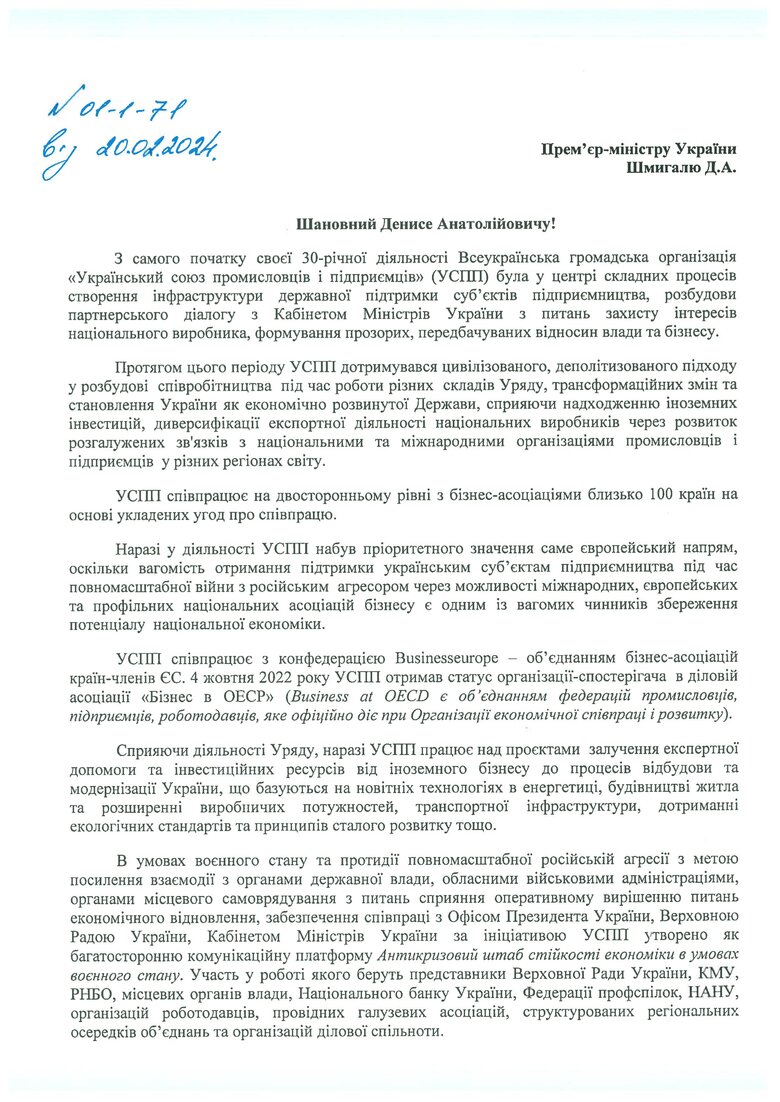
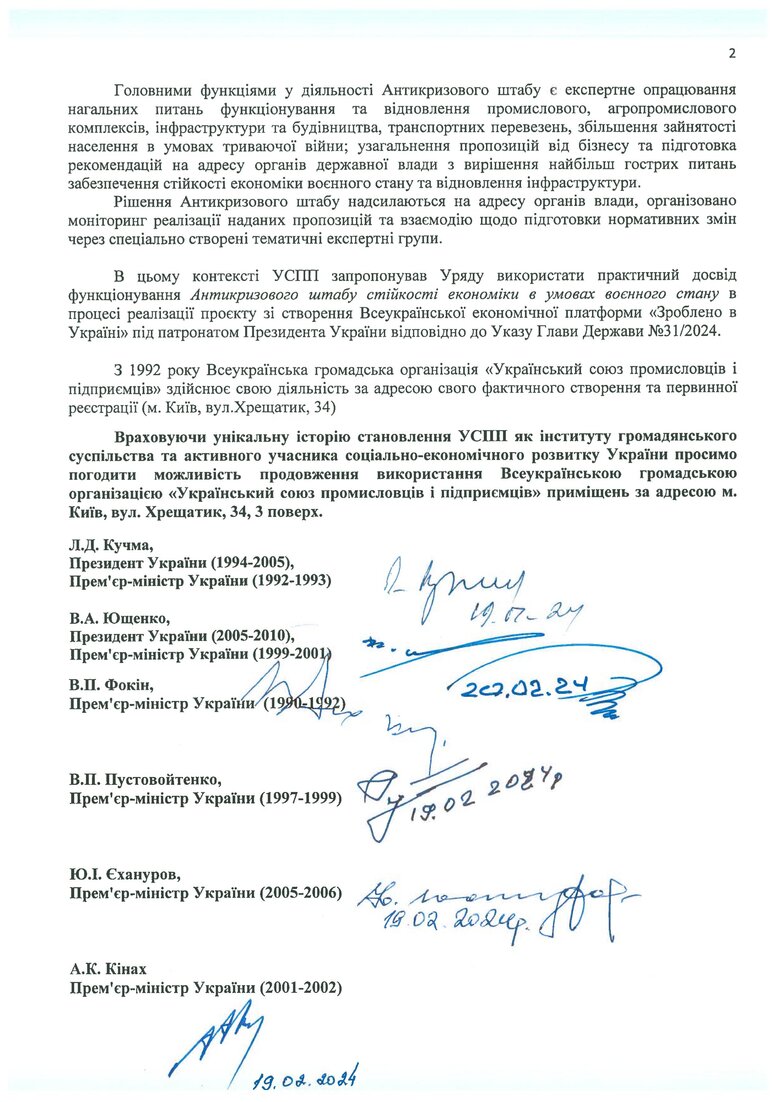
The Ukrainian League of Industrialists and Entrepreneurs (ULIE) has sent an official letter to the Minister of the Cabinet of Ministers Oleh Nemchinov and the leadership of the Administrative Buildings Department of the Economic and Financial Department of the Cabinet Secretariat, stating that it is impossible to fulfill their demand to vacate the office in downtown Kyiv on Khreshchatyk, which the union has occupied for 32 years, by March 10.
“We consider unacceptable any unilateral restrictive steps taken by representatives of the department that will block the activities of the ULIE and its partners – national associations of industrialists, entrepreneurs and employers, members of the Anti-Crisis Headquarters for Economic Sustainability under martial law, which are directly related to the implementation of the initiatives initiated by the President of Ukraine and the Cabinet of Ministers, in particular, “Made in Ukraine,” the ULIE said on Monday.
The union told Interfax-Ukraine that the Cabinet of Ministers’ Secretariat had decided not to extend the UUIE’s location on Khreshchatyk, even on a lease basis. The ULIE claims that, nevertheless, the first floors of the building are occupied by commercial structures with which lease agreements have been concluded.
Among the arguments for the impossibility of fulfilling the demand of March 4 to vacate the occupied premises at 34 Khreshchatyk Street by March 10, the ULIE cites the March 12 meeting of the Anti-Crisis Headquarters for Economic Sustainability under Martial Law with the participation of, among others, representatives of the Cabinet of Ministers, the Verkhovna Rada and the National Security and Defense Council.
“Also in March of this year, the ULIE is planning a number of international events to attract expert assistance and investment resources from foreign partners to support the economic recovery of Ukraine,” the union adds.
In a letter signed by its chairman, former Prime Minister Anatoliy Kinakh, the ULIE emphasizes that it guarantees reimbursement to the balance sheet holder for the costs of maintaining the premises it uses and the utilities actually provided, as it has already informed government agencies.
It is noted that as of March 11, by order of the Secretariat of the Cabinet of Ministers, an attempt has already been made to prevent USPP employees from getting to their workplaces, and there is no electricity and Internet connection in part of the office.
It is noted that several dozen business associations, including the Ukrainian Chamber of Commerce and Industry, the Federation of Employers, the Federation of Trade Unions, Ukrlegprom, the Union of Chemists, Ukrmashbud, the Construction Chamber, Ukrmetallurgprom, as well as the second president of Ukraine Leonid Kuchma, who once headed the union, and Viktor Yushchenko, who later replaced him as head of the country, have already spoken out in support of the USPP.

Prices for benchmark crude oil are rising slightly on Tuesday morning, with quotes ending the previous session virtually unchanged.
The price of May futures for Brent on the London ICE Futures exchange by 7:08 a.m. is $82.43 per barrel, which is $0.22 (0.27%) higher than at the close of the previous session. On Monday, these contracts increased in price by 13 cents to $82.21 per barrel.
Quotes for WTI futures for April in electronic trading on the New York Mercantile Exchange (NYMEX) by this time increased by $0.13 (0.17%) to $78.06 per barrel. At the end of the previous session, the contract fell by 8 cents to $77.93 per barrel.
Market participants are awaiting the release of inflation data in the United States on Tuesday, as well as the publication of monthly reports by OPEC and the International Energy Agency (IEA).
In addition, traders are monitoring the compliance of OPEC+ countries with their voluntary commitments to reduce supplies, as well as the level of production in the United States, which has been near record levels since the end of January.
“OPEC and the U.S. Department of Energy are sending mixed signals, and in order for the market to clearly determine the direction of movement,” they need to come to the same conclusion, said Charu Chanana, an analyst at Saxo Capital Markets in Singapore.

According to preliminary data, Ukrnaftoburinnya (UNB) will receive more than UAH 1 billion in net profit in 2023, the company said in a press release on Monday.
“We planned a net profit of up to UAH 1.5 billion. But due to the revocation of the special permit and the shutdown, this figure will fall to about UAH 1.1 billion,” said Oleg Malchyk, chairman of the board, quoted in the document.
According to him, from the beginning of 2023 until the company was actually taken over by Ukrnafta on July 12 last year, UNB’s profit amounted to UAH 186 million, and for the period from July to December, it managed to make a profit of UAH 905 million.
“This is taking into account the fact that the company did not produce throughout December last year,” the company said.
According to UNB, despite the fact that the company was profitable before the transition to state control, the audit of the financial statements found UAH 18 billion of receivables that had signs of being uncollectible.
“This is either prepayment for some goods or financial assistance,” commented Malchyk.
The PJSC explained that bankruptcy proceedings were initiated against some companies that owe almost UAH 5 billion to UNB in June 2023. However, the new management managed to file applications for recognition of monetary claims, and such claims were recognized by the court, as a result of which UNB was included in the list of creditors of those companies in bankruptcy.
As reported, on November 28, 2023, the Sixth Administrative Court of Appeal (CAAC) overturned the order of the State Service of Geology and Subsoil (Derzhgeonadra) and revoked the special permit No. 6349 of July 10, 2019, under which UNB was producing at the Sakhalin field. The company stopped operating the field on December 1.
For its part, on February 9, 2024, the Kyiv District Administrative Court (KDAC) ordered the State Service of Geology and Mineral Resources to reconsider UNB’s application for a special permit for production at the Sakhalin field. On February 27, the court document came into force. However, the State Service of Geology and Subsoil filed an appeal against the ruling of the Kyiv District Administrative Court (KDAC).
“Ukrnaftoburinnya is one of the largest private gas producers in Ukraine. Since 2010, it has been developing the Sakhalin oil and gas condensate field (Krasnokutskyi district, Kharkiv region) with reserves of 15 bcm of gas. The company’s gross production in 2021 amounted to 691.3 million cubic meters of gas and 76.6 thousand tons of oil and condensate.
Ukraine’s public debt to GDP ratio from 2009 to 2023 (UAH mln)
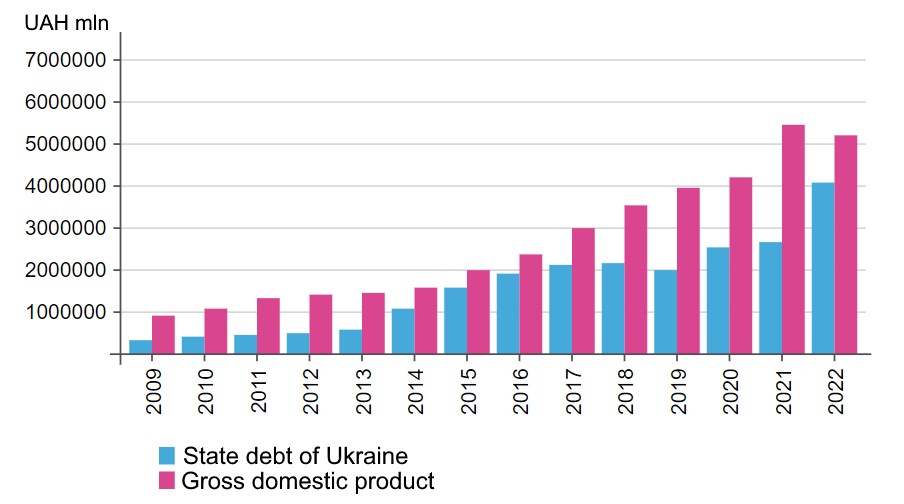
Source: Open4Business.com.ua and experts.news



