
Liquidity of banking system of Ukraine in 2023, bln UAH
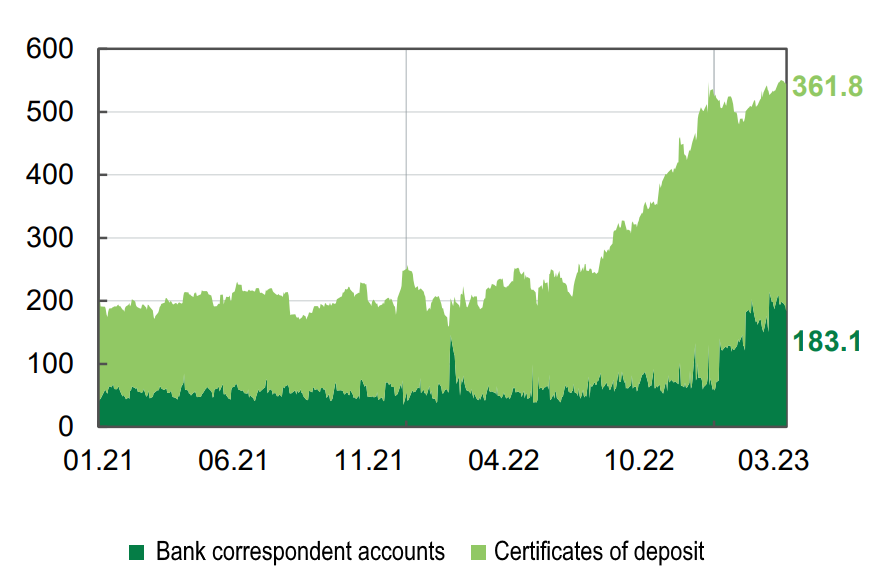
Source: Open4Business.com.ua and experts.news
The role of state-owned companies significantly increased during the war, and it will remain key in postwar recovery as well, Deputy Economy Minister Oleksiy Sobolev said at a roundtable discussion on “The Role of State-Owned Enterprises in Postwar Recovery,” which was held the other day with support from USAID’s State-Owned Enterprise Reform Support Activities in Ukraine (SOERA) project.
“During the discussion, participants repeatedly noted that the role of Ukrainian state-owned enterprises increased significantly during the full-scale Russian invasion, as well as their significant contribution to the post-war reconstruction process. At the same time, the need to create conditions for involving the private sector in the reconstruction was also emphasized,” the press release from the discussion reads.
USAID Ukraine Senior Project Management Specialist Andriy Nesterenko noted that Ukraine has more than 3,200 state-owned and more than 14,000 municipal enterprises. In his opinion, once the war is over and economic recovery begins, state-owned companies will be the first to contribute to the recovery, and private business is sure to follow.
Sobolev said that the Economy Ministry has developed a list of enterprises that should remain in state ownership, but some of them may be partially privatized.
“Some enterprises played an important role during the war and will play a key role in Ukraine’s post-war economic recovery, so the government is considering only partial privatization of them, in particular through IPO, in order to attract investments,” the deputy minister was quoted as saying in a press release.
He also announced that the government had prepared a four-year plan for 2024-2027, which will be submitted to the European Commission for the development of a large-scale assistance program for Ukraine. The plan contains a section on state assets and issues of corporate governance and privatization, the deputy minister specified.
Gabriela Miranda, responsible manager for Ukraine at the OECD’s Global Relations Secretariat, said the OECD’s support for Ukraine in its efforts to recover from the war is formalized in a four-year programme to support reform and reconstruction under the partnership agreement that Ukraine concluded with the OECD on 7 June 2023. Under it, Miranda said, the OECD will work with the government to continue reforming state-owned enterprises, privatization, developing financial markets and fighting corruption.
The head of the State Agency for Infrastructure Rehabilitation and Development of Ukraine, Mustafa Nayem, predicted that during the recovery period the volume of public procurement will grow significantly, but it is necessary to change the perception of the state as a risky customer so that private companies are not afraid to participate in tenders.
Igor Smelyansky, CEO of state-owned Ukrposhta, who also participated in the roundtable, described how the company is actively working on digitalization and logistics development to make its services accessible and efficient for all communities, particularly those affected by Russian aggression. He reiterated the importance of Ukrposhta obtaining the right to provide banking services, as for almost a third of Ukrainians they are currently unavailable.
Smelyansky also pointed out the need for international partners to adapt procedures in order to speed up the provision of urgently needed aid to Ukraine.
At the end of the roundtable, John Tokolish, deputy director of the State-Owned Enterprise Reform Activities in Ukraine (SOERA) project, offered the program’s assistance in various areas of state and municipal enterprises, and promised continued support for reforms by the SOERA project.
It is specified that the event was attended by about 100 experts and specialists from different spheres of activity, mainly C-level managers (CEOs, owners, chiefs of staff), representatives of international organizations (OECD, EBRD, IFC, IMF), international partners (EU Delegation and European Commission), members of supervisory boards of state-owned enterprises, as well as partners from private companies.
Internal and external debt of Ukraine in 2009-2023
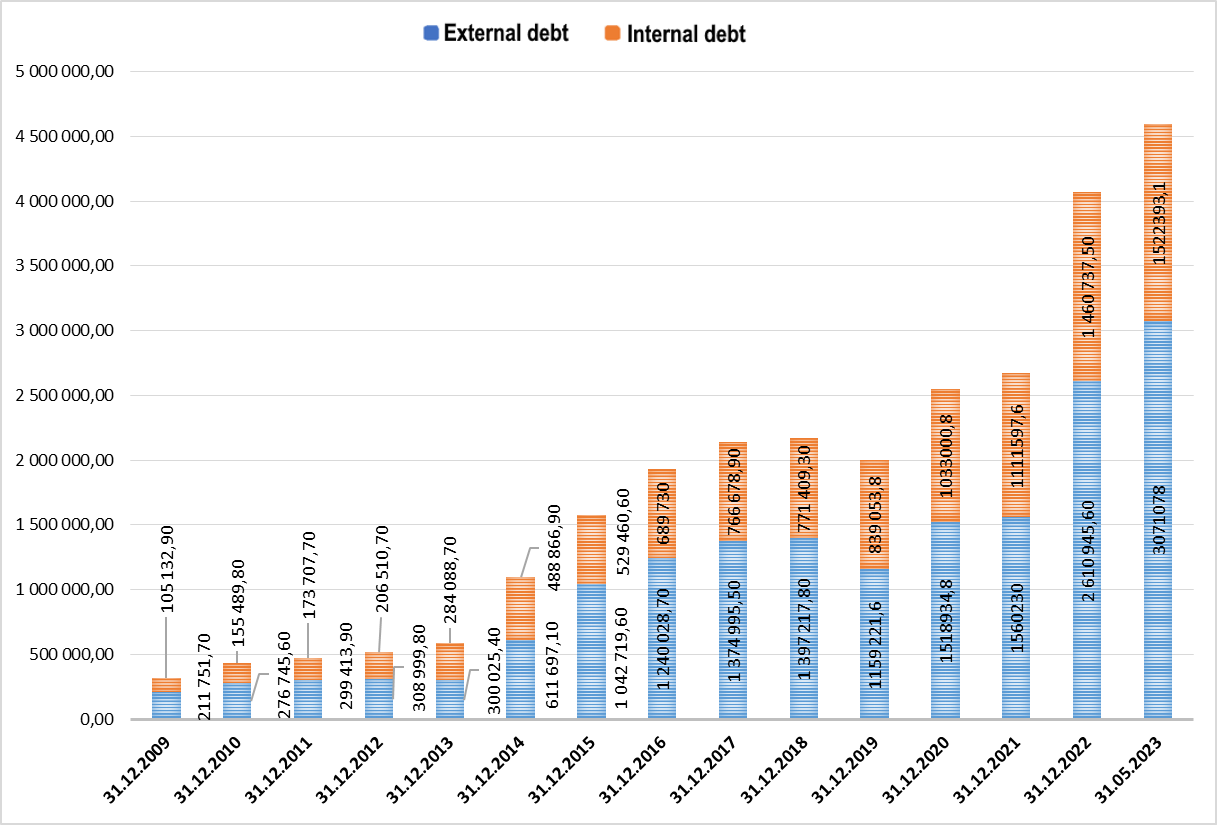
Source: Open4Business.com.ua and experts.news
The international rating agency Fitch Ratings has upgraded the VR of ProCredit Bank (Kyiv) from ‘cc’ to ‘ccc-‘ and affirmed its Long-Term Foreign-Currency Issuer Default Rating (IDR) at ‘CCC-‘ and its Long-Term Local-Currency IDR at ‘CCC’.
“The upgrade reflects our view of ProCredit Bank’s moderately lower risk of failure, driven by stronger asset quality and profitability due to a less severe operating environment than previously expected,” the agency said in a statement on its website on Friday.
It added that the affirmation of the national long-term rating at ‘AA(ukr)’ with a ‘Stable’ outlook reflects the bank’s continued creditworthiness in the local currency relative to other Ukrainian issuers.
Fitch noted that ProCredit Bank’s IDRs are backed by the support of its parent ProCredit Holding AG & Co. KGaA (‘BBB/Stable Outlook’/bbb).
The agency added that the ‘ccc-‘ shareholder support rating reflects the view of the strategic importance of the Ukrainian bank for the holding, as well as potential limitations on the bank’s ability to use the parent company’s support, in particular, to service foreign currency liabilities.
It is noted that a default on priority foreign currency liabilities remains a real possibility due to the war, however, the bank maintains generally adequate foreign currency liquidity compared to its needs, which is facilitated by various capital and currency control measures introduced since the beginning of the war.
According to Fitch, ProCredit Bank will continue to service its external obligations: at the end of the first quarter of 2023, its external debt stood at a moderate 10% of total funding, consisting of EUR20 million of subordinated bonds and funding from international financial institutions.
The agency noted that the gradual improvement in the operating environment for Ukrainian banks has resulted in a more resilient loan portfolio quality for ProCredit Bank, as well as higher revenues and profitability than previously expected. As a result, although capital risks remain very high, Fitch believes that the bank is now less likely to face a material capital shortfall.
The agency recalled that ProCredit Bank’s asset quality indicators deteriorated sharply after the outbreak of the war, resulting in significant provisioning charges (3.4 times operating profit in 2022). “Risks to asset quality remain elevated and dependent on the outcome of the war, despite an improved operating environment in the first quarter of 2023,” Fitch stated.
It added that the bank earned UAH 211 million in net profit in the first quarter of this year after a net loss of UAH 1.8 billion in 2022, and expects an improvement in provisioning.
It is noted that the bank managed to increase its core capital ratio from 9.6% to 11.7% in the first quarter, but it remains modest.
ProCredit Bank was ranked 15th among 65 operating banks in Ukraine in terms of total assets (UAH 39.21 billion) at the beginning of June. Its net profit for the five-month period amounted to UAH 384.43 million.

A group of MPs proposes that the Verkhovna Rada introduce fines and deprive drivers of driving licenses for driving in violation of the permissible noise level.
The corresponding bill No. 9564 was registered in Parliament on August 4.
The MPs propose to supplement the Code of Ukraine on Administrative Offenses (CUOAP) with a new provision (Art. 121-4), which provides for administrative liability for driving or operating vehicles in excess of the permissible noise level established by law.
For this offense it is proposed to establish a fixed fine of 1000 non-taxable minimum incomes of citizens (NMDG), i.e. 17 thousand UAH, and in case of repetition – 2000 NMDG (34 thousand UAH) with possible deprivation of the right to drive vehicles for a period of three to six months.
As noted in the explanatory note, police and courts (in case of repetition) will have the competence to consider cases under Article 121-4 of the Code of Administrative Offenses.
At the same time, the draft law introduces corresponding amendments to the laws “On Road Traffic” and “On Ensuring Sanitary and Epidemic Welfare of the Population”.
The prohibition to drive or operate vehicles with violation of the established noise level is proposed to be established exclusively within populated areas, which excludes liability when holding motor sports competitions and other events outside populated areas.
The legislative initiative was co-authored, in particular, by the head of the Servant of the People faction, Davit Arahamiya, the head of the VR committee for youth and sport, Andriy Kozhemyakin (Batkivshchyna), the deputy head of the committee for humanitarian and information policy, Yevheniya Kravchuk (Servant of the People), and a member of the committee for law enforcement, Yuriy Areshonkov (Doveriye group).

Registrations in Ukraine of new commercial vehicles (trucks and specialty vehicles) in July amounted to 975 units, which is almost 9% (or 93 units) less than in June this year, Ukravtoprom reported in its Telegram channel.
As reported, in June, the market showed a 12% increase over the previous month.
“The market of new trucks in July cooled down a bit,” the association states.
Compared to last year’s July, the specialty car market grew by 64%, and the lag from pre-war July-2021 in this segment of the car market is 43%.
The top 5 of the new commercial vehicles market last month were Renault – 276 units; Ford – 91 units; Mercedes-Benz – 76 units; Volkswagen – 66 units and Scania – 53 units.
In total, in January-July 2023, the Ukrainian fleet of trucks and special vehicles was replenished with 6165 new vehicles, which is 62% more than in the same period of 2022.
As reported with reference to Ukravtoprom, in 2022 the market of new commercial vehicles decreased 2.3 times by 2021 – to 6.9 thousand units.



