
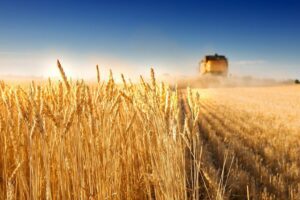
The European Commission has presented a set of actions to help Ukraine export agricultural products, the so-called “Solidarity Lanes.”
The plan was presented by European Commissioner for Transport Adina Vălean in Brussels on Thursday.
The European Commission said these proposals are presented as part of the EU solidarity reaction with Ukraine and will help Ukraine export its agricultural products. “Following Russia’s invasion of Ukraine and its blockade of Ukrainian ports, Ukrainian grain and other agricultural goods can no longer reach their destinations. The situation is threatening global food security and there is an urgent need to establish alternative logistics routes using all relevant transport modes,” the European Commission said.
According to the European Commissioner, some 20 million tonnes of grains have to leave Ukraine in less than three months using the EU infrastructure. “This is a gigantesque challenge, so it is essential to coordinate and optimize the logistic chains, put in place new routes, and avoid, as much as possible, the bottlenecks. Our communication addresses the emergency solutions but also medium and long time measures to better connect and integrate Ukraine’s infrastructure with the EU one. For both short-term and long-term solutions, we will work with the Ukrainian authorities and in close collaboration, especially with the neighbouring Member States, who spared no effort in helping during this crisis,” Vălean said.
According to the press release issued in this regard, as of today, in spite of immediate efforts by the EU and its Member States to ease border crossings between Ukraine and the EU, thousands of wagons and lorries are waiting for clearance on the Ukrainian side. “The average current waiting time for wagons is 16 days, while it is up to 30 days at some borders. More grain is still stored and held back in Ukrainian silos ready for export. Among the challenges are differing rail gauge widths: Ukrainian wagons are not compatible with most of the EU rail network, so most goods need to be transhipped to lorries or wagons that fit the EU standard gauge. This process is time-consuming and transhipment facilities along the borders are scarce,” the European Commission said.
In address these obstacles and set up the Solidarity Lanes, the Commission, together with Member States and stakeholders, will work on the following priority actions in the short term.
The first priorities are additional freight rolling stock, vessels and lorries. “The Commission calls on EU market players to urgently make additional vehicles available. In order to match demand and supply and establish the relevant contacts, the Commission will set up a matchmaking logistics platform and ask Member States to designate dedicated Solidarity Lanes contact points (a ‘one-stop-shop’).”
Another priority is the capacity of transport networks and transshipment terminals: the export of Ukrainian agricultural products should be prioritized, and infrastructure managers should make rail slots available for these exports. “The Commission also calls on market players to urgently transfer mobile grain loaders to the relevant border terminals to speed up transhipment. A road transport agreement with Ukraine will also remove bottlenecks,” the European Commission said.
Among the priorities are customs operations and other inspections and storage of products in the EU. To this end, the Commission urges national authorities to apply maximum flexibility and to ensure adequate staffing to accelerate procedures at border crossing points.
In the medium to long term, the Commission will also work on increasing the infrastructure capacity of new export corridors and on establishing new infrastructure connections in the framework of the reconstruction of Ukraine. “The next round of Connecting Europe Facility (CEF) calls for proposals will allow support for projects improving transport connections to Ukraine, including for railway connections and rail-road terminals. Against this background, the Commission today adopted a Decision with a view to signing a high-level agreement with Ukraine, updating the maps for the Trans-European Transport Network (TEN-T), as part of the Commission’s policy on extending the TEN-T to neighbouring countries.”
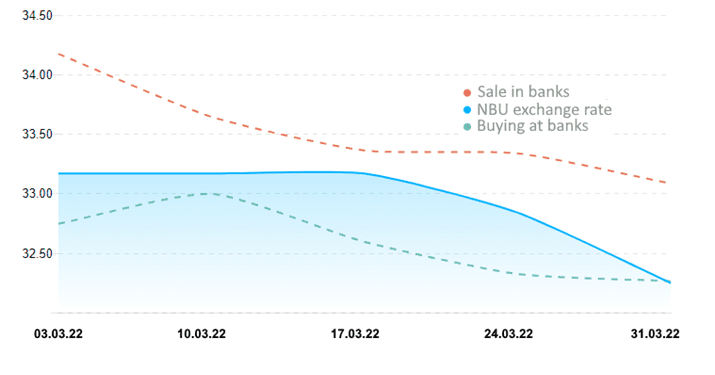
Quotes of interbank currency market of Ukraine (UAH for €1, in 01.03.2022-31.03.2022)

Ukrainian athletes won six medals on the eleventh day of the Deaflympic Games in Caxias do Sul (Brazil), the Ministry of Youth and Sports reported.
According to the press service of the ministry, at the XXIV Summer Deaflympics, the national deaflympics team of Ukraine on the eleventh day won 6 more awards – 3 gold, 1 silver and 2 bronze.
In particular, Ukrainians won four awards in long-distance orienteering: Anna Fedoseeva and Alexander Sankin brought gold, Ruslan Nikolaenko and Anna Androsovich won silver and bronze, respectively.
The Ukrainian national team won two more awards in bullet shooting: Violeta Lykova won the gold medal in shooting from a small-caliber rifle from three positions, and Sergey Fomin won a bronze medal in high-speed shooting from a small-caliber pistol, 25 m.
Thus, Ukraine remains the absolute leader in the medal count with 116 awards, including 51 gold, 31 silver and 34 bronze medals.
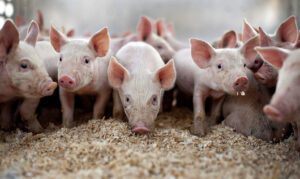
Agroholding KSG Agro in January-March 2022 increased its net profit by 2.5 times compared to the first quarter of 2021 – up to $1.82 million, EBITDA increased by 10% – up to $1.52 million.
According to the holding’s report on the Warsaw Stock Exchange website on Thursday evening, its revenue for the specified period increased by 1% to $3.54 million.
KSG Agro also increased gross profit by 12% to $1.41 million, operating profit by 10% to $1.12 million.
In addition, in the first quarter of 2022, the group of companies received a net loss of $0.65 million due to the difference in exchange rates, while in January-March 2021 this factor generated $0.4 million of net profit.
KSG Agro emphasizes that in the context of the Russian military invasion of Ukraine, it continues to implement a development strategy focused on growing three winter and two spring crops and pig farming. The products of the agrarian group are basic foodstuffs and are always in demand, while the demand for it is especially high in wartime.
“The group has strengthened the security of the pig farm and temporarily moved its headquarters from Dnipro to Chernivtsi. Since most of the group’s production processes are vertically integrated, it depends only on suppliers of fertilizers, fuel and feed for pigs,” the report says.
According to it, the total capital of the agricultural producer by March 31, 2022 increased by 0.3% compared to December 31, 2021, to $23.42 million, its net debt increased by 5.5%, to $28.45 million. Thus, in the first quarter, the ratio of net debt to equity increased by 4.3% to 1.21.
The total assets of the agricultural holding for the specified period decreased by 3.8% – to $68.73 million, while long-term debt obligations increased by 3.7% – to $26.71 million, and current liabilities decreased by 16.8% – to $18, 59 million
“Since the beginning of the Russian invasion, there has been no hostilities in close proximity to the group’s assets. The group’s pig farm and its crop fields are located in the center of Ukraine, where there has not yet been hostilities. Therefore, as of the date of this report, management does not expect significant interruptions as in the spring sowing campaign, as well as in the subsequent harvesting of winter crops,” explained KSG Agro.
The number of sows of the agricultural group in the first quarter of 2022 increased by 2.2% compared to the first quarter of 2021 – up to 5.68 thousand. At the same time, the total number of animals (pigs and piglets) increased by 11.6% – up to 48.8 thousand heads.
In the crop-growing segment, the agricultural holding increased its net profit by 4.3% over the three months of this year compared to January-March 2021 – up to $0.46 million, in the livestock segment – by 27.9%, up to $0.93 million. other operations” (production of fuel pellets and thermal energy), net profit decreased by 4.3 times – to $0.22 million.
Thus, the total profit of the agricultural group in the operating segment in the first quarter of this year amounted to $1.41 million (+12% compared to the same period last year) and amounted to 77% of all net profit for this period.
For the three months of 2022, the Group of Companies increased pork sales by a third compared to January-March 2021, in dollar terms, sales amounted to $1.36 million.
“The figures above suggest that the group has a clear track record of resilience in challenging environments. From the improvement in macroeconomic performance, we can conclude that other Ukrainian companies exhibit the same character traits. A trait that seems to be in the DNA of the Ukrainian people and serves evidence that victory will ultimately be ours,” the agricultural holding’s report says.
The vertically integrated holding KSG Agro is engaged in pig breeding, as well as the production, storage, processing and sale of grains and oilseeds. Its land bank is about 21 thousand hectares.
According to the agricultural holding itself, it is among the top 5 pork producers in Ukraine.
KSG Agro in 2021 reduced net profit by 16 times compared to 2020, to $20.27 million, revenue by 44%, to $30.75 million, while doubling EBITDA to $12.28 million.
The owner and chairman of the board of directors of KSG Agro is Sergey Kasyanov.
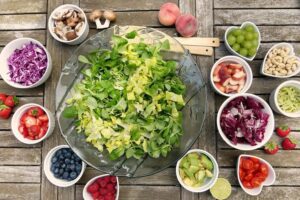
Milk, yogurt, butter, flour confectionery and a number of other food products have been removed from the list of critical imports, which at the same time has new positions: farm animals, cut flowers, yeast, planting material and other agricultural products.
The Cabinet of Ministers made the relevant changes to Decree No. 153 of February 24 on the list of critical imports by its Decrees No. 553 of May 3 and No. 554 of May 7.
Thus, non-condensed milk and cream are no longer critical imports to Ukraine; butter and other fats from milk; milk pastes; prepared foods from cereals, flour, starch or milk; flour confectionery prepared without the addition of vinegar or acetic acid vegetables (except nuts preserved in sugar).
Tomatoes, yogurt, potato starch and peanuts are also removed from the list.
In turn, the list of critical imports includes live farm animals (cattle, pigs, sheep and goats), products of animal origin (caeveta and musk; bile, including dry bile), as well as glands and other products of animal origin used to make pharmaceuticals.
The list dated May 3 was replenished with live plants for further cultivation: seedlings, cuttings and rootstocks, bulbs, tubers, roots and rhizomes that are in a state of vegetative dormancy, vegetation or flowering. Also on the list were mushroom mycelium; trees, bushes and shrubs with edible fruits or nuts, cut flowers, parts of plants and buds for bouquets or ornamental purposes.
In addition, critical imports are expanded by hop cones, yeast (active or inactive), prepared baking powders, glycerine, cocoa-containing finished products and cocoa waste, refined and unrefined olive oil, roasted malt.
As reported, the proposal to exclude dairy products from the list of critical imports was submitted in April by the Union of Dairy Enterprises of Ukraine association. According to her, since the beginning of the military invasion of the Russian Federation into Ukraine, 60-65% of the country’s milk processing enterprises have already resumed work, and the current volumes of their production are able to provide the Ukrainian market.
After the start of Russia’s military aggression on February 24, the government on the same day, by decree No. 153, determined a list of critical import goods, for the purchase of which the National Bank of Ukraine allows buying foreign currency. Since then, the government has changed this list more than 10 times.
According to the NBU, by mid-April, the list of critical import goods covered about 88% of all imports to Ukraine in 2021. At the same time, the National Bank does not yet call for abandoning it, since this list also contains services that are more difficult to analyze and account for.

During martial law, businesses can carry out economic activities on a declarative basis without obtaining the conclusion of the State Food and Consumer Service.
This was announced by the European Business Association (EBA), referring to the official response of the State Food and Consumer Service to the request of the EBA.
“This week, the Association received an official letter from the State Food and Consumer Service, which states that business entities can carry out economic activities under martial law on a declarative basis by submitting a declaration on the production of economic activities to the Ministry of Economy of Ukraine without obtaining a conclusion,” the EBA reports.
In addition, the State Food and Consumer Service confirmed that the period of validity of permits, including its conclusions, is automatically extended for the period of martial law.
The EBA notes that the introduction of martial law and hostilities on the territory of the state have significantly complicated, and in some places made it impossible for entrepreneurs to obtain a number of permits.
We are talking, for example, about the conclusions of the state sanitary and epidemiological expertise, the receipt of which was a necessary condition for the sale of many types of goods, including critical ones for consumers, such as hygiene products, baby food, detergents, cosmetics, certain food products, and equipment. , others.



