

Heavy rains in Brazil have degraded the quality of the new coffee crop and could lead to a shortage of high-quality Arabica beans on the global market, while futures for this variety have risen by approximately 35% since June, according to Bloomberg.
Brazil is the world’s largest producer of Arabica and accounts for about 45% of global production, so problems with harvest quality could affect the supply of premium coffee far beyond the country’s borders.
The main problem was extremely heavy rainfall during the harvest. In June, rains knocked a large number of ripe coffee cherries off the trees, after which they lay on waterlogged ground for several days, increasing the risk of fermentation, mold, and undesirable flavors.
According to Simao de Lima, president of the Expocacer cooperative—which unites more than 800 producers in the Cerrado Mineiro region in southeastern Brazil—the rains knocked down an average of about 20% of the coffee cherries, compared to the usual 5–7%.
Thus, this does not represent a 20% loss of Brazil’s entire harvest, but rather significant damage to the crop in one of the most important regions for the production of high-quality Arabica.
The situation was exacerbated by a second wave of rainfall in July. The rains fell on beans that had already been harvested and laid out to dry, forcing some producers to start the drying process all over again.
According to data from the meteorological company Vaisala, rainfall in certain areas of Brazil’s coffee belt in June and July reached 250–500% of the climate norm, and in some places, up to eight times more rain fell than usual.
Quality issues are already affecting the market. Arabica futures have risen by about 35% since June, offsetting a significant portion of the price decline since the beginning of the year.
In the physical market, high-quality Brazilian coffee is selling at a premium of up to 15 cents per pound compared to futures in New York.
The reduction in the volume of coffee meeting the delivery standards for Intercontinental Exchange (ICE) certified warehouses in the U.S. and Europe could prove particularly significant.
In a typical year, approximately 30–35% of the Cerrado Mineiro region’s production meets ICE requirements. Following this year’s rains, de Lima estimates that this share could drop to 10–15%. Meanwhile, coffee stocks in ICE-certified warehouses are already approaching their lowest levels of this century.
This could intensify competition among international roasters for high-quality beans. Bloomberg notes that Brazilian Arabica is used, in particular, by companies such as Starbucks, Lavazza, and Illy.
However, it is still too early to speak of a general coffee shortage. The U.S. Department of Agriculture expects that in the season beginning in October, global coffee supply will exceed consumption by approximately 10 million bags, which would be the largest surplus in six years. One of the main factors is expected to be record production in Brazil itself.
Therefore, the market’s main problem lies not so much in the total volume of coffee as in the availability of high-quality Arabica. Major producers can partially offset the shortage by adjusting the composition of their coffee blends and sourcing beans from other regions; however, for the premium segment, the situation could lead to further increases in purchasing and retail prices.
Weather remains an additional risk for the market. Reuters notes the intensification of the El Niño phenomenon, which in the 2026–2027 season could further increase volatility in the markets for coffee, cocoa, and other tropical agricultural commodities.
According to the results of a public opinion poll conducted in March 2026 by the research company Active Group in collaboration with the Experts Club information and analytical center, perceptions of Brazil in Ukrainian society show moderately positive trends, although a high level of neutrality remains the key characteristic. Most Ukrainians do not have a clearly formed attitude toward this country, but the share of positive assessments is gradually increasing.
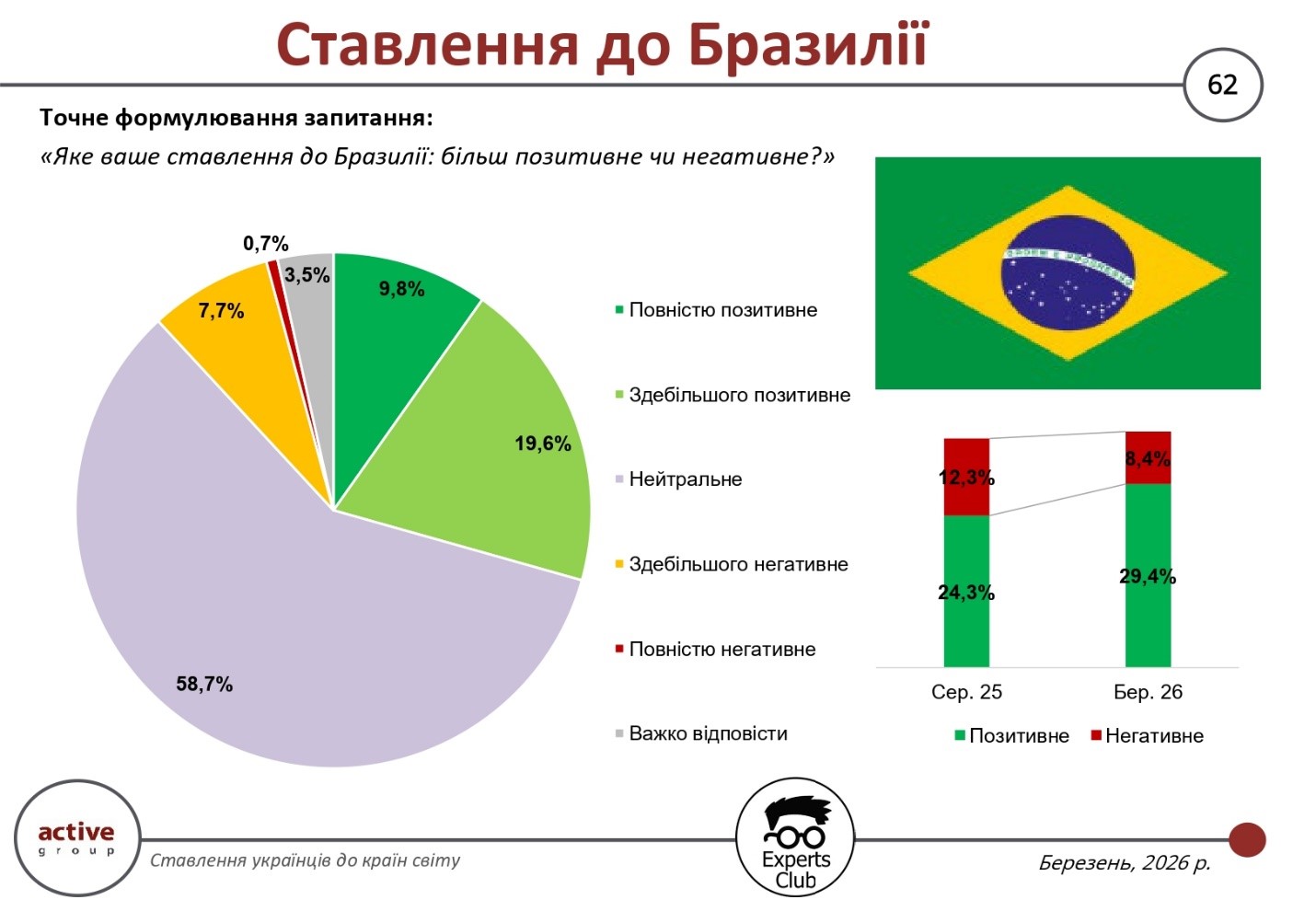
Overall, the positive attitude toward Brazil stands at 29.4%, which is a noticeable increase compared to August 2025 (24.3%). At the same time, 9.8% of respondents chose the “completely positive” option, and another 19.6% selected “mostly positive.” This trend indicates a gradual strengthening of the country’s positive image, although it remains relatively moderate.
At the same time, negative assessments have decreased—from 12.3% to 8.4%. Within the structure of negative perceptions, 7.7% fall under the “mostly negative” category and only 0.7% under “completely negative.” This means that critical perceptions of Brazil in Ukraine are diminishing and are not systemic in nature.
Most telling is the high level of neutrality—58.7% of respondents. This indicates that for most Ukrainians, Brazil remains a country that does not occupy a significant place on the informational or political agenda. The absence of active interaction or regular information flows shapes precisely this model of perception.
Additionally, 3.5% of respondents were unable to determine their position. Combined with neutral assessments, this creates a significant segment of “undecided attitudes,” which could potentially change depending on the development of bilateral relations or the country’s media presence.
From a dynamic perspective, Brazil shows a positive trend: an increase in the share of positive assessments is accompanied by a simultaneous decrease in negative ones. This indicates a gradual improvement in the country’s image in Ukraine, although it is occurring against a backdrop of general inertia in neutral perception.
Overall, Brazil remains a “peripheral” country for Ukrainians in terms of emotional perception, yet with potential for further improvement of its image. The high proportion of neutral assessments means that future changes in perception will largely depend on the level of economic, diplomatic, and informational interaction between the two countries.
According to a study conducted by the Experts Club information and analytical center based on data from the State Customs Service, Brazil ranks 50th in total trade volume of goods with Ukraine, with a figure of $335.6 million. At the same time, imports from Brazil are nearly four times higher than Ukrainian exports, resulting in a bilateral trade deficit of $193.5 million.
The study was presented at the Interfax-Ukraine press center; the video can be viewed on the agency’s YouTube channel. The full version of the study can be found at this link on the Experts Club analytical center’s website.
ACTIVE GROUP, BRAZIL, EXPERTS CLUB, Pozniy, SOCIOLOGY, SURVEY, UKRAINE, URAKIN

Coffee prices fell on Thursday amid expectations of a high harvest in Brazil, the world’s largest coffee supplier.
Arabica futures fell 0.2% to $3.0785 per pound at the end of trading in New York yesterday. This is the lowest price in five months.
Brazil’s new coffee crop, which will begin harvesting in a couple of months, could reach a record 75.8 million bags, Reuters reports, citing a forecast by EISA. One bag weighs 60 kg.
EISA expects the Arabica coffee harvest to amount to 48 million bags and the Robusta harvest to amount to 27.8 million bags.

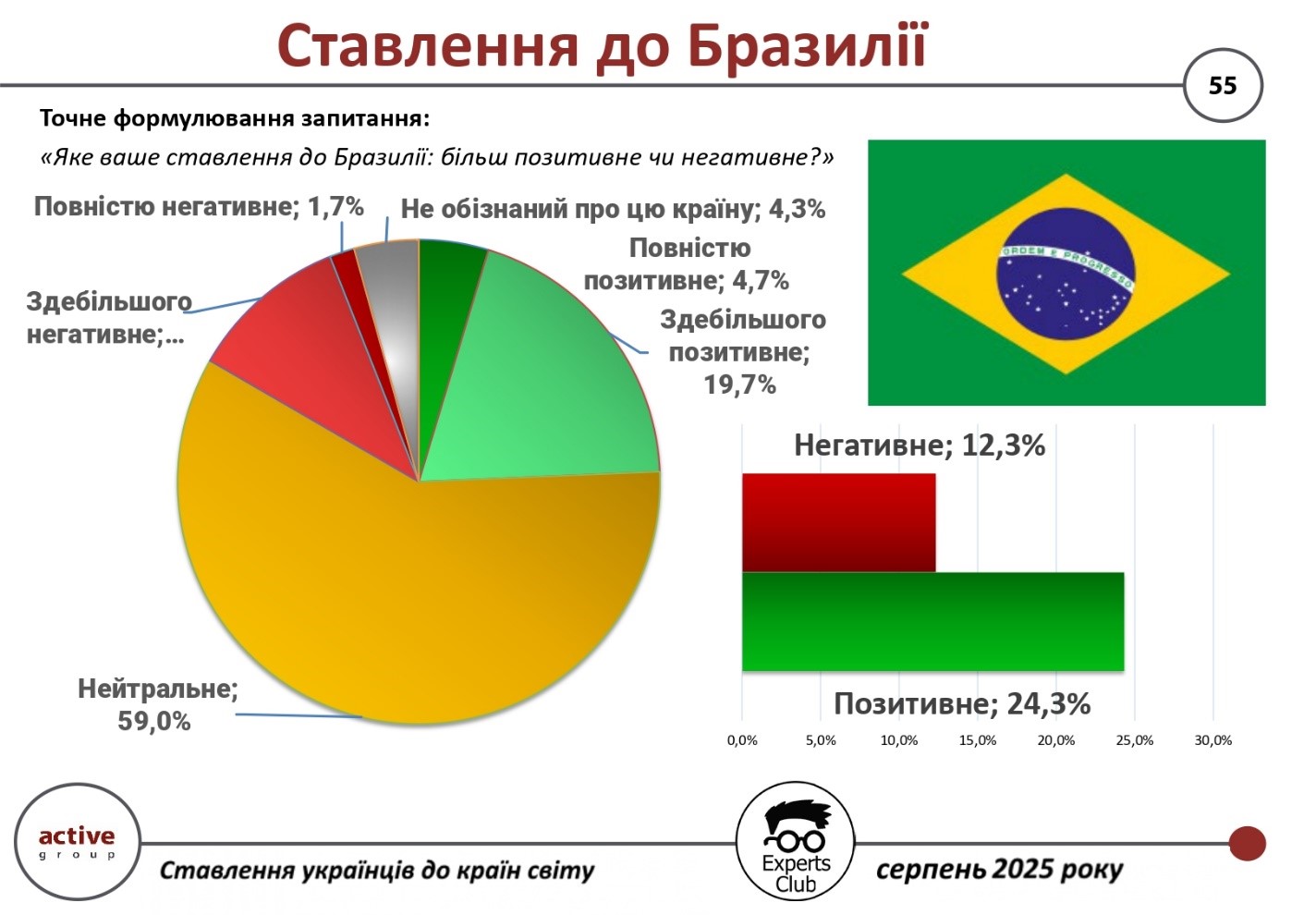
The majority of Ukrainians have a neutral attitude toward Brazil, according to a survey conducted by Active Group and the Experts Club.
According to the survey, 59.0% of respondents have a neutral position on the country. 24.3% of respondents have a positive attitude (in particular, 19.7% – “mostly positive” and 4.7% – “completely positive”). At the same time, 12.3% of Ukrainian citizens expressed a negative attitude toward Brazil, and another 4.3% said they were not familiar with the country.
Thus, the balance of positive and negative attitudes is +12 percentage points (24.3% vs. 12.3%).
According to the latest data, the volume of trade in goods between Ukraine and Brazil amounted to $180.3 million in 2024.
Ukrainian exports to Brazil amounted to $36.1 million,
– imports from Brazil amounted to $144.2 million,
– the negative balance was $108.1 million.
The total trade turnover reached $180.3 million, which indicates Ukraine’s significant dependence on Brazilian imports.
“Brazil remains an important trading partner for Ukraine in Latin America, but the structure of bilateral trade is currently asymmetrical. The significant deficit reflects the predominance of imports, in particular agricultural products and industrial goods,” said Maksym Urakin, economist and founder of Experts Club.
He emphasized that amid growing global competition, Ukraine should actively seek opportunities to increase exports to the Brazilian market: “This applies not only to agricultural products, but also to high-tech industries where Ukraine has competitive advantages.”
The full video can be viewed here:
https://www.youtube.com/watch?v=YgC9TPnMoMI&t
You can subscribe to the Experts Club YouTube channel here:
https://www.youtube.com/@ExpertsClub
ACTIVE GROUP, BRAZIL, EXPERTS CLUB, Poznyi, SOCIOLOGY, TRADE, UKRAINE, URAKIN
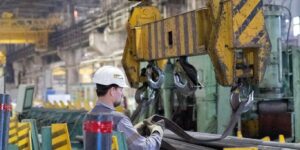
Centravis Production Ukraine (Nikopol, Dnipropetrovs’k region), a member of Centravis Ltd. holding, has supplied boiler pipes to the Brazilian market for Caldema, a company specializing in the production of industrial equipment.
According to the company’s press release on Tuesday, the total volume of deliveries amounted to 193 tons.
It is specified that the Ukrainian pipes are intended for the production of a steam boiler that will run on cotton seeds. This project is part of the environmental trend of using biomass as an alternative energy source. The boiler is being developed for a Brazilian company that seeks to reduce its dependence on fossil fuels.
It is noted that this is an important step towards sustainable development, as the technology of cottonseed processing allows for the production of clean energy, reducing CO₂ emissions.
“This is a large order for one of the largest companies in the industry and a prominent player in the local market. We hope it will help expand our company’s presence in the South American market, which has been growing rapidly in recent years,” said Artem Atanasov, Sales Director of Centravis.
Brazil is one of the top 10 countries in the world in terms of gross domestic product.
Centravis, in turn, is among the world’s top ten producers of hot-rolled seamless stainless steel pipes. In 2024, the company increased production by 12% to 13.7 thousand tons. More than 99% of this volume was exported to 40 countries. The largest consumers of Ukrainian seamless pipes are Germany, the US, Italy, Austria and Spain.
“Last year we had very good growth dynamics in the North and South American markets. We know this region and will work to increase sales in this part of the world,” stated Atanasov.
“Founded in 2000, Centravis is one of the ten largest producers of seamless stainless steel pipes in the world. Its main production facilities are located in Nikopol (Dnipropetrovska oblast). In 2023, the company opened a branch in Uzhhorod.
Centravis Holding Ltd. was established on the basis of Nikopol Stainless Steel Pipe Plant CJSC, service and trading companies of Production and Commercial Enterprise YUVIS LLC. Its shareholders are members of the Atanasov family. Centravis Ltd. owns 100% of the shares of Centravis Production Ukraine.

Arabica coffee is actively rising in price on Monday, reaching 13-year highs on weak forecasts for the Brazilian coffee harvest.
The price of arabica futures on the New York Stock Exchange ICE Futures rose by 1.2% to $3.0575 per pound.
Meanwhile, robusta futures jumped 4.1% to $5191 per ton.
The US Department of Agriculture has predicted that the coffee harvest in Brazil in the 2024/25 agricultural year will amount to 66.4 million standard 60-kilogram bags, while previously the harvest was expected to reach 69.9 million bags.
According to the Cemaden meteorological service, the current season in Brazil is the driest since 1981.



