
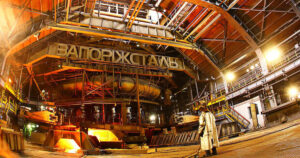
Zaporizhstal steelmaker Zaporizhstal in January-April of the current year decreased shipment of rolled steel by 16.1% compared to the same period of the last year – down to 530.9 thousand tons.
According to the company, steel production fell by 10.3% to 646.5 thousand tons during this period, while pig iron production dropped by 13.6%, to 717.1 thousand tons.
In April 2023, Zaporizhstal produced 231.8 thousand tons of cast iron (in April 2022 – 69 thousand tons), 252.9 thousand tons of steel (73.6 thousand tons), shipped 205.1 thousand tons of rolled steel (68.2 thousand tons).
“The increase in production levels in April 2023 compared to the same period last year is due to the withdrawal of production facilities from forced hot mothballing, caused by full-scale military operations in Ukraine”, – explained in a press release.
It is a reminder that due to aggravation of military actions in the region, since the beginning of March 2022 Metinvest Group has put some of Zaporizhstal’s equipment into hot preservation mode. At the end of March of the same year the plant partially resumed cold-rolling shop operation for production and shipment of cold-rolled coils to European consumers. A month after the forced shutdown the mill put the equipment out of conservation and partially resumed production. Since April 2022 the mill has been working at an average of 50% capacity.
As it was reported, in January-March 2023 “Zaporizhstal” decreased shipment of rolled steel by 42.3% compared to the same period in 2022 – to 325.7 thousand tons, steel melting – by 39.2% to 393.6 thousand tons, cast iron – by 36.3%, to 485.3 thousand tons. In March, 193.6 thousand tons of iron, 184.4 thousand tons of steel were produced and 150.8 thousand tons of rolled products were shipped.
“In 2022, Zaporizhstal reduced the output of rolled steel by 60.4% to 1 million 304.3 thousand tons, steel by 61.7% to 1 million 491.3 thousand tons and cast iron by 54.3% to 2 million 9.9 thousand tons compared to 2021.
“Zaporizhstal” is one of the biggest industrial enterprises in Ukraine, which products are in great demand among the consumers on the internal market and in many countries of the world. The plant specializes in high-quality steel coils, hot-rolled plates, cold-rolled plates, cold-rolled coils from carbon and low-alloyed steels, as well as steel straps, tin plates, formed sections.
Main consumers are producers of welded pipes, enterprises of automotive, transport, agricultural engineering, producers of household appliances.
“Zaporizhstal is in the process of integration into Metinvest Group the main shareholders of which are CJSC “System Capital Management” (71.24%) and Smart Holding group of companies (23.76%).
Metinvest Holding LLC is the management company of Metinvest group.
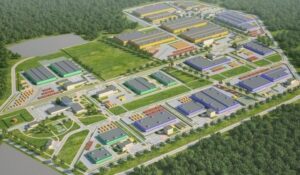
The Cabinet of Ministers has created the Stryi Valley industrial park in the Lviv region, which will ensure, in particular, the development of the processing industry in the region and create about 700 new jobs, Prime Minister Denys Shmygal said.
“We hold a consistent course on all-round business support. Today we are creating another industrial park, the Stryi Valley in the Lviv region,” Shmygal said at a government meeting on Tuesday.
According to the Prime Minister, the implementation of this decision is expected to create about 700 jobs and the development of processing in the region, particularly in the food industry, woodworking and mechanical engineering.

The Cabinet of Ministers at a meeting supported a decision that gives start to the procedure of transforming the state-owned company NAEK Energoatom into a joint stock company, the government portal reported with reference to Prime Minister Denis Shmygal on Tuesday.
“Energoatom is one of the largest operators of nuclear power plants in Europe, the company is strategically important for the energy security of the state. We`re bringing it in conformity with international standards of corporate management. At the same time the state retains 100% ownership of the plant,” he said.
According to Prime Minister, eventually it will increase the efficiency of management, will attract additional funds for implementation of new projects and will strengthen energy independence.
As reported, the Verkhovna Rada of Ukraine on February 6, 2023, supported the draft law 8067 on corporatization of the state-owned enterprise Energoatom, which provides for the transformation of Energoatom from a state-owned enterprise into a joint stock company with 100% state-owned shares.
Energoatom’s corporatization is envisaged by the loan agreement between the company and the European Bank for Reconstruction and Development (EBRD) and the guarantee agreement “Complex Generalized Safety Upgrade Program for Nuclear Power Plants,” ratified by the Supreme Council.
“Energoatom is the operator of all four operating nuclear power plants in Ukraine. It operates the Zaporizhzhya, South Ukraine, Rivne and Khmelnitsky plants, with 15 power units equipped with water-water power reactors, with a total installed electric capacity of 13.8 GW.
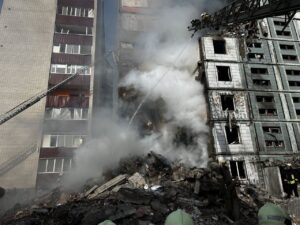
Civilian casualties from February 24, 2022, after Russia launched a full-scale war against Ukraine, to May 1, 2023, totaled 23,375 (23,015 as of April 24), including 8,709 deaths (8,574), the UN Office of the High Commissioner for Human Rights (OHCHR) said Tuesday.
“OHCHR believes that the real number of civilian deaths or injuries is significantly higher, as many reports from places where such cases have occurred still require further confirmation, while information from some places where fighting is ongoing is delayed,” the paper noted regarding the UN data.
This is the case, for example, in such locations as Mariupol (Donetsk region), Lysychansk, Popasna and Severodonetsk (Luhansk region), where numerous civilian deaths or injuries have been reported.
According to confirmed UN data, 3,933 men, 2,341 women, 270 boys and 214 girls were killed, while the gender of 31 children and 1,920 adults could not yet be determined.
Among the 14,666 wounded, 431 were boys and 304 girls, and 278 children whose sex could not yet be determined.
Compared to April 24, nine children were killed and 14 more were wounded.
Whereas the OHCHR casualty report used to be issued daily, and then only on weekdays, it has become a weekly report since July. This report, like the previous one, provides data by month.
According to them, the number of deaths in April was 169, compared with 181 in March, 141 in February, 198 in January, 206 in December and 186 in November.
March remains the deadliest month for civilians, according to the UN, with at least 4,094 deaths. In April, according to an OHCHR publication, the number of civilian deaths due to the war dropped to 798, in May to 534, in June to 426 and in July to 379. In the first five days of the war from February 24-28, 362 people died, in August 336, in September 393 and in October 305.
The number of wounded for April reached 496, compared with 592 in March, 458 in February, 539 in January, 617 in December, and 541 in November. In October, the number of wounded dropped to 795 from 981 in September, when it was up from 917 in August. Before that the number of wounded exceeded a thousand each month: July – 1130, June – 1105, May – 1138, April – 1890, March – 2987. In the first five days of the war last February 465 people were wounded.
According to the report, in April of this year, large-area explosive weapons killed 165 people and wounded another 456, while mines and explosive remnants of war killed four people and wounded four (7% of total casualties).
Government-controlled territories accounted for 84 percent of the casualties in April, according to the UN.
The summary traditionally states that the increase in numbers to the previous summary should not be attributed solely to cases after April 24, as the Office verified some cases from previous days during that period.
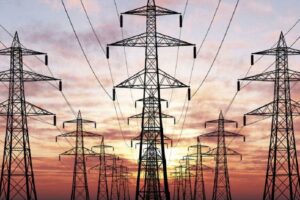
The powerful interstate power transmission line between Poland and Ukraine modernized by NEC Ukrenergo together with Polish transmission system operator PSE has successfully passed a three-day test since April 27, the NEC said.
According to Ukrenergo, the total cost of the project amounted to 350 million UAH, in addition, about 1 thousand tons of necessary equipment was provided for free by Polish partners.
The company explained that the bulk of the work was done in this node, so that the electricity produced by the Ukrainian power system could be converted to the European voltage of 400 kV and transmitted to Europe.
“It was a complex but mutually beneficial project that we implemented in cooperation with our European colleagues. It is important both for Ukraine and the energy security of Europe,” commented Volodymyr Kudrytsky, chairman of the board of Ukrenergo, as quoted in the company’s Telegram feed on Tuesday.
According to him, the line will strengthen links between the Ukrainian and European energy systems, constituting an additional element of European energy security and contributing to the development of a stable energy network in Ukraine.
“If the needs are different, we will be able to import electricity from Europe,” Kudritsky said.
The NEC added that the total length of the line is almost 400 km, more than 70% of which runs through Ukraine. The line is connected to the backbone network through an open switchgear on one of the Ukrainian power facilities. On the construction of the facility from the Ukrainian side for five months during the war worked 125 specialists – 45 employees of “Ukrenergo” and 80 contractors.
At the same time, Polish operator PSE on its auction platform on Tuesday announced a one-month auction to allocate available cross-section capacity on the Rzeszow-Khmelnitsky line for delivery from May 15-31. The capacity offered in the auction is 200 MW for exports from Ukraine and 350 MW for imports from Poland. Under the auction terms, bids from bidders will be accepted until May 8 at 16:00, with the results to be announced by the same time on May 10. Since NEC Ukrenergo during the war can only conduct daily auctions according to the requirements of ENTSO-E, it has to conduct them two days before the delivery day, i.e. the first can be expected on May 13 for the same capacity to be distributed by the Polish operator.
At the same time, the market notes that for the first week of May, Ukrenergo does not distribute cross-section capacity on the Dobrotvir-Zamosc line, through which DTEK Zakhidenergo exports 75MW hourly to Poland, due to a number of holidays in this country and the failure to hold auctions by the Polish operator.
As reported, the reconstructed 400 kV line between KNPP and Rzeszow was scheduled to be put into operation at the end of April. Reconstruction of the 750 kV Khmelnitsky NPP (KNPP) – Rzeszow line, which has not been in operation since the 1990s, provided for its transfer to the 400 kV voltage used in the European grid. Its launch allows for a 25-30% increase in Ukrainian export potential. The line will operate in synchronous mode, i.e. all participants of the Ukrainian and European markets will have access to it.

Azerbaijan reduced associated petroleum gas production 2.9% year-on-year in Q1 2023 to 3.809 billion cubic meters, an oil and gas market source told Interfax.
The total included 985.81 million cubic meters of saleable gas, down 27.3%.
Associated gas accounted for 31.3% of Azerbaijan’s total gas production. Natural gas accounted for the remaining 68.7% and totaled 8.35 bcm.
Gas condensate production fell 1.5% to 1.289 million tonnes and accounted for 16.7% of total oil production. The remaining 83.3% or 6.434 million tonnes was crude oil.
The bulk of associated gas is produced at the Azeri-Chirag-Gunashli (ACG) fields, and most of it is re-injected into the reservoir to maintain pressure. The rest is supplied to State Oil Company of the Azerbaijani Republic (SOCAR) free of charge. Most of the condensate is produced at the Shah Deniz field, from where it is exported by the Baku-Tbilisi-Ceyhan pipeline.



