
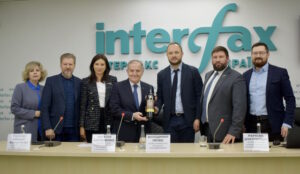
Ukraine needs a state program of winemaking development to bring the industry to a new level of development after the war, said Ricardo Núñez, hereditary winemaker and owner of the Vinos de La Luz winemaking company, at a press conference at Interfax-Ukraine.
“In February 2022 the dynamic development of the wine industry in Ukraine was suspended. A lot of Ukrainians including engaged in winemaking left their homes. But they will return with the knowledge and experience gained outside the country. They must be prepared for new opportunities”, the winemaker said.
Ricardo Nunez presented the novelty of the season – a red dry wine Big Wines big Art, which was produced from the grapes of the Odessa black vintage 2020 grown in the Rhenia district of the Odessa region. The first batch of 1,000 bottles was produced at the facility in the Kyiv region.

The artist Ivan Marchuk was involved in the work on the new Ukrainian wine and provided his painting “Awakening” for the project, which could symbolize the revival of Ukrainian winemaking after the war, said Ricardo Nuñez.
Talking about the future recovery of the industry the winemaker reminded that development always begins with the emergence of many small producers who become the basis for the emergence of large enterprises. However, the true development of the industry can be achieved if Ukrainians start to drink Ukrainian wine.
“I am the first investor in the winegrowing and winemaking industry in Ukraine during the war. I am working on the production of wine now. My task is to teach Ukrainians to drink their own wine. Then the country will have a big and great industry,” he said.
Vinos de La Luz Group has wineries in the Old and New World wine regions, in particular in Spain, Italy, Argentina and the USA, where it produces wines under the Vinos de La Luz brand.

The contract on the merger of UJSIC “ASKA” (Zaporozhye) with IC “VUSO” (Kiev) was approved by shareholders of IC “VUSO” at the meeting on March 22 of this year.
As reported on the web-site of IC “VSCO”, due to the merger all assets and liabilities of UJSIC “ASKA” pass to IC “VSCO”.
The companies will work under one brand of IC “VUSO” (VUSO).
“The merger process began in December 2021. Despite the difficulties of wartime, the reorganization procedure took place and as of today has already been completed”, – is noted in the message.
According to the head of the supervisory board of IC “VUSO” Mykhailo Nazarchuk, this step allowed to increase the presence of IC “VUSO” in the corporate segment of the insurance market, as well as to create a big player with Ukrainian capital.
IC “ASKA” submitted to the regulator an application for withdrawal of the last license and exclusion from the State Register of Financial Organizations.
As it was informed, at the end of November 2021 Renat Akhmetov’s SCM investment company informed about reaching preliminary agreements on selling UJSIC “ASKA” to shareholders of IC “VSO”. The National Bank agreed the purchase of 99,593% of “ASKA”, as well as 62,2156% of PJSC “Insurance company “ASKO-Donbass North” (Druzhkovka, Donetsk region), in which 62,4699% belonged to “ASKA”.
UJSIC “ASKA” is the first private insurance company which has appeared in independent Ukraine, and has been operating for already more than 30 years. It belonged to the portfolio of international investment company SCM. On December, 22nd, 2021 NBU decided to cancel 34 its licenses for insurance, except the license for obligatory insurance of civil liability of motor vehicles owners (OSAGO) on the basis of the submitted application.
IC “VUSO” was founded in 2001. Nowadays it owns 50 licenses: 34 – for voluntary and 16 – for compulsory types of insurance. It is represented in all regions of Ukraine.

Members of the parliamentary committee for national health, medical care and health insurance suggest banning foreigners from using surrogacy services during martial law and up to three years after it ends.
This is specifically in the bill on Assisted Reproductive Technology (ART), which is based on three alternative bills (Nos. 6475, 6475-1 and 6475-2) and was supported by the committee at Friday’s meeting.
The draft law also discloses requirements to a woman who may be a surrogate mother, her rights and obligations, creates a legal basis for keeping records of foreigners wishing to use the surrogacy service in Ukraine, and bans the work of intermediaries or agencies in the field of ART, prohibits advertising of ART of assisted reproductive cells and advertising aimed at attracting women to the surrogate motherhood service.
According to committee member Viktoria Wagner, the demographic situation in Ukraine is worsening due to the war and Ukraine’s population could decrease by 10 million by 2030.
The committee recommended the Ukrainian parliament to reject the alternative bills.

The head of the Verkhovna Rada Committee on Finance, Tax and Customs Policy Daniil Hetmantsev sees a significant potential of additional revenues to the state budget of Ukraine in case of a significant strengthening of the fight against the shadow market of excisable goods, especially tobacco products.
“Of all the excisable industries, we see the greatest potential in the detenization of the tobacco industry. This is about 15-17 billion UAH,” he said in an interview on Radio NV.
According to him, there is also great potential in the fuel market.
“As for vodka, the potential for detenalization is less, because the total amount of excise tax from alcoholic beverages is about 10 times lower than that of tobacco. Although there is certainly a certain reserve of detenalization for alcoholic beverages,” said Getmantsev.
The head of the Committee pointed out that the shadowing and tax evasion in the tobacco market takes place not at the level of its leaders but at the level of smaller companies and illegal manufacturers.
He reminded that the tobacco industry consists primarily of four major international manufacturers that are not suspected of tax evasion, because if it happens, the risks of such evasion for them will be incommensurate with the benefits.
“And we see, actually, by their tax behavior, that it is credible. These are market leaders, these are white companies, these are companies that pay taxes in full,” stated Getmantsev.
At the same time, according to him, some smaller Ukrainian tobacco companies are suspicious.
“There are some legal manufacturers that raise doubts about their compliance with taxation rules. In particular, there is a tobacco factory in the western Ukraine, where recently the Bureau of Economic Security (BES) conducted searches and found excisable goods without excise stamps for 80 million UAH”, – said the head of the Committee.
He added that the market also has some small legal production, but there is still a large part of the market – illegal producers, even without a license. “For example, Odessa customs recently detained and confiscated a cigarette production line, which they tried to bring into Ukraine illegally under the guise of soap production line,” – gave an example Getmantsev.
At the same time, the head of the specialized parliamentary committee stressed the inadmissibility of tax evasion during the war.

The Cabinet of Ministers of Ukraine has set up a budgetary institution, the Center for Humanitarian Demining.
According to Taras Melnychuk, a representative of the Cabinet in the Verkhovna Rada in Telegram, the relevant decision was made at the government meeting on Friday.
In particular, approved the proposal of the State Service for Emergency Situations to create a budget institution “Center for humanitarian demining”.

Tesla has risen by two lines in the list of the most expensive car brands in the world and topped it for the first time, overtaking Mercedes-Benz and Toyota, according to Brand Finance.
Tesla’s brand value is now valued at $66.2 billion, up 44 percent in one year and five times since pre-demonstration times.
“This increase in brand valuation is a positive signal for Tesla because it indicates better brand awareness, which could lead to higher sales and revenue in the future,” said Alex Hay, director of valuation at Brand Finance.
Toyota dropped to third place, losing 18% of its value ($52.5 billion), while Mercedes-Benz remained in second place (minus 3%, $58.8 billion).
The record jump in value in the sector was demonstrated by the Chinese automobile brand Sokon – by 123% over the year to $739 million.
The analysts of Brand Finance called Ferrari NV the strongest automobile brand having given to it the maximum rating “AAA+”. When evaluating brand strength, the company considers a host of other indicators besides value, including investment in marketing, operating results, and relationships with stakeholders (from employees, suppliers and shareholders to government agencies and community organizations).
The value of the Ferrari brand fell 8 percent over the year, mainly due to the depreciation of the euro against the dollar, to $7.4 billion. In euros, the figure rose 3 percent.
Among auto parts manufacturers, the most expensive brand was once again Japanese Denso, which rose in value over the year by 6%, to $4.5 billion. In the segment of tire manufacturers the French Michelin remained the leader (+2%, to $7.9 billion).



