

International rating agency Fitch Ratings has revised its estimates of the cost of iron ore, base metals and coal in the short and medium term, which it uses in its forecasts of operating activities and financial performance of companies in the sector.
The increase in the outlook for copper prices is due to expectations of tight global market conditions. The opening of the Chinese economy will lead to an increase in demand in the near future, as that country accounts for about 55% of global refined copper consumption. In addition, in the medium and long term, demand will be supported by the energy transition. That said, supply of the metal may be constrained by factors such as deteriorating mine productivity in Chile and political protests in Peru.
“We have raised our iron ore price forecast for 2023-2025 as stronger demand from the steel sector in Europe, North America and several Asian countries will offset a gradual decline in Chinese steel production,” the agency said in a statement. – Problems with iron ore supply in Brazil, South Africa and Ukraine will support prices in the short and medium term.
Fitch analysts kept estimates for aluminum prices unchanged except for 2025. “CRU forecasts that global aluminum inventories will remain at about 50 days in the coming years, indicating a market equilibrium,” the report said.
According to CRU, a rebound in demand from China amid lower production in Peru should reduce the global zinc surplus to 100,000 tons in 2023 from 420,000 tons last year. As a result, Fitch revised its price forecast for this metal for the current year.
The increase in estimates of the cost of gold in 2023-2025. “reflects the metal’s investment status in light of ongoing geopolitical tensions and concerns about economic growth, as well as price resilience despite rising interest rates,” the agency said in a review.
The upward revision of nickel price forecast is due to, among other things, the recovery of stainless steel production in China.

The U.S. dollar is strengthening against the euro, yen and pound sterling in trading on Tuesday after falling sharply the day before due to rising expectations that the Federal Reserve (Fed) will stop the cycle of raising the benchmark interest rate because of problems in the U.S. banking sector.
The futures market estimates less than 50% chance of Fed rate hike by 25 basis points (bps) at the March meeting, although last week traders considered the most likely scenario of rate hike at once by 50 bps, notes Bloomberg.
On Tuesday, traders’ attention is directed to the data on the dynamics of consumer prices in the U.S. for February, which is important for the Fed’s decision on the further rate level.
According to the experts’ consensus forecast, which is quoted by Trading Economics, inflation in the U.S. slowed down to 6% on an annualized basis last month from 6.4% a month earlier. Core inflation, which excludes food and energy costs, is expected to weaken to 5.5% from 5.6% in January.
The ICE-calculated index showing the dollar’s performance against six currencies (euro, Swiss franc, yen, Canadian dollar, pound sterling and Swedish krona) added 0.28% in trading, while the broader WSJ Dollar Index gained 0.23%.
The euro/dollar pair is trading at $1.0707 as of 8:10 a.m., up from $1.0734 at Monday’s market close.
The pound/dollar exchange rate is down to $1.2163 from $1.2184 the day before.
The value of the American currency in pair with the yen rose to 133.86 yen against 133.21 yen at the end of the previous session.
Yields on government bonds in Japan fell to a several-month low during Tuesday’s trading. Thus, the yield on 10-year government bonds fell to 0.24%, which is below the upper bound of the interest rate fluctuation corridor that was in effect until last December, when the Bank of Japan unexpectedly widened it to plus/minus 0.5%.
The dollar was down 0.9% against the euro, 1.2% against the pound and 1.3% against the yen on Monday.

Eurogroup finance ministers believe the collapse of U.S.-based Silicon Valley Bank (SVB) will not have a direct impact on Europe’s financial system, but is a signal of the importance of ensuring the stability of the EU banking system amid ongoing uncertainty.
“Since this bank’s presence in the EU is very, very limited, we do not see direct consequences, but we are closely monitoring developments and we take note of the strong reaction of the U.S. authorities,” EU Economy Commissioner Paolo Gentiloni said after the Eurogroup meeting in Brussels.
He noted that the eurozone economy has entered this year in slightly better shape than expected a few months ago, but turmoil in the banking system amid general volatility could arise at any time.
“Uncertainty remains very high,” the European commissioner stressed.
Eurogroup Chairman Pascal Donohue said the SVB collapse, which shook up the U.S. financial system, was one of the topics of discussion among European ministers.
“The problems (in America) arose because of the specific business model of the bank (…) and the picture here in Europe is very different. Our banks are generally in good shape,” Donohue assured.
The Eurogroup’s statement from the meeting notes that the eurozone economy has recovered significantly from the pandemic and has weathered the effects of rising energy prices. Nevertheless, economic growth is expected to “remain modest in 2023 and gradually accelerate in 2024.”
“While uncertainty about the outlook, especially geopolitical and energy factors, remains elevated, the risks to growth appear more balanced than before. This reinforces the need for fiscal policy to remain flexible,” the statement said.
The Eurogroup gave forward-looking guidelines for fiscal policy in the euro zone. Between 2023 and 2024, it should focus on debt sustainability over the medium term as well as sustained improvements in economic growth and addressing the transition to green and digital technologies through investment and reforms.

Oil prices continue to decline on Tuesday amid a general withdrawal of investors from risk due to the situation around Silicon Valley Bank in the United States.
May Brent crude futures on London’s ICE Futures exchange stood at $79.91 a barrel by 7:05 a.m., down $0.86 (1.06%) from the previous session’s closing price. Those contracts fell $2.01 (2.4%) to $80.77 a barrel on Monday.
The price of WTI April futures on NYMEX fell by $0.82 (1.1%) to $73.98 per barrel by that time. The contracts value has fallen by $1.88 (2.5%) to $74.8 per barrel at the end of previous session.
As it was informed, Silicon Valley Bank last Friday was taken over by the Federal Deposit Insurance Corporation. The latter transferred assets of the bank to a new legal entity and promised to provide full compensation to all depositors.
In connection with these events, the Federal Reserve System (FRS) announced a new mechanism for providing funds to financial institutions totaling $25 billion.
On Tuesday, traders’ attention is focused on U.S. consumer price data for February, which is important for the Fed’s decision on the future level of the benchmark interest rate.
The futures market estimates a less than 50 percent chance of a 25 basis points (bps) Fed rate hike at the March meeting, although last week traders considered a 50 bps hike to be the most likely scenario, Bloomberg notes.
“The oil market could not avoid the consequences of the Silicon Valley Bank collapse,” notes Warren Patterson, who is in charge of commodity markets strategy at ING Groep NV. – High market volatility may persist in the short term, given the upcoming release of U.S. inflation data.”
OPEC will release its monthly oil market report on Tuesday, and the market awaits a similar review from the International Energy Agency (IEA) on Wednesday.

China resumes issuing tourist visas to foreign nationals from March 15, the consular service of China’s Ministry of Foreign Affairs said.
“Chinese consulates abroad will resume issuing all categories of visas to foreigners starting Wednesday, March 15. The decision was made to further facilitate border crossings,” said a message posted Tuesday on WeChat.
In addition to resuming new visas, entry will be allowed for visas issued before March 28, 2020, that have not expired.
“The new visa policy will also allow the resumption of visa-free travel for tourists to Hainan Island, passengers arriving on cruise ships to Shanghai, and tourist groups from Hong Kong, Macau and ASEAN (Association of Southeast Asian Nations) countries to the country’s southern regions,” the statement said.
On the sites of Chinese embassies of some countries, including the U.S. and France, there were reports on the resumption of visas for foreign nationals.
China lifted entry and exit restrictions imposed because of the coronavirus pandemic as of Feb. 6.
China welcomed 65.7 million foreign tourists in 2019.
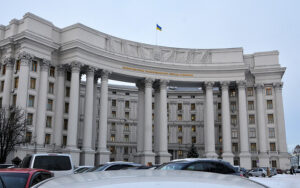
The Foreign Ministry has launched an open search for Ukraine’s ambassadors due to a “personnel famine,” with ambassadorial positions currently vacant in 21 countries, Foreign Minister Dmytro Kuleba said.
“I am convinced that Ukraine has strong and professional people. The only problem is that either a) we have not found them yet, or b) they themselves have not yet learned about the possibility of taking on the super difficult but very necessary job of Ukraine’s ambassador. That is why we are taking the unprecedented step of creating an open mechanism that allows both diplomats from within the system and people from outside to propose their candidacy for the ambassadorship,” the minister wrote on Monday.
A corresponding page has already been created on the website of the Ministry of Foreign Affairs in the “Vacancies.
According to Kuleba, an open search among internal and external candidates will avoid unacceptable situations when a vacancy of an ambassador to a certain country remains unfilled for several years.
He noted that the problem of “staff hunger” is now familiar not only to state institutions but also to the private sector.
“It is particularly difficult to find candidates for ambassadorial positions. Looking for them in the diplomatic system. Looking in the business community. Looking among academics. But the pace of our diplomatic expansion, particularly in Africa, is also increasing. That is why there are still more than two dozen countries without ambassadors,” underlined Kuleba.
According to the foreign minister, an open search for ambassadors is an opportunity for the system to expand its horizons and an opportunity for “worthy candidates to try themselves there, where previously they could get only through closed institutional mechanisms.”
“For the first time in the history of Ukrainian diplomacy, I am opening the door for everyone to have an equal opportunity to try to become a strong manager, which the state needs so much in the world now. I note that the special focus now is on African countries. Applying to these countries automatically increases the chances,” the minister emphasized.
In addition, subject to equal professional performance, preference will be given to women.
“Simply because diplomacy has been unfair for many decades about women’s careers,” he added.
According to the minister, 21 countries in Europe, Latin America, Africa, the Middle East, the South Caucasus and Southeast Asia are currently listed in the vacancies section.



