
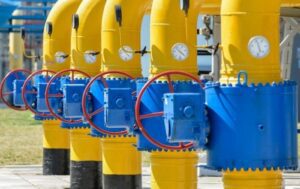
The Gas Transmission System Operator of Ukraine, or GTSOU, has accepted a booking from Gazprom today to transport 42.4 million cubic meters of gas through the country against 42.4 mcm the previous gas day, data from GTSOU show.
Capacity was requested only through one of two entry points into Ukraine’s Gas Transmission System, the Sudzha metering station. A request was not accepted through the Sokhranivka metering station.
GTSOU has declared a force majeure about accepting gas for transit through Sokhranivka, claiming that it cannot control the Novopskov compressor station. Ukraine has also said that if gas continued to be fed from Russia to the Sokhranivka station, amounts would be reduced accordingly at the exit points from Ukraine’s gas transport system. The route through Sokhranivka had provided transit of more than 30 mcm of gas per day.
Gazprom believes there are no grounds for the force majeure or obstacles to continuing operations as before.
Electricity generated from wind power in Europe has dropped nearly 50% in the past two days, and the forecast for Thursday and Friday calls for practically calm weather, which requires utilizing other sources of energy.
Europe’s current temperatures are reaching all-time lows for the month of September, and could be the coldest for the past nine years at more than two degrees below last year’s figure. The forecast in Europe until the end of the month is light winds or calm weather.
Another cold spell has begun in Europe, and it should last at least a couple of days.
Electricity generated from wind power has dropped for the second consecutive day. Wind turbines generated 22.8% of the European Union’s energy balance on Monday, falling to 13.6% on Wednesday. Meantime, the figure is only 6.8% in Germany and 3.3% in the Netherlands, according to data from the WindEurope association. The average for September 2021 was 9.6%.
Spot prices for gas in Europe have risen sharply since Gazprom announced that Naftogaz Ukraine’s latest lawsuit could disrupt transit through Ukraine, adjusting to $2,005 per 1,000 cubic meters for the TTF day-ahead contract.
Prices in Asia are rising on the back of prices in Europe. The most expensive January futures on the JKM Platts index, which reflects spot market prices for gas delivered to Japan, South Korea, China and Taiwan, are $1,962 per 1,000 cubic meters.
The Nord Stream pipeline from Russia to Europe has been unable to restart as planned after maintenance, as oil leaks were found in Siemens turbines and this problem can only be fixed with factory repairs, Gazprom said. The Siemens turbines can only be repaired at a plant in Montreal, but Canada has imposed sanctions against the Russian gas giant.
Moreover, there were reports on Monday of a drop in gas pressure in two strings of Nord Stream 1 and in one string of Nord Stream 2 near the Danish island of Bornholm.
European liquefied natural gas (LNG) receiving terminals are operating at an average of 59% of capacity in September compared to 59% in August, data from Gas Infrastructure Europe indicate, and gas has been received from the EemsEnergy LNG floating receiving regasification terminal since September 16 in the Netherlands.
Europe is continuing to inject gas into underground gas storage (UGS) facilities, with the average level of reserves reaching the targeted 80% of capacity at the end of August. After reaching the target level, there has been some reduction in the injection rate.
Inventories in UGS facilities are currently at 88.17%, up just 0.2 percentage points from the last reporting date, according to Gas Infrastructure Europe data.
Gas inventories in UGS facilities have currently exceeded 80% in Belgium, the Czech Republic, Croatia, Denmark, France, Germany, Italy, the Netherlands, Poland, Portugal, and Spain.
Meanwhile, Austria, Bulgaria, Hungary, and Latvia are lagging, with Austria showing a clear trend toward reaching the target level of reserves by October 1, and Bulgaria and Hungary have also intensified injection, though could be several days late to the prized line.
The gas reserves at the Incukalns UGS facility in Latvia are the lowest in the EU at around 53%. Pumping is 50% below the European average despite this UGS facility being responsible for reserve gas supplies to Estonia, Latvia and Lithuania, as well as Finland.
Steady gas exports in the United States are reducing the amount of resources for injection into storage, which is supporting prices on the domestic market.
The current inventory level is around 71%, which is substantially below the reserves at UGS facilities in Europe, with the EU having topped this level a month-and-a-half ago, and even more so in Russia, which has over 90%.
Current reserves in the country’s UGS facilities are only 5% above the lowest figure in the past five years, and the figure fell in the summer injection season, though it has risen slightly in the past week, data from the U.S. Energy Department’s Energy Information Administration show. The lag behind the norm for the past five years is 10%.
The rate of injection increased during the last reporting week, with 2.9 billion cubic meters accumulated compared to 2.2 bcm on average over the previous reporting weeks. The end of using air conditioning and no heating demand thus far allow the industry to allocate more gas to storage.
The rate of injection into U.S. UGS facilities has improved somewhat after the suspension of exports through the Freeport LNG terminal owing to an accident.
Additionally, Cove Point terminal, with a capacity of 5.25 million tonnes per year, will stop for scheduled maintenance in September-October, with the volumes exported through the terminal also remaining on the domestic market.
The pound sterling again falls against the dollar due to renewed concerns about the British budget deficit amid announced tax cuts.
The pound by 9:05 a.m. fell 1% to $1.0782 compared to $1.0891 at the close of the previous session.
On the eve of the British currency rose after statements by the Bank of England about its intention to start buying long-term government bonds in an unlimited amount to stabilize the market, but the rise was short-lived.
Earlier this week, the pound hit a new all-time low against the dollar, and its fall since the beginning of the month could be a record since June 2016, when the British voted to leave the European Union.
The ICE-calculated index, which shows the dynamics of the US dollar against six currencies (the euro, Swiss franc, yen, Canadian dollar, pound sterling and the Swedish krona), rose by 0.85%, the broader WSJ Dollar – by 0.6%.
The euro/dollar pair is trading at $0.9668 compared to $0.9736 at the close of the session on Wednesday, the euro is losing about 0.7%.
The rate of the American currency against the yen increases by 0.4% and amounts to 144.64 yen compared to 144.12 yen the day before.
Meanwhile, the Chinese yuan is rising against the dollar for the first time in nine sessions. The yuan traded in mainland China rose to 7.1963/$1 from 7.2005/$1 at the close of the previous session.
The People’s Bank of China (PBOC, the country’s central bank) released a statement last night warning speculators that they would definitely lose money in the long run on betting on a weakening yuan and called on key market players to “protect the authority of the reference rate.”
The yuan on the mainland has fallen about 4% since the start of the month, and on Wednesday it hit a new low since 2008. Meanwhile, the offshore yuan traded in Hong Kong has fallen to its lowest level since the introduction of a separate trading system in 2010.
The stock markets of the largest states of the Asia-Pacific region are steadily growing on Thursday after falling the day before.
Asian indexes mainly follow the dynamics of the US stock market, which closed Wednesday’s trading higher amid attempts by the Bank of England to limit significant volatility in the bond markets. The Bank of England has decided to suspend the start of the previously announced government bond sale program and instead start buying government bonds amid a sharp increase in their yields.
The Japanese Nikkei 225 rose 1% by 8:15 a.m.
The growth leader is the shares of the pharmaceutical Eisai Co. Ltd. (+17.5%), musical instrument manufacturer Yamaha Corp. (+6.7%) and medical Shionogi & Co. Ltd. (+6.2%).
Meanwhile, retailer Nishimatsuya Chain Co. are down 8.2% after the company downgraded its full-year forecast, citing a declining yen and high costs.
The Chinese Shanghai Composite index rose by 0.36% by 08:20 Moscow time, the Hong Kong Hang Seng – by 1.1%.
Alibaba Group Holding (SPB: BABA) Ltd. is among the top performers on the Hong Kong Stock Exchange. (+4.3%), energy China Shenhua Energy Co. Ltd. (+3.3%) and Budweiser Brewing Co. APAC Ltd. (+2.6%).
At the same time, the share price of developer CIFI Holdings (Group) Co. (-22.1%) fell to its lowest level since the listing after reports that the company was having trouble financing its many projects in the city of Tianjin.
Electric vehicle manufacturer Zhejiang Leapmotor Technology Co. and divisions of China Vanke – Onewo Inc. started their debut trading in Hong Kong with a drop of 30% and 8%, respectively.
The South Korean Kospi index increased by 1.2% by 08:30 Moscow time.
Quotes of securities of one of the world’s largest manufacturers of chips and consumer electronics Samsung Electronics Co. grow by 1.4%, automaker Hyundai Motor – by 2%.
The Australian indicator S&P/ASX 200 has gained 2% since the market opened.
Shares of the world’s largest mining company BHP rose 3.1%, while the price of securities of another representative of the industry Rio Tinto increased by 1.6%.
Consumer prices in Australia rose by 6.8% in annual terms in August after rising by 7% in July, data from the country’s statistical office showed.
The slowdown in inflation is primarily due to the lower growth in fuel prices – by 15% in August compared to 43.3% in July. Food and beverage prices rose 9.3%.
The Australian Bureau of Statistics publishes monthly inflation data for the first time. The department previously released this report for the quarter. Experts explain this by the fact that inflation in the country has greatly accelerated over the past year and the rare publication of data complicates forecasting and decision-making by politicians and bankers. Third quarter inflation data is expected to be released on 26 October.

On October 1, a charity family festival “Sports for Peace” will be held in Kyiv at Kyoto 25 from 11:00 a.m. to 2:00 p.m. As part of the event, guests can expect:
– Sports quest (climbing, badminton, padel tennis, ping-pong, getting to know horses)
– Workshops for the little ones
– Prize fund for participants
– Demonstration performance of Deryugina’s school
– Musical performances by Sofia Yehorova, the band SESTRA, KISHE and ROXOLANA
Hosts of the event: Roman Mishcheryakov and Vova Shumko (New Channel).

You can buy tickets here – https://sport-zaradu-mury.ticketforevent.com
All proceeds from ticket sales will go to UNITED24 for medical aid.
For the convenience of guests, it is advisable to be in sports clothes, we also recommend having sports shoes with you.
Information partners Interfax-Ukraine, Open4Business, Club of Experts and others.

During a round table in Brussels on September 27, the companies signed a statement at the initiative of the European Commission in which they pledged to help reduce the cost of transfers to Ukraine by up to 3%, the press service of the National Bank of Ukraine (NBU) reported on Wednesday.
According to the report, the heads of Visa, Mastercard, Wise, Extrabanca, Ria Money Transfer, Small World, TransferGo, PrivatBank, Oschadbank, Ukrgasbank, Raiffeisen Bank, PUMB, A-Bank, NovaPay, Ukrposhta, UFG PJSC signed a joint statement.
They committed to provide competitive transfer services to the Ukrainian diaspora, internally displaced persons from Ukraine and anyone who wants to support Ukrainians and transfer funds to Ukraine.
Deputy head of the NBU Oleksiy Shaban pointed out that it is possible to receive transfers in Ukraine using all available methods that were in peacetime (through international systems for transferring funds from card to card via SWIFT using the IBAN number).
He added that at the beginning of the war, most international funds transfer systems completely abolished fees for transfers to Ukraine.
In general, according to preliminary estimates of the National Bank, in January-July 2022, $7.6 billion was transferred to Ukraine, which is 5.7% less than in the same period of the previous pre-war year.
The war in Ukraine led to a decrease in transfers through official channels by about 12%. At the same time, the flow through informal channels increased by almost 3%.
According to NBU statistics, of all funds transferred to Ukraine from abroad in January-July 2022, about a quarter (24%) came through international transfer systems.

The final of Europe’s largest IT competition, DEV Challenge XIX, will be held online and offline in Ukraine and Poland on October 28 and 29, the organizers told Interfax-Ukraine.
The organizers cooperate with the Ministry of Digital Transformation, the Ministry of Foreign Affairs and the Ministry of Defense. This year, competition tasks from UNICEF, the Ministry of Digital Development, the Ministry of Defense and the Army of Drones will be presented.
“Modern warfare is won by modern technologies, so the effective implementation of the best solutions is a strategically important step for victory. High-quality and creative digital solutions for the Ukrainian army are no less important than traditional methods of warfare,” the press service of the director for digitalization of the DC “Ukroboronprom” quotes Timur Korytny.
The DEV Challenge XIX championship started in early September 2022 and will last for two months. Competitions are held in three stages: qualification, online round, final. The judges of the Championship are top professionals of the international IT community from Europe, the USA and Australia.
Already registered more than 1800 participants. The DEV Challenge takes place online, with the exception of the hybrid final. The final was traditionally held in Kyiv, both offline and online. This year it was decided to hold it simultaneously in two countries, Ukraine and Poland. In particular, they already name one of the offline locations of the DEV Challenge XIX final, the Polish city of Lodz, the Ukrainian city is still being chosen.
According to the organizer of the championship Evgenia Bespalova, every year the competition becomes an increasingly powerful tool for inventing technological solutions for the critical tasks of society.
“DEV Challenge participants receive tasks from our partners. Since 2019, we have been actively cooperating with ministries, involving top IT specialists in solving urgent issues of the state. Thanks to the championship, the country is accelerating digitalization processes in various areas. This year we are working on the development of technologies for recovery Ukraine, assistance to the Armed Forces of Ukraine,” Bespalova said.
Among the tasks set are solutions for the protection of children and other humanitarian issues. Participants receive real cases of DEV Challenge partners in the commercial sector, as well as non-profit organizations.
Bespalova gave several examples of online round tasks. In the Frontend and UI Design nomination, a task from the Come Back Alive Foundation is presented: participants will develop an interactive map of crimes during the war based on the collected database.
Participants in the Manual QA nomination will test a mobile application for the development of preschoolers – “Numo” from UNICEF.
In order to increase the number of donations for children and hospitals, the Svichado Charitable Foundation needs to update the site, which will be done by participants in the Product Design nomination.
“As for the final, we are actively continuing to collect tasks from our stakeholders – UNICEF, Ukroboronprom, the Army of Drones and the Ministry of Digital Development,” Bespalova said.
DEV Challenge has been taking place in Ukraine since 2012, founded by Ukrainians Igor and Evgeniya Bespalov. For 10 years, 18 Championships have been held, in which more than 22,000 specialists from different countries took part.



