

According to Interfax-Ukraine, over 17,000 people have visited the victim’s electronic office (based on the “Single Window” system) in two years, and nearly 4,000 veterans have successfully resolved their issues through direct interaction with social workers, notes Maksym Khimchenko, director of the state-owned enterprise “Infotech.”
In an exclusive interview with Interfax-Ukraine, Khimchenko explained that the digital system for veterans is designed to provide rapid support without waiting in lines or dealing with complicated procedures.
According to Khimchenko, “Infotech” is developing an ecosystem to support military personnel and veterans in accordance with a directive from the Ministry of Internal Affairs of Ukraine.
“Its foundation is the Electronic Office for Victims (based on our ‘Single Window’) and the ‘MIA: Social Protection’ system.” The effectiveness of this solution has already been confirmed by the numbers: since its launch in May 2024, the portal has been visited by over 17,000 people, and nearly 4,000 veterans have already successfully addressed their needs through direct interaction with social workers,” Khimchenko said.
He emphasized that the key innovation is the shift from impersonal bureaucracy to direct communication.
“A veteran doesn’t have to explain their story every time—the system is integrated with government databases. The portal displays the contact information of the specific social worker assigned to assist the individual. This is the very human-centered approach we’re talking about,” he explained.
Khimchenko noted that by the end of 2025, “Infotech” had developed a special mobile app that has already been downloaded by over 42,000 users.
“It allows soldiers to log in in seconds, view community events, and quickly receive information from psychologists or service centers,” Khimchenko clarified.
According to him, cooperation with the Ministry of Defense of Ukraine has become a separate important area of the company’s work.
“We have developed specialized software for accounting and control over the disbursement of one-time financial assistance. This is a highly sensitive area where every figure must be verified, and the disbursement process must be transparent and error-free. Our technological solution automates this process, ensuring that every family of a defender receives the necessary support on time,“ noted the director of ”Infotech.”
He also reported that the Ministry of Internal Affairs plans to expand services to include online appointments at medical centers and assistance with employment.
“We don’t just collect applications; we provide the Ministry with analytical tools to ensure that assistance is accurate and timely. This is our contribution to providing proper protection for those who protect us,” concluded the director of Infotech.
State Enterprise “INFOTECH” is the operator and developer of the Ministry of Internal Affairs’ digital systems, ensuring their creation, operation, and 24/7 support.
https://interfax.com.ua/news/general/1162613.html

The number of wine producers in Ukraine currently exceeds 180, with a significant increase in the number of small-scale winemakers, according to Taras Vysotsky, Deputy Minister of Economy, Environment, and Agriculture.
“Today, Ukrainian winemaking is no longer limited to the domestic market. It is becoming part of a global dialogue—an instrument of cultural diplomacy and trust in Ukraine around the world,” he wrote on Facebook.
The deputy minister expressed confidence that it is important to foster a culture of consuming domestic products in Ukraine. It is through specialized venues that Ukrainians can better appreciate the quality and uniqueness of domestic wine.
Vysotsky noted that a series of deregulatory measures has contributed to the industry’s development. In particular, the annual fee for a wholesale trade license for small producers was abolished, and an affordable production license was introduced. In addition, the government simplified licensing procedures, abolished excise tax stamps, and reduced the bureaucratic burden of reporting. These changes gave a boost to the development of craft winemaking in particular.
The Deputy Minister also announced that the first official wine boutique—Wine of Ukraine—has opened in Kyiv, which will serve as a platform for direct access to products from producers. The opening was attended by representatives of the diplomatic corps of Italy, Portugal, Argentina, Egypt, India, Pakistan, and other countries, as well as international organizations, including the FAO.

According to Interfax-Ukraine, the state-owned enterprise “Infotech” is maximizing the automation of the work of the departments and divisions of the Ministry of Internal Affairs of Ukraine in the context of identifying missing persons, while simultaneously providing relatives of the deceased with tools to identify their loved ones.
Maksym Khimchenko, director of the state-owned enterprise “Infotech,” spoke about this in an exclusive interview with the Interfax-Ukraine agency, noting the work of the registry of missing persons under special circumstances.
“The issue of identifying the deceased is not only about making the tool user-friendly, but also about highly sensitive data. And, in general, about the ability to obtain such information and access to it,” Khimchenko noted.
He emphasized that the painstaking work of investigators to enter such information into the database, as well as its collection and processing, requires automation.
“We are generally automating the work of entire departments and divisions regarding identification. And we are providing relatives of the deceased with the tools to work with the remains so they can identify their loved ones,” said the director of “Infotech.”
He concluded: “This is also a service, and it had to be made user-friendly so that people could work with it quickly, since this is data with restricted access, including time-limited access. Furthermore, it is important to avoid re-traumatizing relatives, which is why we are automating such complex and sensitive processes as much as possible.”
State Enterprise “INFOTECH” is the operator and developer of the Ministry of Internal Affairs’ digital systems, ensuring their creation, operation, and 24/7 support.
https://interfax.com.ua/news/general/1162604.html

According to a report by Interfax-Ukraine, the architecture of the Unified Weapons Registry (UWR) eliminates the possibility of any “gray areas” or uncertified third-party software integrations; the goal of the UWR is to provide citizens with a modern service, and the state with reliable control, emphasizes Maksym Khimchenko, director of the state-owned enterprise “Infotech.”
In an exclusive interview with the Interfax-Ukraine agency, Khimchenko explained that the weapons registry is a system that is constantly being improved.
According to the director of “Infotech,” when the registry was launched in 2023, it was built on a fundamentally different foundation.
“We had to deal with a colossal volume of fragmented data that had accumulated over decades in various formats. We carried out a titanic effort: we unified this data and created an electronic classifier of weapons, ammunition, and explosives (WAME),” Khimchenko emphasized.
He explained that now each item has a clear digital profile, which prevents the kind of manipulation typical of the old “manual” management system.
The director of “Infotech” noted that the creation of a branched system of user accounts in the ERZ has changed the philosophy of interaction. “Today, the ERZ is a unified ecosystem where each participant has their own secure workspace—the architecture eliminates the possibility of any ‘gray areas’ or uncertified third-party software connections from the very beginning,” he noted.
Khimchenko added: “This is our own product, where the path of a weapon from the store to the owner is completely transparent. Our goal is to provide citizens with a modern service and the state with ironclad control.”
He emphasized that the path toward tightening regulations and creating a proprietary closed ecosystem was the only correct one for national security.
Speaking about feedback on the operation of the weapons registry, the director of “Infotech” noted that the Ministry of Internal Affairs is engaged in an open dialogue with market participants.
“They voice their needs and comments, after which we work through them together, formulate requirements, prepare functional specifications, and move on to technical implementation and deployment,” said Khimchenko.
State Enterprise “INFOTECH” is the operator and developer of the Ministry of Internal Affairs’ digital systems, ensuring their creation, operation, and 24/7 support.
https://interfax.com.ua/news/general/1162589.html
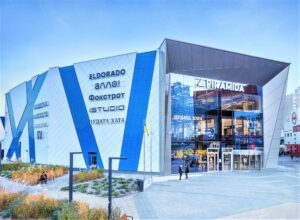
Dragon Capital Property Management has opened the Piramida Business Center (Kyiv, 4 Oleksandra Mishuga St.), with the Dobrobut medical network set to become the anchor tenant, according to the company’s press service.
The Piramida Business Center was built as part of the renovation of the Piramida shopping center in the capital. The six-story business center, with an area of 4,880 square meters, is adjacent to the shopping center, has a separate entrance with a lobby, and is connected to the shopping center via a passageway on the second floor.
“For us as investors, the commissioning of the Piramida Business Center marks the culmination of the phased renovation of the shopping center, which we began back in 2020. Unfortunately, the full-scale invasion somewhat delayed the completion of the office portion of the project. So today we are especially pleased to complete the project without postponing it until the end of hostilities,” said Volodymyr Tymochko, Managing Director of Direct Investments at Dragon Capital.
He announced the signing of a long-term lease agreement with the private medical network “Dobrobut,” which will occupy two floors with a total area of 1,560 sq. m and serve as the business center’s anchor tenant. Tenants have also already been found for the first floor of the new building, which will be a retail space. Currently, 2,300 sq. m of office space is available in the business center.
“Demand for high-quality office space in Kyiv continues to grow, and we are confident that the Piramida Business Center, which is currently the only Class A property at the Poznyaki metro station, will be widely popular among tenants,” said Tymochko.
As previously reported, the renovation of the Piramida shopping center took place in stages: in the spring of 2021, a new shopping gallery was built, increasing the total area of the shopping center from 16,800 square meters to 20,600 square meters. In the summer of 2022, the entrance to the Poznyaki metro station was renovated and the surrounding area was landscaped. In the spring of 2023, the renovation of the facade facing Mykola Bazhan Avenue was completed, a massive 350-square-meter LED screen was installed, and the parking lot was completely redesigned and expanded to accommodate 350 vehicles.
Dragon Capital is one of the largest groups of companies in Ukraine operating in the field of investments and financial services. It has over 20 years of experience in direct investments in leading Ukrainian companies, as well as in landmark residential and commercial real estate projects.
Dragon Capital Property Management is a management company that manages a portfolio of commercial real estate. It manages 25 commercial real estate properties, including 12 office properties, six retail properties, and seven logistics complexes. The total area of the real estate portfolio exceeds 570,000 square meters, making the company one of the largest players in the Ukrainian real estate market.
According to Serbian Economist, Albania has revised its rules for foreigners, significantly simplifying the process of applying for residence and work permits. Under the new regulations, foreign nationals can now submit their applications entirely online, and a temporary confirmation of their right to stay must be issued within one business day of application. This was reported by the Albanian state agency ATA.
The reform applies to foreign residents as well as entrepreneurs and employees applying for residence and work permits. The authorities have standardized the lists of required documents, allowed financial and supporting documents to be submitted in Albanian or English, and clarified procedures for specific categories of employment.
Albania is taking another step toward a more liberal regime for foreign business and long-term residency. For entrepreneurs, the most important aspect is that the administrative part of the process becomes faster and more predictable, while for residents, it is that some of the previous delays between submitting documents and confirming legal status are being eliminated. This is particularly important for the real estate market, small businesses, services, and remote work, where the foreign presence in the country has grown significantly in recent years.
Against the backdrop of this reform, Albania remains a country with a relatively significant foreign presence. According to INSTAT, as of the end of 2024, there were 21,940 foreigners with residence permits in the country. The main reason for obtaining permits was employment—54.3%, followed by family reunification—24.5%, other grounds—16.3%, education—4.0%, and humanitarian reasons—0.9%.
Official INSTAT statistics show that the largest groups of foreigners with residence permits in Albania in 2024 were from Kosovo—4,592 people, Italy—3,763, as well as Turkey, India, and the Philippines.
https://t.me/relocationrs/2713



