

Ukrainian viewers will be able to watch a live broadcast of the 98th Academy of Motion Picture Arts and Sciences Oscars ceremony on the night of March 15-16 on Suspilne Culture.
“The pre-show will begin at 11:00 p.m., the Oscar red carpet broadcast will begin at 12:30 a.m., and the awards ceremony will begin at 1:00 a.m.,” Suspilne reported.
As noted, the broadcast will consist of three parts: the pre-show, the red carpet broadcast, and the awards ceremony itself. The ceremony will be commented on and the pre-show hosted by theater and film actor Oleksiy Hnatkovsky.
The night broadcast will be translated into Ukrainian by simultaneous interpreters Yuriy Mazur and Lyudmila Dyachenko, and sign language interpretation will also be available throughout the broadcast, provided by Anfisa Khudashova and Lada Sokolyuk.
According to the organizers, the 98th ceremony itself will take place on March 15 at the Dolby Theatre (Los Angeles, USA).
https://interfax.com.ua/news/culture/1149457.html
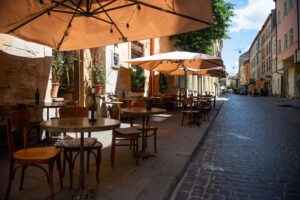
Preparations for the summer terrace season in the capital, which officially begins on May 1, should start in advance to ensure the smooth operation of terraces in accordance with legal requirements, said Yevgen Komarov, business developer and lawyer at GLOBAL LAW, in an interview with Poster Pos.
He noted that the procedure for submitting documents in Kyiv has changed significantly: from now on, it has been transferred to electronic format. The main change is the ability to submit documents through the new electronic portal “Kyiv Digital,” whereas previously this was done in person through the Administrative Services Center or its electronic office. The advantage of the new system is the ability to track all stages of the application and its current status in real time.
The lawyer emphasized that the process of reviewing and concluding a contract now takes place exclusively online and lasts up to 10 business days.
After signing the contract with a qualified electronic signature (QES) and paying the bill, the entrepreneur receives an information ticket with a QR code in digital form with the option to download it. The ticket is the official basis for the legal establishment of a seasonal site.
Instead of traditional diagrams or drawings on paper, restaurateurs must now draw the boundaries of the site directly on an interactive map within the portal.
To submit documents through the service portal, you must log in using a QES, fill out an online application, and upload the required set of documents in PDF format. The list of required documents includes a copy of the extract from the Unified State Register, an order appointing the director or the minutes of the general meeting, the head’s RNOICP, documents of title or a lease agreement for the premises, as well as four recent photographs of the location from different angles. If the documents are submitted by an authorized representative, a power of attorney is required. The applicant must also indicate the exact dimensions of the site, bank details, and attach a plan with a reference to the location and indication of the width of the passage for pedestrians.
Komarov also reminded about the important conditions for placing terraces. In particular, the site may only be installed near the facade of the establishment, and the minimum width of the pedestrian passage must be at least 1.8 m. It is prohibited to place structures on the roadway, lawns, closer than 20 m to intersections and public transport stops. The structure of the platform must be safe, easy to dismantle, and accessible to people with disabilities. Awnings and furniture must not cover the facade of the building or its decorative elements, and it is recommended to use natural materials.
It is prohibited to install stages, barbecues, and dance floors on summer terraces, and there are restrictions on loud music in residential areas. If the platform extends beyond the facade of the establishment, the owner must obtain written permission from the user of the neighboring premises.
Poster Pos is a Ukrainian restaurant automation company. It is the developer of an accounting program in the HoReCa system, which is installed on tablets.

The presence of “negative” social relationships in one’s environment may be associated with accelerated biological aging, according to research cited by Psychology Today.
In the study, published in the Proceedings of the National Academy of Sciences (PNAS), the authors used epigenetic “clocks” (age assessment based on DNA methylation) based on saliva samples and social network data from more than 2,300 participants in Indiana. According to the abstract, each additional “hassler” (a person who causes stress and creates difficulties) was statistically associated with approximately 1.5% faster aging and approximately 9 months “older” in biological age; associations with markers of inflammation and multimorbidity were also noted.
Experts emphasize that such results describe a relationship rather than prove a causal effect: biological aging is simultaneously influenced by stress, lifestyle, and health. Previous studies have also linked chronic stress to markers of cellular aging, including telomere changes. Additional work shows that negative and positive social experiences may be associated with accelerating or slowing epigenetic aging.

Die Ukraine hat in den letzten Jahren ihre Präsenz auf dem deutschen Markt für gefrorene Himbeeren deutlich ausgebaut, der zusammen mit Polen nach wie vor ein wichtiger Absatzmarkt für ukrainische Beeren ist und die Exporttrends für die Branche bestimmt, berichtet der Verband „Yagidnyctvo Ukrainy“.
Nach Angaben des Verbandes führte das Wachstum des ukrainischen Angebots zuvor zu einem Rückgang der durchschnittlichen Importpreise in Deutschland um fast die Hälfte.
Gleichzeitig kam es 2025 aufgrund von Ernteeinbußen in der Ukraine, Polen und Serbien zu einer Verknappung auf dem europäischen Markt, was die Preise in Deutschland auf das Niveau von 2022 steigen ließ, wie der Verband feststellt und dabei die Sensibilität des Marktes gegenüber Produktionsausfällen bei den drei wichtigsten Lieferanten, darunter die Ukraine, betont.

According to Serbian Economist, Montenegro has extended temporary protection for people from Ukraine until March 4, 2027, according to a decision published in Službeni list Crne Gore No. 27/26.
The Ministry of Internal Affairs of Montenegro has called on Ukrainian citizens whose foreigner’s certificate with temporary protection status is valid until March 4, 2026, to contact the territorial division of the Ministry of Internal Affairs at their place of residence to exchange the document and extend their status. For those applying for the first time after the decision comes into force, temporary protection will also be granted until March 4, 2027.
According to the Montenegrin Ministry of Internal Affairs, since the decision on temporary protection came into force (March 14, 2022) until March 2, 2026, 15,820 applications have been submitted, of which 14,893 have been approved.
Temporary protection in Montenegro entitles beneficiaries to legal residence and access to basic rights, including employment, medical care, and education, in accordance with national legislation. The decision was taken in light of the extension of temporary protection for persons from Ukraine at the EU level until March 4, 2027.
https://t.me/relocationrs/2383

The Royal Canadian Mint has issued a new collectible coin made of pure gold in the shape of a Ukrainian pysanka, dedicated to the traditions of Ukrainian folk art. This was reported by the Royal Canadian Mint.
“This exquisite pure gold pysanka vividly combines art and heritage. It embodies the spring celebration of elegance and harmony,” the coin’s description reads.
The new coin is the eighth gold “pysanka” in the Canadian Mint’s series. This time, its design is decorated with a rose ornament, a symbol of beauty and rebirth.
The coin was designed by artist Steven Rosati and Dave Melnichuk, a Canadian of Ukrainian descent who is a member of the Ukrainian Museum of Canada in Toronto.
The coin is made of 58.5 grams of pure gold and has a face value of 250 Canadian dollars. Only about 350 such coins have been minted, making them a collector’s item for numismatists.
The release of a series of coins in the shape of pysanka eggs is a tribute to Ukrainian cultural heritage, which is widely represented in Canada, home to one of the largest Ukrainian diasporas in the world.
As reported, banknotes with denominations of 1, 2, 5, and 10 hryvnia from 2003-2007 will be replaced by corresponding coins in circulation on March 2, 2026, and will no longer be legal tender (NBU).



