

During the 2025/2026 season, Ukraine earned a record 250.8 million euros in revenue from frozen raspberry exports, a 65% increase over the previous season.
Between June 2025 and May 2026, Ukrainian companies exported 63,300 metric tons of frozen raspberries, increasing the physical volume of shipments by 7%, according to data from the July analytical report by the Ukrainian Berry Growers Association, published on August 7.
Thus, the main factor driving the growth in export revenue was not an increase in volume but a significant rise in the price of Ukrainian berries. The average export price was 3.96 euros per kg, which is 54% higher than in the previous season.
In May, the final month of the 2025/2026 season, Ukraine exported approximately 2,900 metric tons of frozen raspberries at an average price of 3.95 euros per kilogram. Poland, the Czech Republic, and Germany were among the main export destinations.
This revenue growth continues a trend that began as early as the 2025 calendar year. At that time, frozen raspberry exports rose from 55,700 metric tons in 2024 to 60,700 metric tons—an increase of approximately 9%—while their value jumped from 129.3 million euros to 216.7 million euros.
The average price of Ukrainian raspberries rose significantly throughout last year. While it stood at about 2.78 euros per kg at the beginning of 2025, it exceeded 3.8 euros in the second half of the year and reached 4.29 euros per kg in December.
Poland Remains the Main Market
Poland remains the largest buyer of Ukrainian frozen raspberries and is also a major European processing and re-export hub.
In 2025, Ukraine supplied 24.1 thousand metric tons of frozen raspberries to Poland. The Polish market accounted for 39.7% of Ukraine’s total export revenue from this product, or 86.1 million euros. A year earlier, that share stood at 31.8%.
Germany is the second-largest market. Direct Ukrainian shipments there in 2025 totaled 14.1 thousand metric tons, compared to 15.4 thousand metric tons the previous year. At the same time, the “Berry Growers of Ukraine” Association suggests that a portion of German demand is increasingly being met through Polish intermediaries.
The Czech Republic retained its third-place position. Ukraine supplied approximately 10,000 metric tons of frozen raspberries there annually, and the value of shipments in 2025 rose from 24.1 million euros to 39.1 million euros, primarily due to higher prices.
The price situation remains favorable for Ukrainian producers
The “Berry Growers of Ukraine” Association expects that in the 2026/2027 season, the situation on the European market may remain favorable for Ukrainian exporters.
Among the factors supporting prices, analysts cite problems with the raspberry harvest in Serbia and the uneven condition of plantations in Poland. In its July report, the association estimates Serbia’s 2026 harvest to be 20–30% below normal levels due to drought.
This potentially reduces supply from one of Europe’s traditionally largest producers and exporters of frozen raspberries and opens up additional opportunities for Ukrainian suppliers.
As a result, Ukraine is gradually increasing not only the physical volume of berry exports but also the value of its shipments. In the 2025/2026 season, price increases had a significantly greater impact on export revenue than increases in tonnage, bringing revenue from frozen raspberries to a historic high of 250.8 million euros.

In 2025, Ukraine reduced the physical volume of organic berry exports by 12.5% compared to 2024—to 15,400 tons—but increased its value by 8.5%—to EUR39.8 million.
“Over the past two years, organic raspberries, strawberries, currants, and blueberries have remained the main export items,” said Iryna Fedorchenko, a leading export specialist at the organic production certification body “Organic Standard,” during a presentation of a study on the export of organic berries and nuts in 2024–2025 at the forum “Development of Exports in Ukraine’s Berry and Nut Sector” on June 10 in Kyiv.
She noted that Ukraine accounts for a significant share of organic berry exports to the EU. The largest buyers of Ukrainian products were Poland, the Czech Republic, Italy, Germany, and Austria.
“We are second only to Serbia in raspberries. Ukraine accounts for about 20% of organic raspberry imports, and 30% for blackberries. Blueberries are our trump card, because almost all organic blueberries exported to the EU come from Ukraine,” said Fedorchenko.
Currently, there are 55 companies in Ukraine exporting organic berries to 18 countries worldwide.
According to the study, wild berries continued to form the bulk of last year’s shipments—11,800 tons worth EUR27.1 million—while 3,600 tons of cultivated berries were exported for EUR12.7 million.
The cultivated berry segment saw an increase in export value despite a decline in volume. For example, organic raspberry exports fell by 18.7% to 2,230 tons, but their value rose by 31% to EUR8 million.
Organic strawberry shipments decreased by 13% to 1,290 tons, while revenue rose from EUR3.4 million to EUR4.2 million. Exports of organic blueberries, on the other hand, increased more than 11-fold—from 8.1 tons to 91.8 tons—and their value rose from EUR0.1 million to EUR0.5 million.
According to Fedorchenko, the vast majority of Ukrainian organic berries are exported in frozen form. “It is very difficult for us to export fresh berries, especially when they are organic and untreated,” she emphasized.
Separately, the representative of “Organic Standard” noted changes in the structure of organic berry farming. The area under organic raspberries in 2025 increased to 842 hectares from 768 hectares a year earlier, and under blueberries—to 353 hectares from 337 hectares. In contrast, the area under strawberries decreased to 210 hectares from 309 hectares, and under cherries—to 54 hectares from 146 hectares. The total area of organic berry plantations decreased from 1,700 hectares to 1,600 hectares.
The study was conducted by the certification body “Organic Standard” in collaboration with the Office for Entrepreneurship and Export Development and the national project “Dія.Бізнес” with support from Switzerland as part of the Global Quality and Standards Program (GQSP Ukraine), implemented by UNIDO.
EXPORTS, organic berries, Organic Standard, RASPBERRIES, UKRAINE

Die Ukraine hat in den letzten Jahren ihre Präsenz auf dem deutschen Markt für gefrorene Himbeeren deutlich ausgebaut, der zusammen mit Polen nach wie vor ein wichtiger Absatzmarkt für ukrainische Beeren ist und die Exporttrends für die Branche bestimmt, berichtet der Verband „Yagidnyctvo Ukrainy“.
Nach Angaben des Verbandes führte das Wachstum des ukrainischen Angebots zuvor zu einem Rückgang der durchschnittlichen Importpreise in Deutschland um fast die Hälfte.
Gleichzeitig kam es 2025 aufgrund von Ernteeinbußen in der Ukraine, Polen und Serbien zu einer Verknappung auf dem europäischen Markt, was die Preise in Deutschland auf das Niveau von 2022 steigen ließ, wie der Verband feststellt und dabei die Sensibilität des Marktes gegenüber Produktionsausfällen bei den drei wichtigsten Lieferanten, darunter die Ukraine, betont.

At the end of 2025, Ukraine confirmed its status as the world’s largest exporter of frozen raspberries, and in the 2026 season, the key vector for the development of the fruit and vegetable sector against the backdrop of stagnant domestic consumption will remain the expansion of exports, said Taras Bashtannik, president of the Ukrainian Fruit and Vegetable Association (UFOA).
“We have been the world’s largest raspberry exporter for two years in a row. According to the results of the 2025 season, exports are expected to reach about 80,000 tons, compared to 65,000 tons a year earlier. The potential for growth remains,” he said during the conference “Profitable Agribusiness 2026.”
According to the expert, a similar trend is observed in the blueberry segment, where production is growing by 15-20% annually. Bashtannik emphasized that the domestic blueberry market has reached a consumption “ceiling” of about 10,000 tons, so further development of the industry is only possible through exports. Currently, Ukraine exports about 8-10 thousand tons of this berry, while world leaders such as Chile and Peru supply up to 400 thousand tons to foreign markets, which indicates significant room for replacement of players in the global market.
Detailing the forecasts for the 2026 season, the president of the UPOA stressed that cheap vegetables and fruits should not be expected. He expressed confidence that the world has entered a phase where the opportunities for low-cost production have been exhausted, and Ukraine remains competitive only because of its lower costs compared to EU countries.
The high profitability of certain crops in previous years (sometimes up to 700% above cost—IF-U) is prompting farmers to rapidly expand their acreage without proper analysis. Bashkanik recalled that this has already led to a “slump” in prices for borscht vegetables in 2025. However, in the new season, the risk of overproduction of carrots or beets will remain and will depend on the timing of spring sowing.
According to the expert, the key obstacle to the development of the fruit and vegetable sector will be the shortage of skilled and unskilled workers. As a result, the industry will face the need for either total mechanization or even the involvement of foreign labor.
Bashkanik predicts that fruit and vegetable producers will traditionally experience problems in the 2026 season due to extreme weather conditions, ranging from drought to abnormal rainfall. This will require farmers to increase their investments in irrigation and protection systems.
Given the high cost and long logistics, particularly to Middle Eastern markets, the success of the season will depend not on the volume of the harvest, but on the ability to sell it to foreign markets.
“The issue of overproduction is not about how much we harvested, but whether we were able to sell it. If we work well for export, everything will be fine. Ukraine has an advantage in the diversity of its soil and climate zones, and if you choose the right varieties, you can invest in any crop — from pears to Jerusalem artichokes,” summarized the president of the UPA.
Earlier, the Experts Club information and analytical center released a video dedicated to global raspberry production https://www.youtube.com/shorts/IHaYTp6IbCM
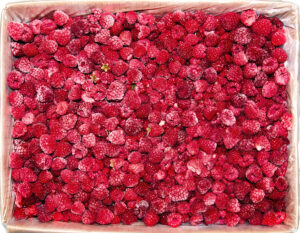
According to EastFruit analysts, Ukraine in the 2024/25 season continues to actively catch up with the world leaders in frozen raspberry exports, which remain Serbia and Poland. However, Poland is increasingly dependent on re-exports of products, mainly of Ukrainian origin, to hold on to its leadership position.
During the first three months of the season, from July to September inclusive, Ukraine exported more than 28 thousand tons of frozen raspberries and blackberries, which is a new record for this period. Exports thus increased by 36% compared to the same period last year and by 45% compared to 2022. It is noteworthy that the increase in exports comes against the backdrop of numerous reports from farmers about a lower raspberry crop in 2024.
“Although Poland remains the main market for frozen raspberries from Ukraine, its share in total exports continues to decline. Ukraine is gradually starting to enter with frozen raspberries directly into traditional markets for Poland, such as Germany and France. For example, this season the share of the German market in frozen raspberry exports from Ukraine already exceeds 20%,” says Andriy Yarmak, economist at FAO Investment Department.
Among the main markets for Ukrainian raspberries at the beginning of the season are also the Czech Republic, Lithuania, Austria, Belgium and Italy. Also in the new season, the first batches of Ukrainian frozen raspberries have already been shipped to such important and promising markets as the USA and Canada.
According to analysts, even Serbia, the world leader in raspberry exports, purchased a large batch of produce from Ukraine in September 2024, apparently for re-export.

Ukrainian exporters in 2021 for the first time sent one sea container with frozen raspberries to the United States and Canada. This event is important for domestic producers, since this berry is traditionally more expensive in the markets of these countries than in other regions of the world.
As reported on the website of the Ukrainian Horticultural Association (UHA) on Monday, the importance of this event for the development of production and freezing of berries in Ukraine is explained by the high level of requirements for product quality and logistics, which were successfully overcome by Ukrainian suppliers this year.
“One shipment of raspberries was sent to Canada and the United States in the amount of one sea container. The logistics took about one and a half months, and the buyer was satisfied with the quality of the supplied products and is considering the possibility of continuing cooperation with Ukrainian suppliers on an ongoing basis,” the association said.
The association said that the higher import price for berries in the United States and Canada is due to high requirements for the quality of products, for the confirmation of which Ukrainian exporters have been certified by the FDA (The U.S. Food and Drug Administration).
“The United States and Canada account for about 80% of all global imports of frozen raspberries in value terms and about 65% in physical terms. However, Ukraine has traditionally exported frozen raspberries mainly to Poland, which makes good money on the re-export of Ukrainian raspberries to other countries of the world,” the organization said, citing Economist of the Investment Department of the Food and Agriculture Organization of the United Nations (FAO) Andriy Yarmak.
According to the UHA, the United States imports frozen raspberries from Chile, Mexico and Serbia, and Canada from Chile, Serbia, the United States and Mexico.
The approximate carrying capacity of a standard 40-foot sea container is 27 tonnes.
“Accordingly, for Ukraine, which is one of the five largest world exporters of frozen raspberries, it is very important to gain a foothold in these two most important sales markets. This is especially important amid the expected growth in production of all types of berries in 2022-2024. It remains to hope that not only the volume, but also the quality of the berries produced will grow,” the association said.
According to the data on the website of the Ukrainian Agribusiness Club, in 2020 Ukraine produced 35,000 tonnes of this berry, ranking seventh in the world in terms of its production. Some 89% of this berry was grown on household farms.
Last year, Ukraine exported 539 tonnes of raspberries, which is 2% of its total production. At the same time, Poland was practically the only consumer of Ukrainian fresh raspberries.



