
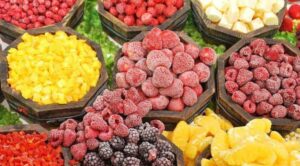
Galfrost LLC (Zhovkva, Lviv Oblast) plans to raise $28.5 million to expand its integrated fruit processing complex and build new production and cold storage facilities in Lviv Oblast, according to the Ukraine Investment Guide 2026, presented at the Ukraine Recovery Conference (URC2026) in Gdańsk.
The total project budget is $35.5 million, of which the company is prepared to finance $7 million with its own funds and plans to raise an additional $28.5 million through project financing.
The project involves expanding production and cold storage capacity, launching new product lines, and increasing output of freeze-dried fruits and berries, individually quick-frozen (IQF) products, and thermostable fillings for the confectionery industry. The capacity of the cold storage complex is planned to be increased to 10,000 metric tons.
The project is expected to take two years to complete, with the new facilities expected to begin operations in 2029–2031, according to the catalog.
Galfroast LLC was founded in 2007. The company specializes in the processing, freezing, and freeze-drying of fruits and berries, produces fruit ingredients for the food industry, and exports its products to foreign markets. According to the company, it processes approximately 6,000 metric tons of frozen products and produces about 100 metric tons of freeze-dried fruits and berries annually.
Last year, Galfrost LLC increased its revenue by 20.3% to 603.5 million UAH and reported a net profit of 5.9 million UAH, compared to a net loss of 10.2 million UAH the previous year.
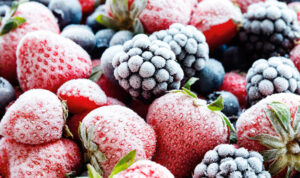
Ukraine is rapidly increasing its exports of frozen raspberries, blackberries, and other berries: their value rose from $53.4 million in 2023 to $114.6 million in 2024 and $176.4 million in 2025, according to a study of Ukraine’s berry and nut sector presented at the forum “Development of Exports in Ukraine’s Berry and Nut Sector” in Kyiv last week.
According to Olga Gvozdeva, advisor to the director of the State Agency “Office for Entrepreneurship and Export Development,” the main markets for these products are Poland, Germany, the Czech Republic, and France, reported a correspondent for the Interfax-Ukraine news agency.
According to the study, exports of fresh berries—blueberries, blackberries, and cranberries—declined to $22.4 million in 2025 after growing from $16.8 million in 2023 to $27.9 million in 2024. The main buyers remain the Netherlands, the United Kingdom, Germany, and Moldova.
According to the study, exports of shelled walnuts, after increasing from $68.1 million in 2023 to $82 million in 2024, fell to $61.9 million in 2025. The largest buyers of this product were France and the Netherlands.
Exports of walnuts in shell also declined—from $8.6 million in 2024 to $5.5 million in 2025, with Iraq remaining the main market, the document states.
“After a decline in 2022, we are now gradually catching up to previous levels,” Gvozdeva noted.
The study of Ukraine’s berries and nuts sector was prepared by the Office for Entrepreneurship and Export Development based on data from the State Statistics Service of Ukraine, the State Customs Service of Ukraine, and FAOSTAT.

Ukraine may face a critical shortage of seasonal workers for raspberry harvest in 2026, the head of the Ukrainian Fruit and Vegetable Association (UFOA) Taras Bashtannik said.
According to him, without attracting foreign labor, the country will not be able to harvest raspberries and maintain its position as an exporter of this berry.
As noted in the publication, the area of raspberries in Ukraine in 2024 was about 5 thousand hectares, and the need for labor is estimated at about 15 pickers per 1 hectare. Thus, the season requires more than 70 thousand workers only for raspberries. Labor shortages are also affecting blueberry and strawberry farms, as well as apple orchards.
Volodymyr Gurzhyi, the head of USPA Fruit gardening company, said that in 2026 Ukrainian companies plan to import workers to orchards, including from Bangladesh and Nepal, similar to the practice in Serbia. At the same time, taking into account the growth of orchard areas, the additional need may amount to at least 100 thousand pickers.

The cancellation by the UK of all duties and quotas on products from Ukraine to support it in the face of a military invasion by the Russian Federation may allow Ukrainian farmers to increase their presence in the UK markets of poultry meat, walnuts, honey, cranberries, blueberries and peas.
The list of high-margin agricultural products that Ukraine could supply to the UK at a time when the export of its traditional agricultural raw materials is blocked by the aggressor country of the Russian Federation was published on the website of the Ukrainian Agribusiness Club (UCAB) on Wednesday evening.
According to the results of 2021, agricultural products worth $553 million were exported from Ukraine to the UK, including sunflower oil (31% of export earnings), rapeseed (28%) and corn (24%). However, the supply of traditional agricultural crops in 2022 is difficult due to the naval blockade of Ukraine by Russian warships, as a result of which the country can potentially increase the export of a number of other agricultural products by road.
Ukrainian farmers, in particular, can focus their export efforts on the supply of poultry meat to the UK. The volume of its export in 2021 was 2,600 tonnes. The share of Ukraine of UK imports is 1%. Main competitors: the Netherlands, Poland, and Belgium.
The export of walnuts without shells is also promising. The volume of its export in 2021 was 0700 tonnes. The share of Ukraine of UK imports is 6%. Main competitors: the United States, Germany, and China.
According to the UCAB, Ukrainian farmers can increase honey exports to the UK (800 tonnes were delivered in 2021). The share of Ukraine of UK imports is 1%. Main competitors: China, Poland, and Mexico.
The export of cranberries and blueberries is also promising (supplies in 2021 – 200 tonnes). The share of Ukraine of UK imports is 0.3%. Main competitors: Spain, Peru, and Chile.
Ukraine exported 4,900 tonnes of peas to the UK in 2021, which amounted to 12% of the UK market in 2021. At the same time, Russia is Ukraine’s main competitor in this market, which, taking into account the economic sanctions imposed against it, adds an advantage to Ukrainian suppliers.
“Now the railways and seaports of neighboring countries are heavily loaded due to the export of grain crops, the volumes of which we have the largest. Therefore, to increase export earnings, we should focus on the export of goods that have a higher price with less weight and thus export by road,” UCAB cites a promising export model from its analyst Svitlana Lytvyn.
BERRIES, HONEY, PEAS, POULTRY, UK, UKRAINIAN FARMERS, WALNUTS
On Tuesday, July 9, at 10.00, the press center of the Interfax-Ukraine news agency will host a press conference entitled “Results of Exports of Fresh Fruits and Berries in 2018-2019. Forecast for Harvest (and Ukrainian Exports) for 2019-2020 Season.”
Participants: Dmytro Kroshka, the chairman of the Ukrainian Association of Agrarian Export, Volodymyr Hurzhiy, an expert for exports at First Ukrainian Apples Producers Aggregating Company USPA FRUIT, Oleksandr Yaschenko, the deputy director for research of the Institute of Horticulture, and Oleh Bosy, the agricultural technologist and managing partner of FruiTech (8/5a Reitarska Street). Registration of journalists requires press accreditation.
AGRARIAN, BERRIES, EXPORT, EXPORTS, FORECAST, FRUITS, HARVEST, PRESS CONFERENCE, RESULTS
Ukraine in 2018 exported $229 million worth of fruits and berries, which is 17% more than a year earlier.
According to the Ukrsadprom association, the main products in this group were walnuts, which were delivered for $117 million, frozen fruits and berries for $78 million, apples and pears worth $15 million. Their total share in exports of horticultural products was 92%.
According to Ukrsadprom, in 2018 exports of walnuts rose by 32%, to 41,000 tonnes, frozen fruits by 14%, to 48,000 tonnes, apples and pears by 79%, to 43,000 tonnes.
Apples of Ukrainian production were exported to 60 countries, the leaders are Belarus (40%), Moldova (14%), and Sweden (9%).
The average price of domestic apples in foreign markets exceeded $350 per tonne, peeled walnuts $3,670 per tonne, and frozen berries $1,640 per tonne.
Traditionally, the main markets for Ukrainian exporters remained the EU countries, which buy about two-thirds of Ukrainian fruits and berries. The largest number of Ukrainian products was exported to Poland (for $39.8 million), Turkey ($20.4 million), France ($15.7 million), Belarus ($13.8 million), Greece ($12.9 million), the Netherlands ($11.2 million), and Italy ($10.2 million).



