
According to data from the A-95 consulting group, retail prices for diesel fuel rose from 58.3 to 59.9 hryvnia per liter, or by 1.6 hryvnia per liter, between January 5 and January 30. while prices for A-95 gasoline rose from 58.2 to 60.3 hryvnia per liter, or by 2.1 hryvnia per liter.
According to A-95 director Sergey Kuyun, the reason for the rise in fuel prices in January is the global increase in oil prices.
“Today is January 30. Since the beginning of the month, the price of oil has risen from $60.7 to $70.7 (+16.5%). Global diesel fuel prices for the same period rose from $614 to $714/t (+16.2%),” he wrote on his Facebook page at the end of last week.
The expert also noted that wholesale prices for automotive diesel fuel in Ukraine rose from 48.52 to 52.46 UAH/liter, or by 4 UAH/liter (+4%), over the same period.
“In other words, we see that global prices rise first, followed by wholesale prices, and only then retail prices,” he said.
At the same time, according to A-95, prices for autogas rose by only 0.7 UAH/liter between January 5 and 30, from 37.6 to 38.3 UAH/liter.

The Office of the United Nations High Commissioner for Refugees (UNHCR) has estimated the financial needs for assisting Ukrainian refugees in 2026 at $614 million, which is 23.6% less than the plan for 2025 ($803.6 million), according to a publication on the office’s website.
“In 2025, the intensification of hostilities, including increased air attacks and strikes on critical infrastructure, led to significant civilian casualties and new displacements – trends that will continue to shape needs both inside and outside Ukraine in 2026,” the UNHCR states, emphasizing the severity of the problem four years after the start of Russia’s full-scale invasion of Ukraine.
At the same time, according to the publication, last year the level of funding for the Ukrainian refugee assistance plan fell to 43.7% or $351.1 million, compared to 64% or $635.7 million in 2024. This is significantly less than 84% or $924 million in 2023 and 91.7% or $1.1 billion in the first year of Russia’s full-scale aggression.
According to the UN Human Rights Monitoring Mission report for December 2025, last year was the deadliest for civilians in Ukraine since 2022: 2,514 civilians were killed and 12,142 were injured as a result of war-related violence, which is 31% more than in 2024. By the end of 2025, there were 5.86 million refugees from Ukraine registered worldwide, of whom about 5.3 million were in Europe. Another 3.7 million people remained internally displaced in Ukraine, with 73% of them having been displaced for more than two years.
“According to the Humanitarian Needs and Response Plan (HNRP) for 2026, more than 10.8 million people in Ukraine will need humanitarian assistance and protection in 2026, with many people having been displaced multiple times and their vulnerability exacerbated by the ongoing war,” the document says.
It is estimated that by September 2025, more than 1.4 million refugees from Ukraine will have returned to their places of residence and remained in Ukraine for at least three months, including more than 0.3 million who did not return to their former homes.
“Changes on the front line continue to cause new displacements: from June to December 2025, more than 150,000 people were evacuated from frontline areas with the support of the government or humanitarian organizations, and even more people fled on their own,” the publication says.
It notes that an estimated 2.5 million displaced families in Ukraine still do not have access to adequate housing. At the same time, large-scale Russian strikes on energy infrastructure in the winter of 2025/26 left millions of people without reliable heating, water, and electricity in sub-zero temperatures.
“In refugee-hosting countries, some refugees continue to face barriers in accessing housing, decent work, health care, education, and social protection, while vulnerability continues to deepen over time as the full-scale war continues,” UNHCR adds.
According to the document, the plan for 2026 aims to help 2.1 million people in Ukraine and 482,000 Ukrainian refugees in other countries. Accordingly, the financial needs for assistance within Ukraine are estimated at $470 million, and outside Ukraine at $144 million, of which $64 million is in Moldova, $21.8 million in Romania, and $18.4 million in Poland.
The UNHCR specified that of these 2.1 million Ukrainians within the country, it wants to provide 955,000 with protection services, 652,000 with cash assistance, 325,000 with materials for housing repairs or settlement support, and another 178,000 with basic necessities.
According to the publication, in 2024, the UNHCR’s assistance plan in Ukraine was funded at 44% or $243 million, compared to 57% or $338.5 million in 2024. This led to a reduction in the number of services provided to 1.14 million as of November 2025, compared to 1.6 million for the same period in 2024.
As part of the 2025-2026 winter assistance, as of December 5, 176,000 people received cash support, which is 32% less than in 2024-2025, when 258,300 people received support.
It is noted that UNHCR works in Ukraine with 12 partners, 11 of which are local, and with 39 partners in 11 other countries, 33 of which are local.

On February 1, Bulgaria ended its transition period for currency change, during which it was possible to pay in both Bulgarian levs and euros. Now, payments are made exclusively in euros, according to the Bulgarian service of Radio Liberty.
“At midnight on January 31, the one-month period during which the euro and the lev were in simultaneous circulation in Bulgaria ended. From February 1, merchants no longer accept payments in levs and must give change only in the single European currency,” according to a statement on the publication’s website.
People who still have cash levs can exchange them for euros at commercial banks and Bulgarian Post offices until June 30. After that date, commercial banks may set a certain exchange rate, but the Bulgarian National Bank will continue to offer cash lev-euro exchanges free of charge and without a deadline.
Retail chains will have to display prices for goods in both euros and levs for another six months, until August 8, “for transparency and to prevent speculative practices.”
Although the law prohibits sellers of goods and services from raising prices during the first six months of the euro’s introduction, hundreds of complaints about possible violations have already been received.
Bulgaria joined the eurozone on January 1, 2026, 18 years after joining the EU. January was a transition period when the lev and the euro were in circulation simultaneously.
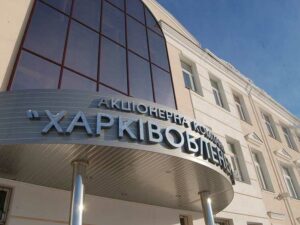
Kharkivoblenergo JSC is convening an extraordinary general meeting of shareholders, which will be held remotely in the form of a poll, with the date of the meeting set for February 27, 2026 (the date of completion of voting).
According to the announcement, the meeting is being convened by Ukrainian Distribution Networks JSC, which owns 166,754,183 ordinary registered voting shares of the company (65.0010% of the total number of ordinary registered shares and more than 50% of voting shares).
The list of shareholders entitled to participate in the meeting will be compiled on February 24, 2026 (as of 23:00). Ballot voting will be accepted from 11:00 on February 17 to 18:00 on February 27, 2026; ballots on issues other than the election of bodies are planned to be posted on February 17, and the ballot for cumulative voting on the election of bodies is planned to be posted on February 23, 2026, on the website of the meeting initiator.
The draft agenda includes issues on the early termination of the powers of the current members of the supervisory board, the election of new members of the supervisory board by cumulative voting, the approval of the terms of civil law contracts with members of the supervisory board and the amount of their remuneration, as well as compensation to the initiator of the meeting for the costs of organizing and holding the meeting.

Schneider Electric, a global leader in energy technologies, has introduced Schneider StarCharge Fast 720— a next-generation charging solution for electric vehicles (EVs) designed for commercial and industrial sites, as well as fleet operators. The system delivers up to 720 kW of power and enables simultaneous charging of up to 12 vehicles, meeting the growing demand for electric vehicles in Europe.
With 97% efficiency, Schneider StarCharge Fast 720 sets a new standard for performance and sustainability for EV charging infrastructure. Dynamic load management ensures optimal charging for different types of vehicles—from electric trucks and buses to passenger cars—helping drivers get back on the road quickly.
The solution’s decentralized architecture provides unparalleled flexibility: operators can place up to six dispenser modules within an 80-meter radius of the power cabinet equipment, creating scalable configurations for any site. This design minimizes grid connection requirements, simplifies installation, and reduces noise levels, providing a better user experience.
Schneider StarCharge Fast 720 also includes full lifecycle support, from installation to customized maintenance plans, with 24/7 support and remote monitoring via EcoStruxure Energy Asset Portal by Schneider Electric. This ensures maximum availability and cost-effectiveness for operators.
As Europe accelerates its transition toward a ban on gasoline and diesel engines from 2035—while electric vehicles already account for 16% of new car registrations—StarCharge Fast 720 offers a reliable, high-performance solution for charging station operators and businesses seeking future-ready infrastructure.
Related resources:
Schneider Electric is a global leader in energy technologies that increases efficiency and supports sustainability by electrifying, automating, and digitalizing industry, business, and residential spaces. The company’s technologies enable buildings, data centers, factories, infrastructure, and power grids to operate as open, interconnected ecosystems, improving productivity, resilience, and environmental performance. Its solutions portfolio includes intelligent devices, software-driven architectures, AI-based systems, digital services, and expert consulting.
With 160,000 employees and 1 million partners in more than 100 countries, Schneider Electric consistently ranks among the world’s most sustainable companies.
Discover new perspectives on energy technologies on Schneider Electric Insights.