
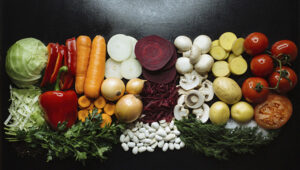
In 2025, Ukraine imported $89.54 million worth of vegetables used in borscht, including carrots, beets, cabbage, and onions, and $164.36 million worth of potatoes.
According to statistics released by the State Customs Service (SCS), Ukraine increased its imports of onions by 2.4 times in 2025, to 43,180 tons. The purchase cost $22.66 million, which is 2.6 times more than the $8.61 million spent in 2024. The top three suppliers of onions to Ukraine were China and Egypt, which accounted for 21.2% and 17.44% of imports, amounting to $4.80 million and $3.95 million, respectively. The Netherlands rounded out the top three with a 16.33% share ($3.70 million).
During this period, Ukraine imported 68.9% more cabbage than last year — 45.66 thousand tons versus 27.03 thousand tons, respectively. The cost of purchasing it increased by 62.3% and amounted to $34.31 million (compared to $21.14 million in 2024). The main suppliers were Poland (27.45% of supplies worth $9.42 million), Macedonia (22.96% worth $7.88 million), and the Netherlands (14.48% worth $4.97 million).
Ukraine increased its imports of carrots, beets, and celery by 4.9 times in 2025, to 48,010 tons (compared to 9,850 tons in 2024). USD 32.57 million was spent on these needs, which is 5.1 times more than in 2024 (USD 6.37 million). Last year, the main suppliers of these root vegetables to Ukraine were Poland, Moldova, and the Netherlands, which accounted for 46.31%, 12.9%, and 11.54% of the imported volume, respectively. In monetary terms, they earned $15.08 million, $4.20 million, and $3.76 million from these supplies, respectively.
As reported, Ukraine imported 138.41 thousand tons of potatoes in 2025, which is 5.3 times more than in 2024. In monetary terms, potato imports increased 4.9 times, to $74.82 million, compared to $15.21 million a year ago.
In total, Ukraine imported 275.26 thousand tons of vegetables for borscht in 2025.
Imports of vegetables for borscht to Ukraine (2025 vs. 2024)
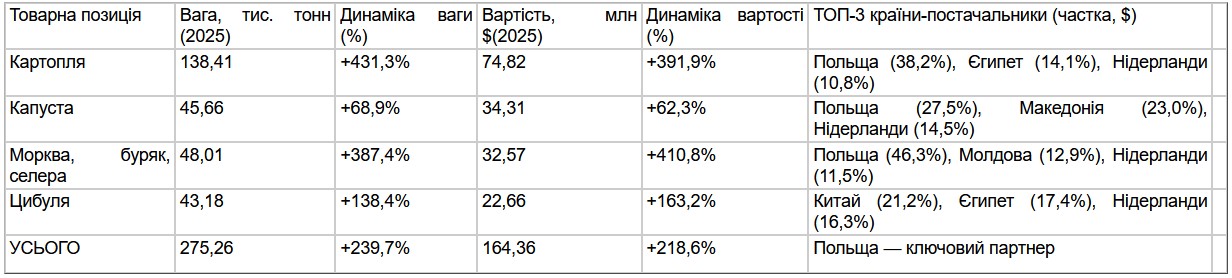
Data: State Customs Service
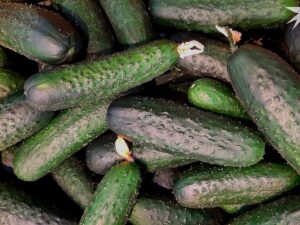
Ukraine increased cucumber imports by 46.3% in 2025 compared to 2024, reaching 70,820 tons, according to the State Customs Service.
In monetary terms, cucumber imports grew by 38.8% to $89.14 million.
The largest suppliers of cucumbers to Ukraine in 2025 were Turkey (83.5% in monetary terms), Romania (7.6%), and Poland (4.6%). A year earlier, the top three were Turkey (73.6%), Poland (11.8%), and Romania (4.9%).
As reported, in July 2025, Ukraine introduced anti-dumping duties on imports of fresh cucumbers from Turkey at a rate of 20.1% for a period of five years.
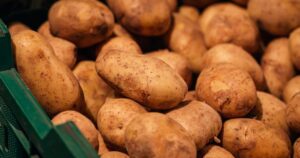
In January-December 2025, Ukraine imported 138,410 tons of potatoes, which is 5.3 times (+431.3%) more than in 2024, when 26,050 tons were imported into the country, according to the State Customs Service.
According to published statistics, in monetary terms, potato imports increased 4.9 times (+391.9%) to $74.82 million compared to $15.21 million a year earlier. The main imports came from Poland (38.2%), Egypt (14.1%), and the Netherlands (10.8%).
Potato exports from Ukraine during the same period amounted to 2.38 thousand tons, which is 11.2% less than in 2024 (2.68 thousand tons). At the same time, despite the physical reduction in export volumes, in monetary terms, the sale of Ukrainian potatoes abroad was more profitable and brought in 3.1% ($584 thousand) more revenue than in 2024 ($566 thousand). The main buyers were Moldova (60.2% of all exports), Azerbaijan (35.4%), and Georgia (1.2%).
As reported, Ukraine had a poor potato harvest in the 2024 season due to drought, extremely high temperatures, and a lack of seed material.
Deputy Minister of Economy, Environment, and Agriculture Taras Vysotsky noted in a podcast by the Center for Economic Strategies that the 2025 vegetable harvest in Ukraine is sufficient and even larger than last year, so no shortage is expected in this sector.
Commenting on Ukraine’s potato imports in 2024-2025, Mykola Furdyga, director of the Potato Institute, explained that this record volume of imports was caused by the unusual weather conditions in 2024. Therefore, the state was forced to import potatoes to meet domestic food needs. European countries were eager to supply Ukraine with their products due to their attractive prices. At the same time, potatoes from Egypt did not dominate the market but occupied their traditional niche in the off-season (February-March – IF-U). In addition, Ukraine traditionally imports seed potatoes from leading breeding companies in the European Union.
Furdyga noted that since the beginning of the war, there has been a trend in Ukraine toward reducing potato cultivation in households and expanding production areas for this crop in farms and even in agricultural holdings. He explained this trend by the departure of the population from villages abroad and mobilization.
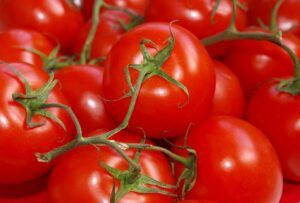
Ukraine increased tomato imports by 32.5% in 2025 compared to 2024, to 104,820 tons, according to the State Customs Service.
According to statistics, in monetary terms, tomato imports increased by 31.6% to $140.84 million.
The main imports of tomatoes in 2025 came from Turkey (82.3% of all supplies in monetary terms), Poland (7.3%), and the Netherlands (1.9%). A year earlier, Turkey accounted for 77.3%, Poland for 10.9%, and the Netherlands for 4.3%.
As reported, in July 2025, Ukraine introduced anti-dumping duties on imports of fresh tomatoes from Turkey at a rate of 26.9% for a period of five years.

Oleksiy Shevchuk, spokesperson for the Ukrainian National Bar Association, said that he and his family had received threats and asked the Ukrainian president, the leadership of the Office of the President, the Minister of Internal Affairs, and the National Police to provide protection and investigate the incident.
Speaking at a press conference at the Interfax-Ukraine news agency, Shevchuk said that, according to him, over the past few days, he and his family had been subjected to pressure and a wave of public discrediting, and subsequently received direct threats to their lives and health. He linked this to the decision to appoint him as a member of the commission for the selection of prosecutors for the Specialized Anti-Corruption Prosecutor’s Office.
According to Shevchuk, the threats came after reports of his appointment to the commission, and he considers them to be real. He noted that he had taken security measures and, in his words, temporarily secured his family.
“Over the past few days, my family and I have been subjected to significant hate from marginal elements of our society. But the last straw was that my family and I received direct threats to our lives and health. Yesterday evening, in connection with my appointment as a member of the commission for the selection of prosecutors for the Anti-Corruption Prosecutor’s Office, my family and I received messages that we were to be physically destroyed,” Shevchuk said at a press conference at the Interfax-Ukraine agency on Wednesday.
He stressed that he has the status of a special subject under criminal law and appealed to the state leadership and law enforcement agencies to ensure his safety.
Shevchuk also said there might be attempts to fake public statements on social media and mess with electronic voting, which he said could be meant to discredit him as a candidate. He said he’s getting ready to talk to the National Police about the threats and possible fake statements and petitions in electronic systems.
Separately, Shevchuk made a number of statements regarding the involvement of certain public figures in information pressure, naming specific individuals.
No official comments from law enforcement agencies regarding the circumstances outlined in the appeal have been released at this time.
Shevchuk stressed that he expects criminal proceedings to be opened on the basis of the threats and called on state authorities to “prevent” attacks on him and his family. He also emphasized that, according to him, he is the only representative of the bar in the relevant commission and links the wave of pressure to his participation in the work of the judiciary.
A video of Oleksiy Shevchuk’s statement is available at the following link:
Source: Interfax-Ukraine.

During the Fastiv Forum on Unity and Security Solutions, the initiative to create a socio-cultural complex called “Platform of Unity” was discussed. This would be a space for continuous work on uniting Ukrainian society.
One of the key elements of the initiative is the reconstruction of the Fastiv railway station complex and rethinking its role as a space for communication, historical memory, and modern dialogue.
The forum participants emphasized that in wartime, any management, infrastructure, and social decisions must be made with security in mind—whether the decision enhances security or creates additional risks.
The event featured five panel discussions with the participation of representatives of the Verkhovna Rada of Ukraine, state authorities, local self-government, the scientific community, public organizations, international partners, and experts in the fields of security, culture, and restoration.
The discussions culminated in the signing of a Declaration of Unity—a joint position of the forum participants, representatives of government bodies, and diplomatic missions on the need to consolidate efforts to rebuild the Fastiv railway station and create the Platform of Unity socio-cultural complex.
Among the initiators and participants of the forum were People’s Deputy Oleg Dunda, Deputy Minister of Social Policy Ilona Gavronska, representatives of the Verkhovna Rada of Ukraine, Taras Shevchenko National University of Kyiv, V. M. Korets Institute of State and Law of the National Academy of Sciences of Ukraine, Kyiv National University of Construction and Architecture, National Institute for Strategic Studies, World Congress of Ukrainians, Association of Ukrainian Lawyers, diplomatic missions, and experts in the fields of security, culture, and reconstruction. Korets Institute of State and Law of the National Academy of Sciences of Ukraine, Kyiv National University of Construction and Architecture, the National Institute for Strategic Studies, the World Congress of Ukrainians, the Ukrainian Bar Association, diplomatic missions of Lithuania, as well as the Donetsk Regional State Administration, Chuhuiv and Berdiansk City Councils, and other partners.
The forum participants thanked the residents of Fastiv for their support and the Armed Forces of Ukraine for ensuring the stability of the state and countering Russian aggression.
Interfax-Ukraine was the information partner of the event.
Source: https://interfax.com.ua/news/press-release/1140144.html



