

Schneider Electric reported a roughly 30% increase in net income attributable to the company’s shareholders to EUR2.49 billion for the first half of 2026, while revenue reached a record EUR21.23 billion.
A year earlier, revenue stood at EUR19.34 billion. Organic sales growth in the first half of 2026 was 14%.
Adjusted EBITA rose to EUR4.09 billion from EUR3.51 billion, representing organic growth of 22%. The margin for this metric reached 19.3%.
The company’s free cash flow more than tripled, reaching approximately EUR 1.6 billion.
The second quarter was particularly strong, with Schneider Electric’s revenue reaching a record EUR 11.5 billion, an organic increase of 17%. The Energy Management segment grew by 18%, and Industrial Automation by 11%.
The company cites the data center market as one of the main drivers. Demand for electrical infrastructure for data centers is growing rapidly amid the development of artificial intelligence, which significantly increases computing density, power consumption in server racks, and demands on cooling and backup power systems.
North America posted organic growth of 23%, while China and East Asia saw growth of 20%.
Following a strong first half of the year, Schneider Electric raised its forecast for the full year 2026. The company expects organic growth in adjusted EBITA of 14–19%, up from its previous forecast of 10–15%.
Organic revenue growth is projected at 10–13%.
Schneider Electric’s results reflect a broader investment cycle in energy infrastructure. AI data centers require not only servers and graphics processing units (GPUs), but also transformers, distribution equipment, UPS systems, automation systems, cooling systems, and digital energy management solutions.
Thus, energy infrastructure is gradually becoming one of the key constraints on the further scaling of AI.
For Ukraine, this trend is significant in the long-term context of rebuilding digital infrastructure and constructing new data centers. Future facilities will require significantly more connected power capacity and a more complex power supply architecture than traditional server centers.
Schneider Electric has been operating in Ukraine for over 30 years. Globally, the company is present in more than 100 countries and employs approximately 160,000 people.

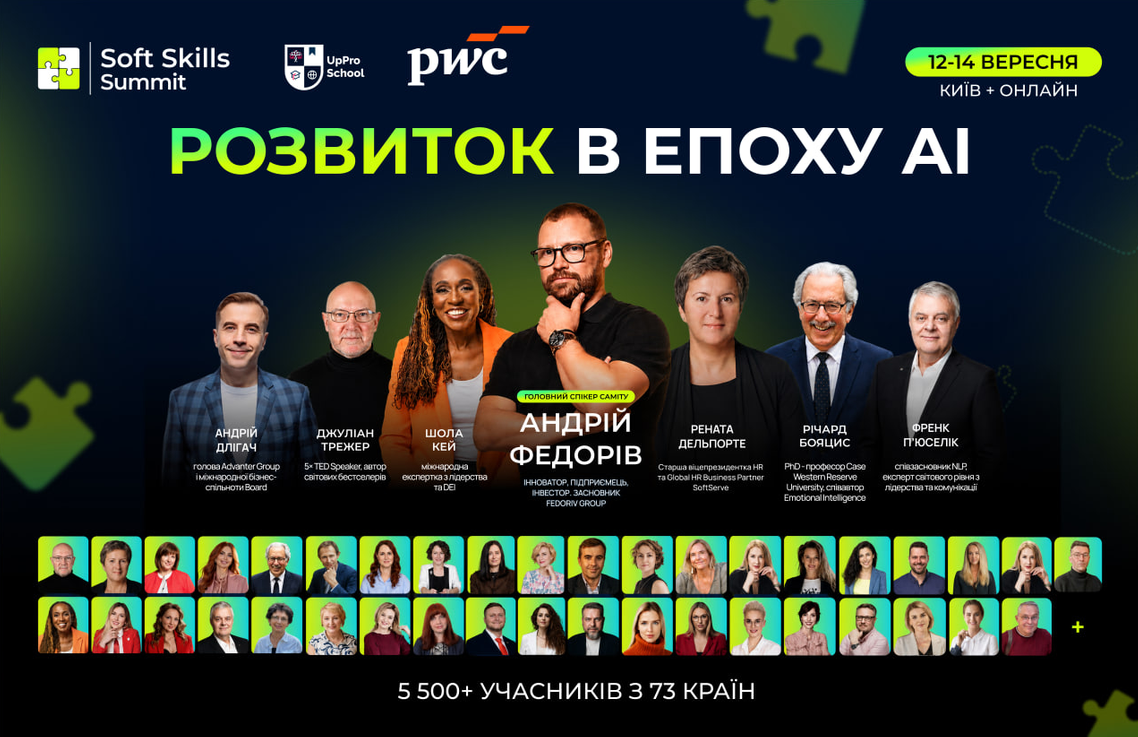
The International Soft Skills Summit 2026, dedicated to the development of individuals, teams, and organizations in the era of artificial intelligence, will take place September 12–14 in a hybrid format and will bring together more than 70 Ukrainian and international experts.
According to the event organizers, the first day of the summit will take place in person in Kyiv with an online livestream, while the remaining two days will be held online. More than 5,000 participants are expected to attend.
The summit will also feature the inaugural Soft Skills Summit Awards 2026—a professional award for corporate programs in the areas of leadership development, talent development, team development, corporate culture, and soft skills.
According to the organizers, the Soft Skills Summit program is structured around three levels of development: the individual, the team, and the organization.
On September 12, the program will focus on individual development. On this day in Kyiv, there will be presentations on the main stage, panel discussions, hands-on Soft Skills Hubs, a Mindfulness Zone, an EXPO, Guided Speed Networking, and the awards ceremony for the winners of the Soft Skills Summit Awards 2026.
On September 13, the online program will focus on team development, communication, psychological safety, and modern approaches to leadership.
On September 14, participants will discuss corporate culture, talent and change management, organizational effectiveness, and corporate transformation driven by artificial intelligence.
“Today, a company’s competitive advantage is determined not only by technology. It is determined by people—their ability to think, interact, learn, and lead others through change. That is why we created the Soft Skills Summit—a platform that brings together global expertise and Ukrainian experience to help people, teams, and organizations prepare for the future,” said Ihor Lukianenko and Nataliia Novhorodska, co-founders of UpPro School and the Soft Skills Summit.
The organizers note that the development of soft skills is taking on added significance amid the spread of artificial intelligence technologies and changing labor market demands.
According to a World Economic Forum forecast, by 2030, approximately 39% of the professional skills required for work will have changed. Among the competencies expected to grow in importance the fastest are analytical thinking, resilience, adaptability, creativity, leadership, and social influence.
For Ukraine, the relevance of this issue is also linked to labor shortages, the integration of veterans and internally displaced persons into the labor market, the potential return of Ukrainians from abroad, the need to develop management teams, and the implementation of AI tools in business processes.
Among the announced speakers for the Soft Skills Summit 2026 are Andriy Fedoriv, founder of Fedoriv Group; Richard E. Boyatzis (U.S.), communications expert and TED speaker Julian Treasure (U.K.), SoftServe Senior Vice President of HR Renta Delporte, Advanter Group Chairman Andriy Dligach, PwC Ukraine Academy Leader Iryna Blinova, business consultant Frank Pucelik (U.S.), Shola Kaye (UK), an expert in communications and People-First culture, and Chen Lizra (Canada), a somatic transformational coach and TED speaker.
The full program and information on participation are available on the Soft Skills Summit 2026 website.
The summit is aimed at business owners, CEOs, team leaders, HR and L&D professionals, business trainers, coaches, psychologists, consultants, and other specialists working in the field of people and organizational development.
As part of the Soft Skills Summit Awards 2026, the best programs will be recognized in five categories: leadership development, talent development, team and corporate culture development, mental health support, and innovation in soft skills training and development.
Projects will be evaluated using a unified methodology developed by the UpPro School Analytical Center in collaboration with the non-governmental organization “Independent Association of Psychology and Coaching” and an independent panel of experts. The organizers state that the main criteria will be the program’s professional value, the quality of its implementation, and its actual impact, regardless of the company’s size.
Detailed information about the award and the terms of participation is available on the Soft Skills Summit Awards 2026 page.
The summit is organized by UpPro School—an international educational center for training and professional development of psychologists, HR and L&D specialists, managers, and other professionals working in the field of people, team, and organizational development. According to the organizers, UpPro School is an accredited CPD provider in the United Kingdom; over 150,000 participants have taken part in the center’s educational events, and more than 8,000 students have completed professional training.
For readers of “Open4business,” the promo code Open4business is available, offering a 10% discount on tickets to the Soft Skills Summit 2026. The promo code is valid through September 11, 2026.
For partnership inquiries, contact Svitlana Chaurova at partnerships@softskills-summit.com.
Open4Business is the official media partner of the event

According to Experts.news, regular interaction with artificial intelligence and social robots may gradually influence how people communicate, perceive themselves, and shape their behavior, according to a study by researchers from the United Kingdom, Denmark, and Sweden published on August 19, 2026, in the journal AI & Society.
The authors of the study, from the University of Birmingham, Aarhus University, and Linnaeus University, coined the term “robotoid humanness.” By this term, the researchers mean a possible process in which, through repeated interaction with AI, a person begins to adapt their behavior to the machine’s logic—becoming more predictable, standardized, and amenable to algorithmic processing.
This effect could be particularly noticeable in the service sector, where AI is already used in retail, the hospitality industry, tourism, and healthcare. Modern digital assistants and robots mimic human speech and emotional cues and personalize their responses to build trust and facilitate interaction with customers.
Researchers suggest that this process may be two-way. Machines are becoming increasingly human-like, but humans may also unconsciously adopt communication patterns from their interactions with machines.
“The consumer acts, the robot responds, and through repeated interaction, the person eventually adopts this communication model,” explains Selchen Ozturkjan of Linnaeus University, one of the study’s authors. According to her, people’s natural tendency to mimic the behavior of their conversation partner can lead users to begin replicating the communicative traits of AI.
The authors describe a three-stage mechanism. First, a person begins to perceive their interaction with the AI as a social one. Then, the algorithm creates a simplified digital model of the user and feeds it back to the user in the form of personalized responses. Subsequently, the user may gradually adapt their self-presentation and behavior to the patterns that the system more easily recognizes and encourages.
The researchers identify one of the risks as the formation of a kind of feedback loop, in which the algorithm constantly reinforces the user’s characteristics that it already knows. Unlike communication with people, where a conversation partner might unexpectedly disagree, misunderstand, or offer a completely different perspective, algorithmic systems are typically designed for consistency, convenience, and personalization. This has the potential to reinforce existing views and reduce the diversity of self-expression.
At the same time, the authors emphasize an important limitation of their work: this is a theoretical study, not an experiment involving human participants. Scientists have not yet proven that prolonged interaction with ChatGPT, robots, or other artificial intelligence systems actually makes people more “robot-like.” The proposed concept must be tested in further empirical studies.
The research paper “Robotoid humanness: when selfhood becomes machine-legible” was published on August 19, 2026, in the journal AI & Society. The ScienceAlert article highlighting the study was published on August 31.

Schneider Electric reported a roughly 30% increase in net income attributable to the company’s shareholders to EUR2.49 billion for the first half of 2026, while revenue reached a record EUR21.23 billion.
A year earlier, revenue stood at EUR19.34 billion. Organic sales growth in the first half of 2026 was 14%.
Adjusted EBITA increased to EUR4.09 billion from EUR3.51 billion, representing 22% organic growth. The EBITA margin reached 19.3%.
The company’s free cash flow more than tripled, reaching approximately EUR 1.6 billion.
The second quarter was particularly strong, with Schneider Electric’s revenue reaching a record EUR 11.5 billion, an organic increase of 17%. The Energy Management segment grew by 18%, and Industrial Automation by 11%.
The company cites the data center market as one of the main drivers. Demand for electrical infrastructure for data centers is growing rapidly amid the development of artificial intelligence, which significantly increases computing density, power consumption of server racks, and demands on cooling and backup power systems.
North America posted organic growth of 23%, while China and East Asia saw growth of 20%.
Following a strong first half of the year, Schneider Electric raised its forecast for the full year 2026. The company expects organic adjusted EBITA growth of 14–19%, up from its previous forecast of 10–15%.
Organic revenue growth is projected at 10–13%.
Schneider Electric’s results reflect a broader investment cycle in energy infrastructure. AI data centers require not only servers and graphics processing units (GPUs), but also transformers, distribution equipment, UPS systems, automation systems, cooling systems, and digital energy management solutions.
Thus, energy infrastructure is gradually becoming one of the key constraints on the further scaling of AI.
For Ukraine, this trend is significant in the long-term context of rebuilding digital infrastructure and constructing new data centers. Future facilities will require significantly greater connected power capacity and more complex power distribution architectures than traditional server centers.
Schneider Electric has been operating in Ukraine for over 30 years. Globally, the company is present in more than 100 countries and has approximately 160,000 employees.
Schneider Electric published its financial results for the first half of the year on July 30, 2026.

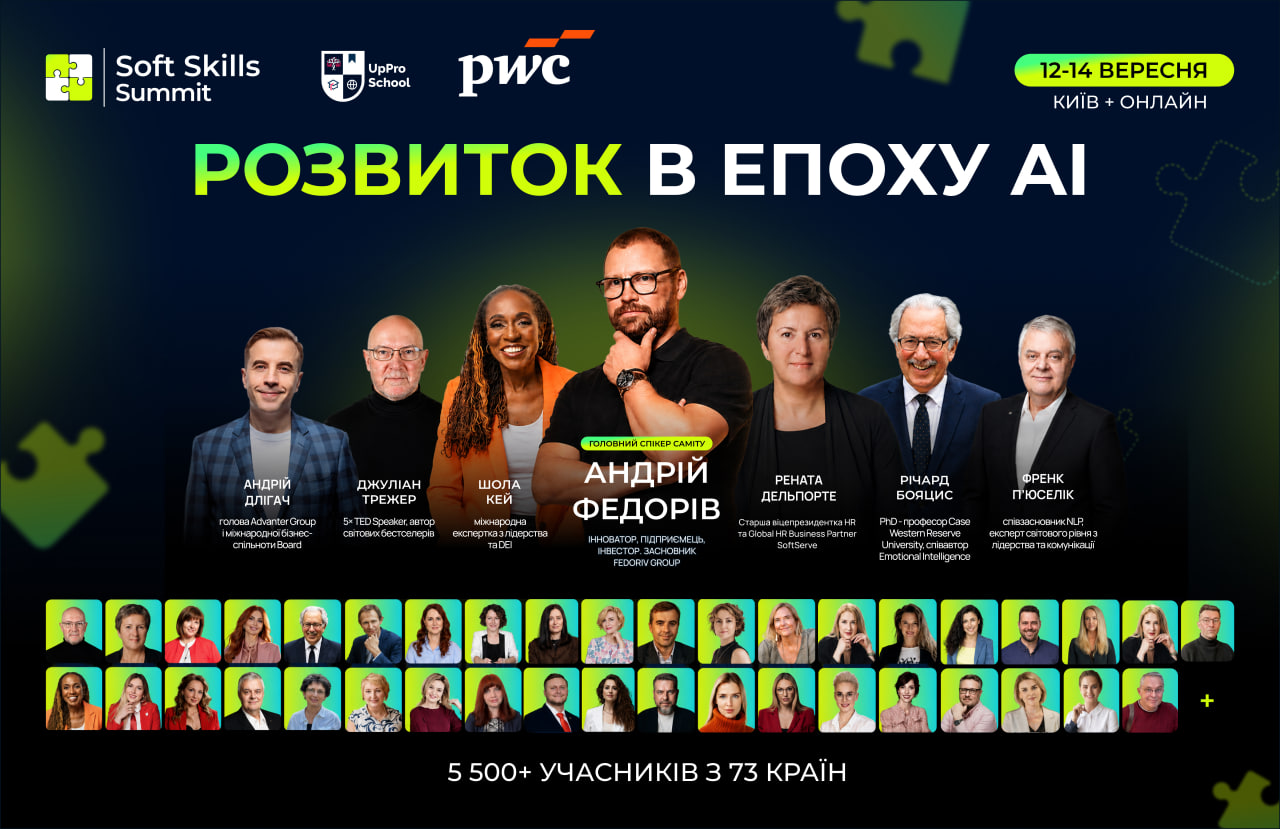
The International Soft Skills Summit 2026, dedicated to the development of individuals, teams, and organizations in the context of the spread of artificial intelligence, will take place September 12–14 in a hybrid format and will bring together over 70 Ukrainian and international experts.
According to the event organizers, the first day of the summit will take place in person in Kyiv with an online livestream, while the remaining two days will be held online. More than 5,000 people are expected to participate.
The summit will also feature the inaugural Soft Skills Summit Awards 2026—a professional award for corporate programs in the areas of leadership development, talent development, team development, corporate culture, and soft skills.
According to the organizers, the Soft Skills Summit program is structured around three levels of development: the individual, the team, and the organization.
On September 12, the program will focus on individual development. On this day in Kyiv, there will be presentations on the main stage, panel discussions, hands-on Soft Skills Hubs, a Mindfulness Zone, an EXPO, Guided Speed Networking, and the awards ceremony for the winners of the Soft Skills Summit Awards 2026.
On September 13, the online program will focus on team development, communication, psychological safety, and modern approaches to leadership.
On September 14, participants will discuss corporate culture, talent and change management, organizational effectiveness, and corporate transformation driven by artificial intelligence.
“Today, a company’s competitive advantage is determined not only by technology. It is determined by people—their ability to think, interact, learn, and lead others through change. That is why we created the Soft Skills Summit—a platform that brings together global expertise and Ukrainian experience to help people, teams, and organizations prepare for the future,” said Ihor Lukianenko and Nataliia Novhorodska, co-founders of UpPro School and the Soft Skills Summit.
The organizers note that the development of soft skills is becoming increasingly important amid the spread of artificial intelligence technologies and changing labor market demands.
According to a World Economic Forum forecast, approximately 39% of the professional skills required for work will change by 2030. Among the competencies expected to grow in importance the fastest are analytical thinking, resilience, adaptability, creativity, leadership, and social influence.
For Ukraine, the relevance of this issue is also linked to labor shortages, the integration of veterans and internally displaced persons into the labor market, the potential return of Ukrainians from abroad, the need to develop management teams, and the implementation of AI tools in business processes.
Among the announced speakers for the Soft Skills Summit 2026 are Andriy Fedoriv, founder of Fedoriv Group; Richard E. Boyatzis (U.S.), communications expert and TED speaker Julian Treasure (UK), SoftServe’s Senior Vice President of HR Renta Delporte, Advanter Group Chairman Andriy Dligach, PwC Ukraine Academy Leader Iryna Blinova, business consultant Frank Pucelik (U.S.), Shola Kaye (UK), an expert in communications and People-First culture, and Chen Lizra (Canada), a somatic transformational coach and TED speaker.
The full program and information on participation are available on the Soft Skills Summit 2026 website.
The summit is aimed at business owners, CEOs, team leaders, HR and L&D professionals, business trainers, coaches, psychologists, consultants, and other specialists working in the field of people and organizational development.
As part of the Soft Skills Summit Awards 2026, the best programs will be recognized in five categories: leadership development, talent development, team and corporate culture development, mental health support, and innovation in soft skills training and development.
Projects will be evaluated using a unified methodology developed by the UpPro School Analytical Center in collaboration with the non-governmental organization “Independent Association of Psychology and Coaching” and an independent panel of experts. The organizers state that the main criteria will be the program’s professional value, the quality of its implementation, and its actual impact, regardless of the company’s size.
Detailed information about the award and the terms of participation is available on the Soft Skills Summit Awards 2026 page.
The summit is organized by UpPro School—an international educational center for training and professional development of psychologists, HR and L&D specialists, managers, and other professionals working in the field of people, team, and organizational development. According to the organizers, UpPro School is an accredited CPD provider in the United Kingdom; over 150,000 participants have taken part in the center’s educational events, and more than 8,000 students have completed professional training.
For “Open4Business” readers, the promo code Open4Business is available, offering a 10% discount on tickets to the Soft Skills Summit 2026. The promo code is valid through September 11, 2026.
For partnership inquiries, contact Svitlana Chaurova at partnerships@softskills-summit.com.
Open4Business is the official media partner of the event
Ukrainian defense startup Swarmer, which went public on the Nasdaq in March of this year (ticker SWMR), reported in its financial statement that in the second quarter of 2026, its net loss increased from $1.6 million in the same period of 2025 to $7.3 million, while revenue rose from $138,200 to $216,000.
“The second quarter of 2026 was our first full quarter as a public company and a period of significant progress across all areas of our business. We successfully attracted new customers and made progress in implementing projects to deploy our solutions on various unmanned platforms, while continuing to invest in the team and technologies necessary to ensure future growth,” the press release quotes company co-founder Alex Fink as saying.
According to the report, the company’s gross profit for the second quarter of 2026 was $183,600, compared to $82,000 in April–June 2025. This growth was primarily driven by licensing revenue recognized under the SkyKnight program.
It is noted that Swarmer’s operating expenses for this reporting period totaled $7.5 million, compared to $854,800 a year ago.
“This increase is primarily due to investments in personnel, engineering development, product creation, and platform integration capabilities, as well as higher expenses for consulting, legal, and professional services related to the company’s operations as a public entity,” the company noted.
Operating expenses for the second quarter of 2026 also included, among other things, approximately $1.2 million in non-cash stock-based compensation expenses and certain one-time expenses for equipment purchases, which are not expected to recur on a regular basis.
The report added that during the second quarter of this year, the company billed drone manufacturer SkyKnight $1.5 million. Specifically, $0.2 million was recognized as revenue, $0.1 million was recorded as deferred revenue, and the remaining amount was recorded as an advance payment on the balance sheet.
The company noted that as of the end of June 2026, cash and cash equivalents had increased to $25.3 million from $9.3 million as of December 31, 2025.
Swarmer explains that this growth was driven by approximately $16 million raised from its initial public offering (IPO), $8.8 million raised under a share-for-equity financing facility, and $3.5 million from the sale of Series A-1 convertible preferred shares.
In April–June of this year, Swarmer also signed a memorandum of understanding (MOU) with the technology company Autonomous Power Corporation (Powerus) to explore the potential integration of Swarmer’s battle-proven software with Powerus’s autonomous aerial and maritime platforms.
The company’s core areas of activity include autonomous swarm coordination, integration of multi-domain unmanned systems, AI-based collaborative autonomy, and software for commanding and controlling distributed robotic operations, according to the press release. In addition, the company’s clients include drone manufacturers that license Swarmer’s software for integration with their hardware platforms.
As previously reported, Swarmer posted a net loss of $4.5 million for January–March 2026, compared to $0.7 million for the same period in 2025. Revenue fell to $20,300 from $110,700, while operating expenses rose to $4.5 million from $0.8 million.
The company was founded by Serhiy Kuprienko and Alex Fink in May 2023. Its registered headquarters and marketing and sales office are in Austin, Texas, USA, while its engineering divisions are split between offices in Kyiv, Ukraine, and Warsaw, Poland. The company’s holding structure includes “subsidiary” companies in Ukraine, Poland, and Estonia.
Prior to the IPO, Kuprienko held a 27.4% stake and Fink held 15.1%, while other shareholders included Theseus Capital Partners—where Philip Wagenheim, a member of the board of directors, serves as managing partner—with 22%, D3 Fund (Evelyn Buchacki) with 10.1%, RG.AI Technologies, led by Charles Eberle von Sexi, held 14%, Green Flag Fund I held 5.3%, and Radius Fund I held 6.9%
Swarmer’s revenue in 2025 fell to $0.31 million from $0.33 million a year earlier, while its net loss increased to $8.53 million from $2.07 million.



