

According to Experts.news, the number of words people speak in everyday life has decreased significantly over the past decade and a half, which could potentially affect social connections, psychological well-being, and communication at work, according to a study by psychologists at the University of Missouri–Kansas City and the University of Arizona.
According to the study, published in the scientific journal Perspectives on Psychological Science, between 2005 and 2019, the average number of words spoken per person decreased by approximately 338 words per day with each subsequent year of observation. As a result, the estimated decline over the entire period was about 28%.
The study is based on data from 2,197 people aged 10 to 94 who participated in 22 research projects conducted primarily in the United States, as well as in Mexico, Australia, and Europe. The assessment relied on periodic audio recordings of the participants’ natural daily lives, rather than their own recollections of how much they spoke.
In an earlier 2007 study using a similar methodology, the average person spoke about 15,959 words per day. In a later combined sample, this figure had dropped to about 12,792 words.
The researchers observed the most pronounced decline among young people. For participants under the age of 25, the number of words spoken decreased by approximately 451 words per day for each year, while for those over 25, it decreased by approximately 314 words. Thus, the rate of decline among young people was approximately 44% higher.
The authors did not identify a specific cause for this trend. The study period coincided with the rapid spread of smartphones, social media, messaging apps, email, and other forms of written digital communication; however, the researchers emphasize that the available data do not allow them to prove that technology itself was the cause of the decline in conversation.
The researchers also point out that texting does not necessarily fully replace the psychological and social functions of face-to-face conversation. Voice communication involves intonation, pauses, emotional cues, and immediate feedback, which are more difficult to convey through text.
The authors link this issue to a broader trend toward increasing social isolation. Previous studies show a consistent link between loneliness and a decline in various indicators of physical and mental health, although a reduction in the number of spoken words has not yet been proven to be the direct cause of such outcomes.
On September 10, Fast Company highlighted the potential implications of this trend for business. Talia Varly, a physician and corporate health specialist, notes that a decline in face-to-face conversations in the workplace potentially means fewer informal interactions among employees, fewer opportunities to discuss problems and voice dissent, and weaker bonds within teams.
In her view, small daily interactions are particularly important—a brief conversation with a colleague, discussing an idea outside a formal meeting, or a few minutes of casual conversation. Such interactions may seem insignificant on their own, but they are precisely what gradually build trust and social bonds within a team.
The rise of remote work and artificial intelligence may further alter the structure of communication. Digital tools allow for faster information exchange and the automation of some correspondence, but at the same time, they can reduce the number of situations in which people need to speak directly with one another.
At the same time, the researchers caution against the overly simplistic conclusion that people need only mechanically increase the number of words they speak. The quality of the conversation, the nature of the relationship, and the social context can be just as important as the duration of the interaction.
However, the study’s authors note that an additional 300 words per day may amount to only a few minutes of conversation—for example, a brief exchange with a neighbor or colleague, or a more detailed response to the common question, “How was your day?”
Thus, the observed decline in conversational activity may be one indicator of broader changes in how people maintain social connections in the age of digital communications. However, further research is needed to assess the long-term impact of this trend on health, loneliness, and productivity.

According to Experts.news, regular interaction with artificial intelligence and social robots may gradually influence how people communicate, perceive themselves, and shape their behavior, according to a study by researchers from the United Kingdom, Denmark, and Sweden published on August 19, 2026, in the journal AI & Society.
The authors of the study, from the University of Birmingham, Aarhus University, and Linnaeus University, coined the term “robotoid humanness.” By this term, the researchers mean a possible process in which, through repeated interaction with AI, a person begins to adapt their behavior to the machine’s logic—becoming more predictable, standardized, and amenable to algorithmic processing.
This effect could be particularly noticeable in the service sector, where AI is already used in retail, the hospitality industry, tourism, and healthcare. Modern digital assistants and robots mimic human speech and emotional cues and personalize their responses to build trust and facilitate interaction with customers.
Researchers suggest that this process may be two-way. Machines are becoming increasingly human-like, but humans may also unconsciously adopt communication patterns from their interactions with machines.
“The consumer acts, the robot responds, and through repeated interaction, the person eventually adopts this communication model,” explains Selchen Ozturkjan of Linnaeus University, one of the study’s authors. According to her, people’s natural tendency to mimic the behavior of their conversation partner can lead users to begin replicating the communicative traits of AI.
The authors describe a three-stage mechanism. First, a person begins to perceive their interaction with the AI as a social one. Then, the algorithm creates a simplified digital model of the user and feeds it back to the user in the form of personalized responses. Subsequently, the user may gradually adapt their self-presentation and behavior to the patterns that the system more easily recognizes and encourages.
The researchers identify one of the risks as the formation of a kind of feedback loop, in which the algorithm constantly reinforces the user’s characteristics that it already knows. Unlike communication with people, where a conversation partner might unexpectedly disagree, misunderstand, or offer a completely different perspective, algorithmic systems are typically designed for consistency, convenience, and personalization. This has the potential to reinforce existing views and reduce the diversity of self-expression.
At the same time, the authors emphasize an important limitation of their work: this is a theoretical study, not an experiment involving human participants. Scientists have not yet proven that prolonged interaction with ChatGPT, robots, or other artificial intelligence systems actually makes people more “robot-like.” The proposed concept must be tested in further empirical studies.
The research paper “Robotoid humanness: when selfhood becomes machine-legible” was published on August 19, 2026, in the journal AI & Society. The ScienceAlert article highlighting the study was published on August 31.
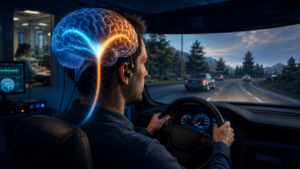
Nur ein kleiner Teil der Menschen ist in der Lage, zwei komplexe Aufgaben gleichzeitig zu erledigen, ohne dass sich die Ergebnisse merklich verschlechtern. Dies zeigte eine Studie der Psychologen Jason Watson und David Strayer von der University of Utah.
Die Arbeit mit dem Titel Supertaskers: Profiles in Extraordinary Multitasking Ability wurde in der wissenschaftlichen Fachzeitschrift Psychonomic Bulletin & Review veröffentlicht. An der Studie nahmen 200 Personen teil.
Die Teilnehmer wurden in einem hochrealistischen Fahrsimulator getestet. Zunächst erledigten sie die Aufgaben getrennt. Anschließend steuerten sie gleichzeitig ein Auto und absolvierten den komplexen auditiven OSPAN-Test, der das Einprägen von Informationen und die Lösung kognitiver Aufgaben erforderte.
Bei der überwiegenden Mehrheit der Teilnehmer verschlechterten sich beim Übergang zum Multitasking entweder die Ergebnisse beim Autofahren, beim kognitiven Test oder bei beiden Aufgaben gleichzeitig.
Allerdings zeigten 2,5 % der Teilnehmer – also etwa fünf von 200 Personen – bei der gleichzeitigen Ausführung beider Aufgaben keinerlei Verschlechterung ihrer Ergebnisse. Die Forscher bezeichneten sie als „Supertaskers“ – Menschen mit einer ungewöhnlich hohen Fähigkeit zum Multitasking.
Darüber hinaus erzielten diese Teilnehmer auch bei der getrennten Ausführung jeder einzelnen Aufgabe hohe Ergebnisse: Bei allen wichtigen Messwerten des Fahrens und des Arbeitsgedächtnistests gehörten sie zum besten Viertel der Stichprobe. Statistische Modellierungen zeigten, dass das Auftreten einer solchen Gruppe nur mit geringer Wahrscheinlichkeit durch reinen Zufall erklärt werden konnte.
Die Studie stellte die Annahme infrage, dass die Fähigkeit, die Aufmerksamkeit effektiv auf mehrere komplexe Aufgaben zu verteilen, bei allen Menschen gleich ausgeprägt ist. Die Autoren kamen zu dem Schluss, dass erhebliche individuelle Unterschiede bei den Mechanismen der Aufmerksamkeit und der kognitiven Kontrolle bestehen.
Dabei sollte der Wert von 2,5 % nicht unmittelbar als Beweis dafür interpretiert werden, dass genau dieser Anteil der gesamten Weltbevölkerung über außergewöhnliche Multitasking-Fähigkeiten verfügt. Die Studie wurde mit einer Stichprobe von 200 Teilnehmern durchgeführt und untersuchte eine konkrete Kombination von Aufgaben – das Autofahren und eine komplexe Belastung des Arbeitsgedächtnisses.
Die Arbeit hat zudem praktische Bedeutung für die Frage der Nutzung von Telefonen am Steuer. Ihre Ausgangsannahme basierte auf früheren Studien, die zeigten, dass Telefongespräche in der Regel die Fähigkeit des Fahrers beeinträchtigen, die Verkehrssituation zu kontrollieren. Die Entdeckung einer kleinen Gruppe von „Supertaskers“ war eine Ausnahme von der allgemeinen Regel und kein Beweis dafür, dass Multitasking für die meisten Fahrer sicher ist.
Die Studie wurde am Fachbereich Psychologie der University of Utah durchgeführt.



