According to Experts Club, Ukrainians’ attitudes toward Vietnam in August 2026 remain predominantly neutral: 60.5% of respondents hold this view. Twenty-one point five percent of those surveyed view the country positively, while 12.2% view it negatively. Compared to March, the share of positive assessments has increased slightly, although the negative segment has also grown, reports the Experts Club Information and Analytical Center.
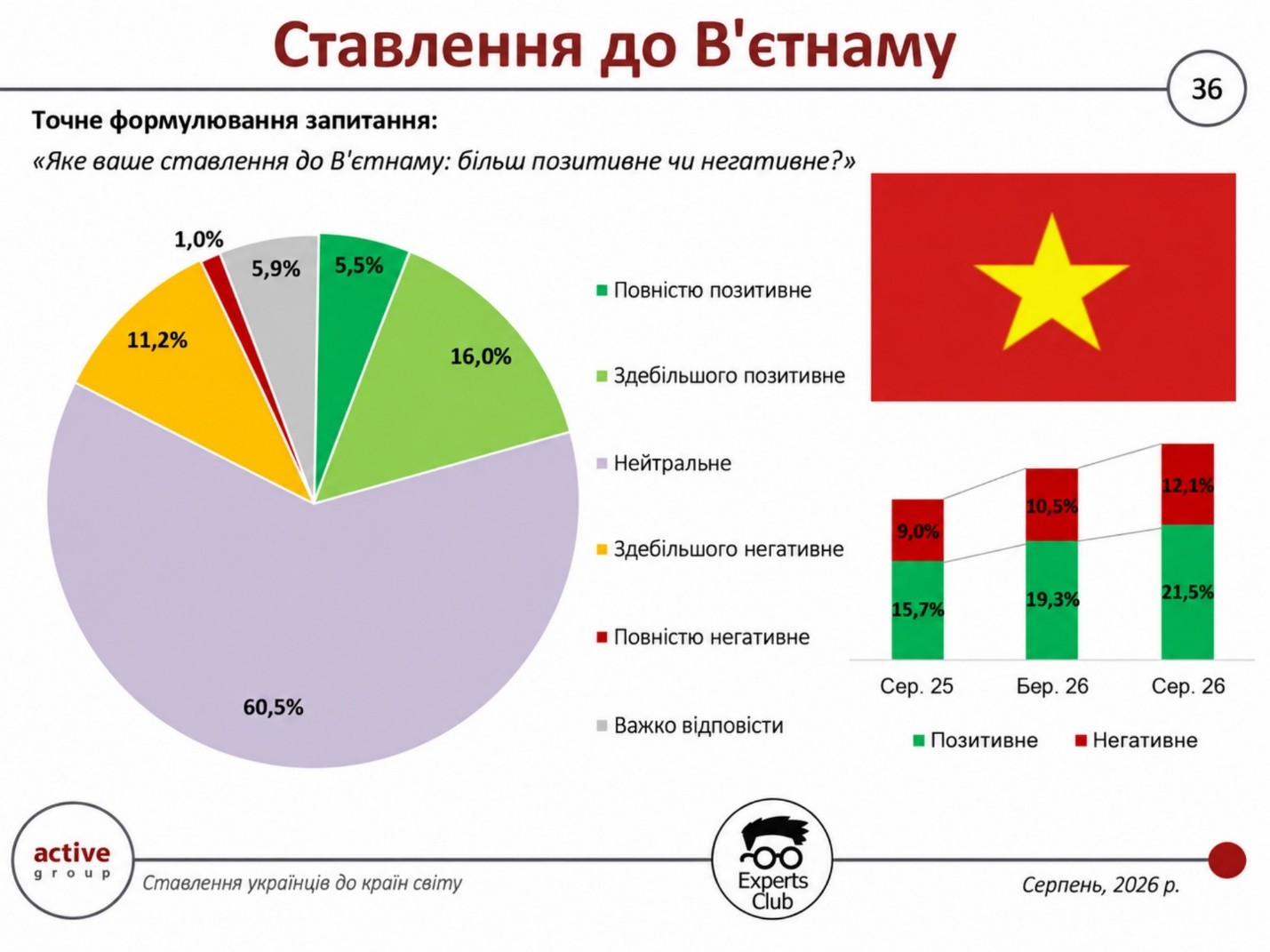
According to the results of the August survey, 5.5% of Ukrainians have a completely positive attitude toward Vietnam, while 16% have a mostly positive attitude. 60.5% of respondents chose a neutral response. 11.2% expressed a mostly negative attitude, 1% a completely negative one, and another 5.9% were undecided.
According to the rounded data in the table, the balance of positive and negative assessments is approximately plus 9.3 percentage points, while in the consolidated survey results, it is reported at plus 9.4 percentage points. Vietnam thus remains in the positive balance zone, but the main feature of its perception is not explicit sympathy or antipathy, but a significant proportion of neutral responses.
In March 2026, 6.1% of respondents had a completely positive attitude toward Vietnam, and 13.3% had a mostly positive attitude. The overall positive rating in the survey was 19.3%. A neutral stance was held by 66.9% of respondents, a negative attitude accounted for 10.5%, and another 3.3% were undecided.
Thus, over the course of five months, the share of positive assessments increased by approximately 2.2 percentage points—to 21.5%—while negative assessments rose by 1.7 percentage points, to 12.2%. In contrast, the neutral group shrank by 6.4 percentage points—from 66.9% to 60.5%. The share of those who found it difficult to answer rose from 3.3% to 5.9%.
These changes indicate the gradual formation of a more defined attitude toward Vietnam, although the process is moving in both positive and negative directions simultaneously. At the same time, the positive balance has remained virtually unchanged: in March it stood at approximately plus 8.8 percentage points, and in August—at approximately plus 9.4 percentage points.
At the same time, Vietnam is one of Ukraine’s major trading partners in Southeast Asia. Maksym Urakin, founder of the Experts Club information and analytical center and a candidate of economic sciences, emphasized the importance of geographic diversification in Ukraine’s foreign trade.
“The latest foreign trade data demonstrate not only the geographic diversification of Ukraine’s trading partners but also a clear focus on integration into the European and global markets. Despite the challenging security situation, Ukrainian businesses continue to expand into international economic networks, particularly in the sectors of agricultural products, metallurgy, and machine building. Significant growth in trade with EU countries and the U.S., as well as the maintenance of strong cooperation with China and Turkey, indicate that Ukraine has not lost its ability to be an active player in the global market,” Urakin noted.
In the case of Vietnam, the survey results show significant potential for shaping a more distinct public image of the country. Despite a decline in the neutral segment, three out of five Ukrainians still do not have a clearly positive or negative attitude toward Vietnam.
The survey was conducted in August 2026 using self-administered online questionnaires in the SunFlowerSociology panel among 800 Ukrainian citizens aged 18 and older. The previous wave in March also included 800 respondents; the sample was representative by age, gender, and region, with a maximum theoretical margin of error of ±3.5 percentage points for indicators at the 50% confidence level.
ACTIVE GROUP, EXPERTS CLUB, FOREIGN TRADE, international relations, PUBLIC OPINION, SOCIOLOGY, Southeast Asia, UKRAINE, VIETNAM

Related: